Data Centers, the I‑Codes and a New Data Center Guideline
This article provides a building safety perspective on how codes address data centers today and what's to come.
Data centers have moved from a niche building type to a central pillar of modern infrastructure. Across the International Code Council’s (ICC) code development process, proposals now under consideration reflect growing recognition that these facilities present unique building safety considerations. At the same time, ICC is launching a dedicated Data Center Guideline development effort to provide near‑term clarity for code officials, designers and owners navigating today’s projects.
This article provides a building safety perspective on how codes address data centers today and what’s to come.
The Importance of Data Centers
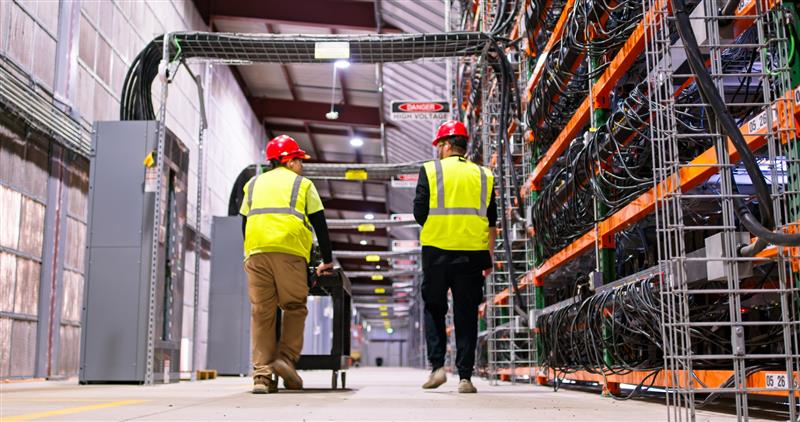
Data centers are among the most critical pieces of infrastructure in modern society. Banking, communications, commerce, entertainment, government services and even national defense all rely on the continuous operation of these facilities. Many building departments themselves depend on data centers to process permits, manage inspections and store records.
The Data Center industry has seen extensive growth in recent years, with investments more than quadrupling over the past five years. Demand is expected to accelerate further as artificial intelligence, cloud computing and digital services continue to expand. These trends are driving the development of larger, more complex facilities with substantial electrical, mechanical and operational demands.
For building safety professionals, this rapid evolution raises important questions about how data centers should be classified, regulated and designed under existing building codes.
What Is a Data Center?
Data centers can take several forms:
- Enterprise data centers: owned and operated by an organization for their internal needs
- Managed service data centers: operated by third parties that provide infrastructure and services for clients
- Colocation data centers: where multiple tenants lease space, power and cooling for their own equipment
- Cloud or hyperscale data centers: operated by major service providers such as AWS, Microsoft Azure or Google Cloud, often at a massive scale
- Edge data centers: smaller, decentralized facilities located closer to end users to reduce latency
These facilities vary widely in size, staffing levels, equipment density and operational risk. A data center may be a standalone building, part of a larger mixed-use facility or even integrated within an existing commercial or industrial structure. This diversity complicates the application of prescriptive code requirements that were not originally developed with data centers in mind.
Data Centers and the I-Codes
The International Building Code® (IBC), the International Fire Code® (IFC) and the broader family of International Codes® (I-Codes®) provide the foundation for safe and resilient building construction, addressing occupancy classification, means of egress, fire protection, structural integrity and life safety. Utilizing these codes as a foundation, data center construction requires addressing a unique combination of characteristics, including:
- Extremely high electrical loads and water usage
- Onsite power generation and energy storage
- Specialized structural and HVAC systems
- Separation of uses
- Sound attenuation
- Reuse/discharge of waste heat
The Occupancy Classification Challenge
The 2024 IBC defines “data center” in Section 202 but does not explicitly assign data centers to a specific occupancy group in Chapter 3. As a result, according to the IBC, code officials must classify these facilities based on use, hazards and risk. When a proposed use is not specifically listed, it must be classified as the occupancy it most nearly resembles. Data centers have commonly been classified under several different occupancy groups: Group B (Business), Group F-1 (Moderate-Hazard Factory Industrial) and Group S-1 (Moderate-Hazard Storage).
Each of these classifications carries different implications for allowable area and height, means of egress, fire protection systems and other life safety features.
Group B – Business Occupancy
Group B is often applied to data centers that resemble office-like environments. Electronic data entry is listed as a Group B occupancy and has been used as a basis for assigning data centers to this use group. These spaces typically include energized electrical equipment such as servers, batteries, fans and chillers, along with workstations for staff. Group B occupancies are often occupied during predictable hours and have comparatively low fuel loads.
Group F-1 – Moderate-Hazard Factory Industrial
Factory and industrial occupancies are classified based on hazard level rather than specific function. In these facilities, fire risk is closely tied to fuel load, equipment and processing activities. Some data centers share characteristics with industrial uses: limited occupancy, extensive use of machinery and continuous operation of equipment with significant electrical and thermal output. Although it should be noted that facilities containing operational energy storage systems (ESS) and equipment containing lithium-ion batteries are identified as being classified as a Group F-1 occupancy.
Group S-1 – Moderate-Hazard Storage
Group S-1 occupancies are intended for moderate-hazard storage, including combustible materials and certain battery technologies. Data centers with dense, static racks of equipment, minimal staff presence and limited interaction with the space may resemble storage occupancies more than offices or factories.
How Occupancy Affects Code Requirements
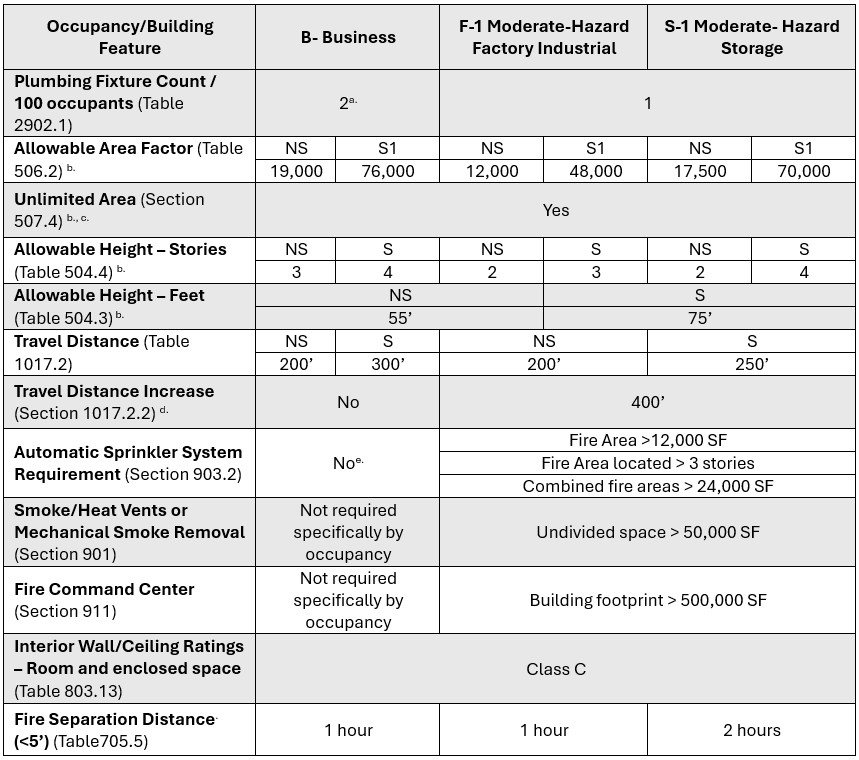
Occupancy classification dictates allowable building area and height, distance to egress points, sprinkler thresholds, smoke control, fire command centers and fire-resistance ratings. The following comparison of Group B, F-1, and S-1 occupancies under the 2024 IBC (assuming Type III-B construction) illustrates how the code treats these classifications. Differences reflect varying assumptions about fire load, occupant risk and operational hazards. For data centers, these differences can significantly influence design decisions, construction cost and overall safety outcomes.
Looking Ahead: The Future of Data Centers in the Codes
Data centers have become an active topic of discussion within the code development process. During the 2025 code development cycles for the IBC and IFC, several proposals sought to provide clearer direction for this building type. For instance, proposal G38-25, which is pending future action at the Public Comment Hearings, would assign data centers to a Group F-1 occupancy.
Key issues that merit continued attention for this construction type include:
- Means of egress
- Lighting
- Fire protection
- Structural and electrical design
- Water usage
- HVAC requirements
- Onsite power generation
- Energy storage
- Waste heat management
- Sound attenuation
ICC’s Data Center Guideline Initiative
To address these issues more comprehensively, ICC is developing a dedicated Data Center Guideline (G12). The G12 will be informed by public comment and by a committee of regulators, designers, operators and other stakeholders. The guideline will clarify current compliance pathways, identify gaps in existing codes and recommend best practices.
Topics are expected to include physical security and site control, occupancy classification, allowable height and area, passive and active fire protection, interior environmental conditions, structural design considerations, electrical systems and environmental impacts.
Building safety professionals interested in participating can apply for the guideline committee or sign up as interested parties through ICC’s committee application process. Committee Applications and Interested Party Signup by locating the G12 – Data Center Guideline option on the committee list. We welcome U.S., Canadian and other international participation.
A dedicated webpage G12 – Data Centers – ICC is available to follow the progress of the guideline as it proceeds through the development process.
About the Author

Kevin McOsker is the Vice President of Technical Services, International Code Council Government Relations