An Inside Look at How Adult Height Adjustable Changing Table Advocates are Driving Change and Improving Accessibility, Part 3
Advocacy continues to play an important role in educating others and promoting the need for universal changing tables.
This is Part 3 in our series on how advocacy, code updates, grants and legislation have paved the way for more adult height adjustable changing tables, improving accessibility for many individuals. Read Part 1 and Part 2.
Before the 2017 A117.1 Accessibility Standard was updated to include the technical criteria for adult changing tables – marking the first time A117.1 was updated between cycles – bathroom inclusivity was a bit like the Wild West. There were a growing variety of airports, zoos and other places that voluntarily decided to include a solution, but they weren’t consistent in their adoption or installation.
“What was being provided for adult changing facilities was extremely inconsistent,” said Kim Paarlberg. Senior Staff Architect in Technical Services with the International Code Council (ICC) and Staff Representative for the A117.1 Accessibility Standard. “It could be a marble slab at transfer height, an adjustable changing table, or a stretcher. These could be in a bathroom or just stuck into a room without a toilet or lavatory.”
While their installations lacked uniformity, these venues were ahead of the curve in understanding the need to take action. Adult height adjustable changing tables (or universal changing tables, as they are commonly known) are essential for people with severe disabilities and their caregivers, but they can be used by anyone who needs assistance. Many within the building construction industry wanted to help; they simply needed a blueprint for how and where to add a universal changing table.
The A117.1 Supplement 1 to the 2017 edition, which was referenced in the 2024 International Building Code® (IBC), provides that blueprint. And it’s not just for new construction or expansions. The A117.1 updates can help guide any number of institutions, including federal agencies.
In February 2026, the U.S. Access Board (which designs and develops accessibility guidelines and standards) sought public comment on the criteria for adult changing tables at airports. Starting in 2030, the FAA Reauthorization Act of 2024 will require medium and large airport hubs to provide at least one universal changing station per terminal if they wish to apply for federal airport construction grants.
ICC has responded to the request for comments explaining how the criteria in the A117.1 was researched and developed.
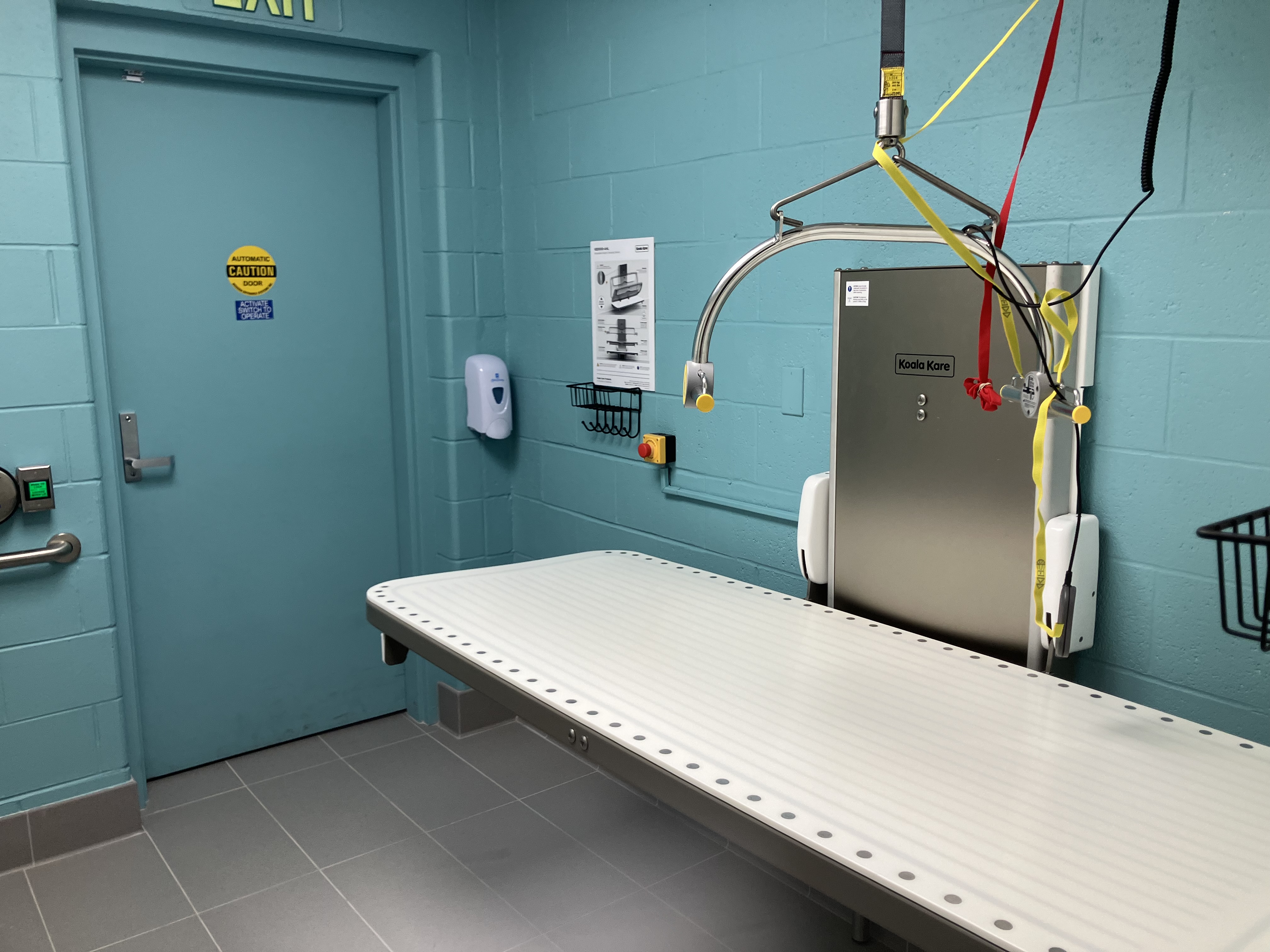
Ohio Embraces Universal Changing Tables and Codes That Require Them
Jennifer Corcoran, Program Consultant for the Montgomery County Board of Development Disabilities Services (MCBDDS) in Dayton, Ohio and Co-Lead of Changing Spaces Ohio, has been a committed advocate for universal changing tables for several years. Her advocacy, along with Changing Spaces Ohio Co-Lead Kim Kirkwood, has helped build awareness, inspired more places to add tables and led to building code changes.
Their work has also helped Ohio become a leader in universal changing table adoption. In January 2025, Ohio Governor Mike DeWine unveiled the first of 29 planned universal changing stations at Ohio rest areas. These upgrades were made as part of a massive reimagining effort for several rest areas throughout the state.
“Obviously this makes perfect sense,” said David Rose, Chief Communications Officer for the Ohio Department of Transportation. “Part of our mission is to make a transportation system that is accessible to everyone. [The addition of adult changing tables] hit perfectly with our mission. It was perfect timing, too, because they were reimagining those rest areas.”
ODOT has a map that clearly highlights which rest areas contain a universal changing table. The project began before Ohio adopted the IBC provisions for adult changing tables in its statewide code. Around the same time, Governor DeWine allocated $4.4 million in grants for public spaces adding universal changing tables.
Corcoran, whose son Matthew has special needs and cannot safely and comfortably use the bathroom without adult changing tables, continues to advocate for their adoption in as many places as possible. She is especially excited about their inclusion at Ohio rest stops and would love to see additional states follow Ohio’s lead to improve the travel experience within each state.
“If we can get rest stops, it would open up travel,” said Corcoran. “Travel is a huge issue. [And now], even if I go to Columbus or Cincinnati to meet my son Matthew’s medical needs, I’m going to hit a rest stop that has it. Rest areas across the other states would allow Matthew to travel to see his family and experience vacations.”
Minnesota also approved a state law to add adult changing tables using the A117.1 Accessibility Standard for the technical criteria.
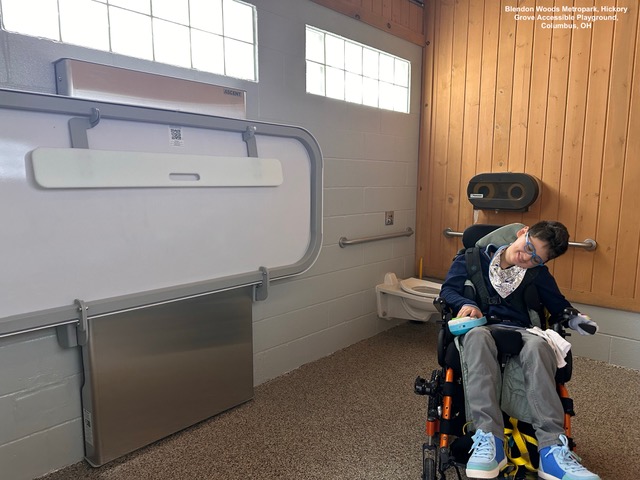
Grants and Donations Make a World of Difference
Most adult changing tables are not installed solely because the builder or property owner was required to do so. In the months and years leading up to the building code changes, the majority were installed on a voluntary basis. That attitude – the goal to promote inclusivity by improving accessibility – has continued to grow as more people become aware of the need and value of universal changing tables.
Tracey Tomme, President and CEO of the Dayton Society of Natural History (which owns and operates the Boonshoft Museum of Discovery in Dayton, Ohio), is among those who understood their life-changing benefits. When Corcoran approached her about adding a universal changing table, Tomme quickly understood the need and made it her mission to acquire the necessary funds.
“MCBDDS was offering to fund the table installation through the HCBS ARPA funds we were awarded through Governor DeWine’s allocation of funds,” said Corcoran. “That’s what got the project started and she took off from there and took it upon herself to secure all the other funders and features she included.”
Tomme knew she had found the perfect place to install a universal changing table when she realized the museum had not one but two underutilized staff restrooms.
“One of them had been closed down and the other room was used by astronomy staff – just two people,” said Tomme. “I realized that if we knock down the center wall, it’ll make a longer space, and we can convert it into one bathroom.”
The total cost of renovations, which included a universal changing table, Hoyer track system lift and a sensory room for relaxation, reached $100,000. Most of the expenses ($75,000) were covered by grants and donations with help from Corcoran.
“I can help people find those funders,” said Tomme. “That’s what Jennifer did for us. I send people her way, I connect them. I’ll be a reference for anyone. I would really like to be helpful in whatever way [I can].”
Tomme described the Boonshoft addition as a universal changing station that can be used by anyone. She is proud to say that Corcoran purchased a museum membership partially with the intent of using its universal changing table when commuting with her son. Tomme encourages others to use it as well and take as long as they need, and she hopes other venues will add their own tables.
“It doesn’t have to be as big of a space as we have,” Tomme added. “But do something.”
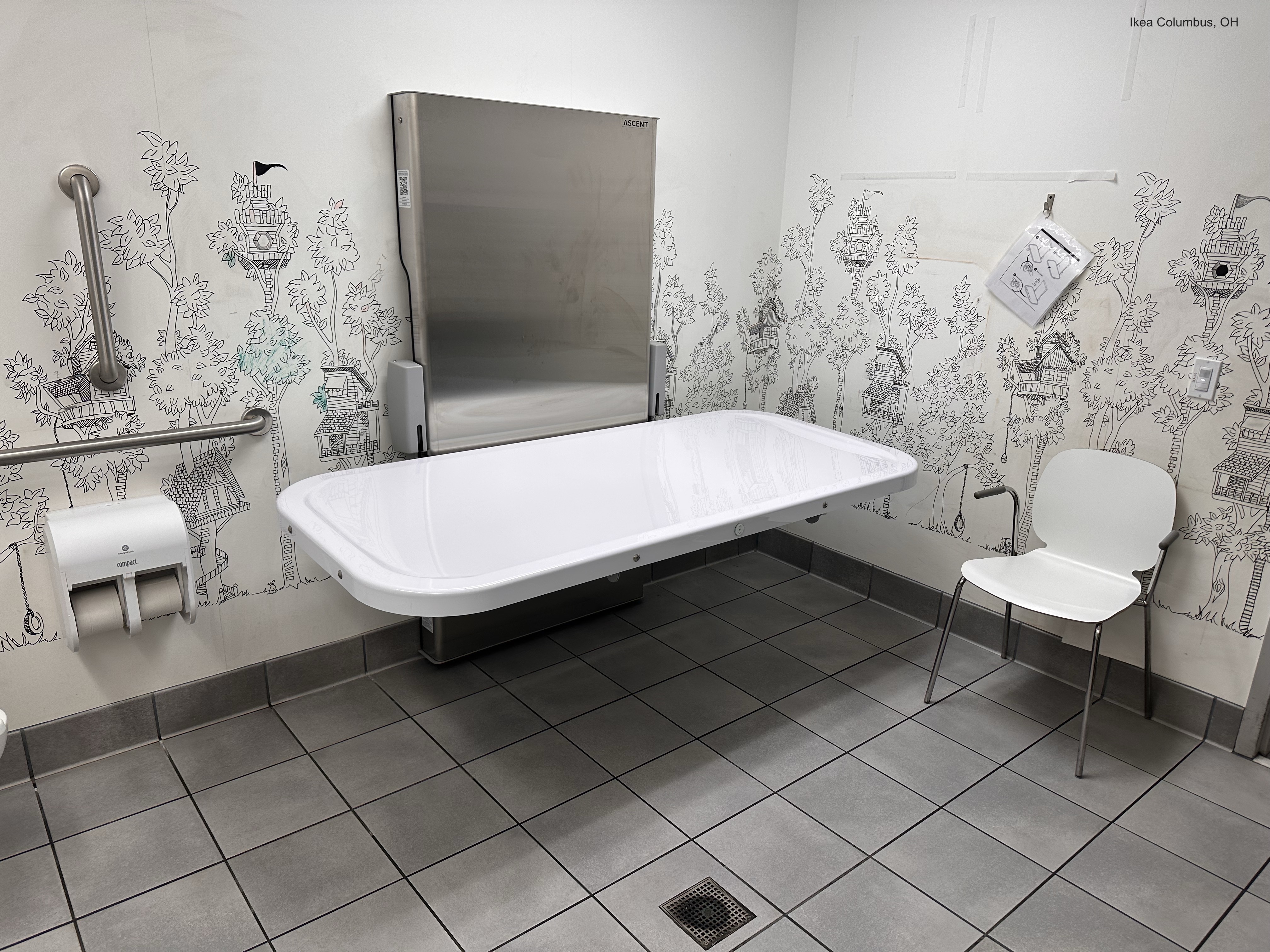
Advocacy Continues to Play a Pivotal Role
As building codes evolve and as more states adopt the 2024 International Codes® (I-Codes®) and/or provisions for adult changing tables, more will become available through expansions and/or new construction. Advocacy will still play an important role in the process to ensure that everyone understands why these tables are so vital to those who need them.
“One of the first places I advocated for a universal changing table was the Franklin Park Conservatory and Botanical Gardens in Columbus, Ohio,” said Kirkwood, Project Leader for the Universal Changing Table Map. She also co-founded the Inspired Access Foundation with Corcoran. “It’s a beautiful, mostly accessible place. However, they did not have a universal changing table.”
At that time, the conservatory didn’t have anywhere for Kirkwood to safely and hygienically change her son Aiden. She said it’s usually on families or caregivers to figure out how to solve this problem, which usually involves getting changed in the car or on the floor somewhere.
“Bringing someone along in that thought process – presenting them with this problem they’ve never encountered before, and asking them to solve it with you – really helps them to understand the impact on families and people with disabilities,” said Kirkwood.
She added that once people go through that mental process of trying to solve it, they realize they can take action. This was especially true at the Franklin Park Conservatory, which installed a universal changing station within six months of Kirkwood’s request. As a result, more people and groups (including adult day groups, field trip groups, K-12 schools and others) are able to enjoy the conservatory.
“Since then, our Columbus metro libraries have committed [to] installing universal changing tables,” Kirkwood continued, noting that the grant funds helped other institutions follow suit. “Delaware county libraries [and] many businesses have done the same.”
Her and Corcoran’s advocacy even persuaded Buc-ee’s, a chain of travel centers that became known for having dozens of clean bathrooms at every location, to add a universal changing table to its first Ohio venue. Buc-ee’s made this decision even though it was not required by the code to do so.
“You have to find people who are in a place and position to do something about this,” Corcoran said of her advocacy. “That’s important. The reason for our success has been my son, Matthew. Even though he doesn’t speak and has such high needs, his presence speaks to the humanity behind including all people in our communities.”
“When we went to Buc-ee’s [grand opening], it was full of people, and we wanted to speak to [Buc-ee’s co-founder and CEO Arch “Beaver” Aplin III] and Governor [DeWine], it wasn’t me that they noticed. It was Matthew. It’s so important to have those who are affected, or those who could be positively affected by these tables, to be in the forefront.”
Subscribe to the Building Safety Journal Weekly newsletter, here.
About the Author
Louis Bedigian is a writer, editor and content strategist with experience producing short- and long-form content for a variety of industries. By day, he's Senior Copywriter for PR agency Brands2Life, where he transforms complex and often technical jargon into content that’s compelling and easy to digest. By night, he's Freelance Copywriter at Fundable, where he develops powerful narratives that drive brand awareness within the investment community.