Ask Me Anything: Your Questions About Inspections and More, Answered
Member-submitted questions about home and restaurant inspections, creating strong relationships with building inspectors and more are answered by Chris McWhite, Director of Municipal Inspections and Zoning for the Town of Hopkinton, MA.
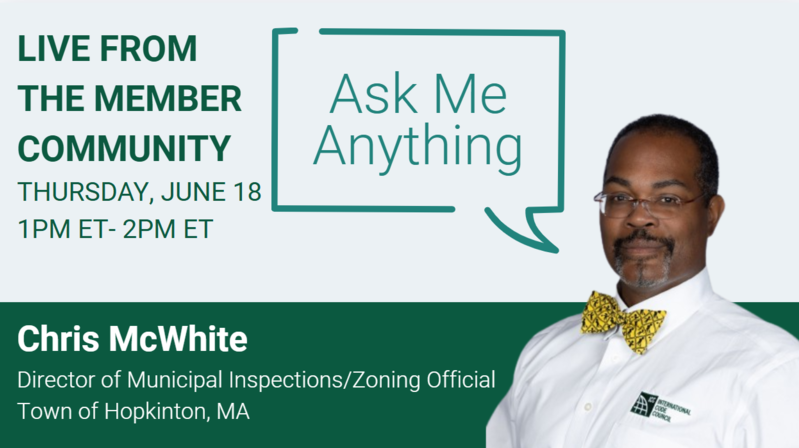
Chris McWhite, Director of Municipal Inspections/Zoning Official for the Town of Hopkinton, MA, joined us on our “Ask Me Anything” series in the online member community to answer member-submitted questions.
From insights on building official certification paths to on-the-job relationship building, here’s a recap of his answers.
Editor’s Note: Some of the questions and answers have been edited for length. View the original “Ask Me Anything” post in “Talkin’ Shop” in the online member community here.
Q&A With Chris McWhite
What certification path should I follow in my quest to become a building official?
McWhite: Your first resource should be your state’s legislative requirements. Chapter 1 of the building code in your state will most likely be a good place to begin finding out what certifications are required for the position. My certifications began in code enforcement as a housing code official. It was five or six years after I started inspections that I earned my first residential building inspection certification. I encourage you to begin there because it is a logical code book that starts with foundations and works its way up to exterior requirements, from Chapter 2 all the way through Chapter 10.
I have noticed a drastic decrease in office traffic in the last few years since so many permits and applications are being handled through digital means. How are you planning to keep public relations between the public and governmental offices good?
McWhite: There are at least two areas where relations can be maintained in a positive direction. First, permit technicians at the counter are friendly faces who can transmit a smile through the telephone, asking questions of the applicant where necessary, or even following up with a phone call after emailing to let them know the permit is ready. A second area is with the inspector. Inspectors need to be as focused on life safety as they are on interpersonal relationships. I went to a training not long ago that talked about how your IQ will get you the job, but your EQ will help you keep it. It’s important that we focus on emotional intelligence and be the government that we want to see. None of that compromises our professional integrity; in fact, it enhances our ability to maintain a positive presence, even as we have fewer opportunities to do it.
When you say “build relationships,” are you referring to relationships within the inspector community?
McWhite: Building a relationship within the inspector community is only the beginning. It’s important, but it should never end there. It needs to include everyone who is a neighbor in the global sense. The community that you serve, the appointing authorities that hired you, the fire official who is your partner in Chapter 9, and the permit technician who helps make your life easier every day with every phone call and application.
Is a preliminary inspection a good idea?
McWhite: Not only is a preliminary inspection a good idea, but I also encourage it whenever possible. It shows a vested interest by the town in being a partner during the construction phase. It shows interest and curiosity rather than just throwing code at a design. I’m very happy it’s in Chapter 1 of the building code because it gives the building official an opportunity to see the structure before construction begins and to help identify areas where the design may have assumed something that just isn’t the case or missed something that is an unavoidable problem.
What can permit techs do to support inspectors?
McWhite: Number one, work with your local union or appointing authority to make “permit technician” an official title and then get funding set in the budget for certification. With a certification, you will increase your awareness of what the building official and inspectors are looking for on plans and during inspections. The second thing is to understand the personalities of the inspectors. When you know what their bailiwick is, that can help you focus on making sure that information is provided to them at the time of application.
Does the building official have to have destructive testing of existing assemblies to determine fire rating?
McWhite: The good news is that it very rarely has to happen. In the back of the International Existing Building Code, there is an archaic construction chapter within the appendices. There are a number of fire-rated assemblies that are vertical and horizontal, and they include historical data to help determine approximately what their fire rating is. I found that particular resource to be a lifesaver, literally, in mill buildings being converted into medical facilities and educational institutions.
How do you see AI, digital inspection tools, and remote inspections changing the work of municipal inspectors over the next five years?
McWhite: I see those tools as a positive influence on enhancing our ability to recognize design problems before they are approved at the review table, while also allowing for efficient inspections, even when an inspector is unable to be on-site. This is especially helpful when there are tight deadlines for materials to be delivered on site and the inspector can’t be there physically. This will also help builders because they would not have to rely so heavily on registered design professional affidavits. That helps the bottom line, and everybody comes out ahead.
In your experience, what are the most common structural deficiencies you find in multifamily buildings that designers and contractors could have prevented during the design phase?
McWhite: In my experience, the most common structural deficiencies that I’ve seen occur when the MEP contractors and design professionals are not in the room when the architectural and structural team is laying out the floor plan. These discipline contractors know their work very well and know how to run their systems, but if they must adjust on the fly, that can make compliance with code very difficult. One pro tip for you is to encourage your plans examiner to look for the issuance date on the drawings and see if the dates align. If the dates are significantly different, that could be one indication that the discipline designers were not in the room at the same time as the structural and architectural team.
Do you have any strategies for encouraging contractors to call for timely inspections?
McWhite: Our primary job is to educate. I encourage you to be a positive and encouraging face at the counter whenever possible. Let the contractor know what your expectations are up front and in as friendly a manner as possible. Especially do this at the time of application and repeat it when the permit is issued. When contractors, who may well be first-time contractors in your community, feel welcome, they will welcome your presence at inspections to show off with pride what they’ve done rather than with fear and trepidation.
Are there any questions that you get frequently that might surprise us? What is the most unusual question or zoning project that you can remember working on?
McWhite: It may not be a total surprise, but I often get the question, “How do they comply with energy code?” I try my very best to simplify their approach to it by saying that the bigger the building, the fewer options they have for energy sources to heat and cool their home. I think one of the most unusual questions I’ve ever been asked was: “Can a homeowner propose to build their accessory dwelling unit first and then their primary home second?” The answer may not be the same or even possible in every community, but in our community, we found a way to make it happen.
What are a few good strategies that you’ve utilized, or are considering, to recruit younger talent into the profession?
McWhite: In an old story, a teacher tells a fisherman to cast his nets on the other side of the boat. When he did, he pulled in more fish than his net could handle. I believe we can do the exact same thing in our career path. Instead of continuing to draw from the same places we always go to for qualified candidates, I recommend going to high schools and local trade schools and letting them know on career day that this is a viable career. Volunteer at your local Scout troop to teach the architecture badge. Maybe let them know about your career. Maybe even look at your state legislation, see what the required certifications are for inspectors, and find other types of work in your department that do not require certification, where they can be hired, mentored, and taught how to do the work from the inside. Perhaps that could be as a permit technician, plans examiner, or something else that doesn’t have statutory certification requirements. ICC offers education that will supplement what you’re teaching in-house and is a valuable resource.
Subscribe to the Building Safety Journal Weekly newsletter, here.
ICC members can join the FREE member community, here (use existing myICC username and password).
About the Author
The International Code Council is a nonprofit association that provides a wide range of building safety solutions, including product evaluation, accreditation, certification, codification and training. It develops model codes and standards used worldwide to construct safe, sustainable, affordable and resilient structures.