Ask Me Anything: Your Questions About Building Department Challenges and More, Answered
Member-submitted questions about service on the International Code Council (ICC) Board of Directors, public administration, project management, building codes and more are answered by Jessica Fust, CBO, MPA, Building Official at City of Billings, MT, and ICC Board Member.
Jessica Fust, CBO, MPA, Building Official at City of Billings, MT, and ICC Board Member, joined us on our “Ask Me Anything” series in the online member community to answer member-submitted questions.
From insights on service on the ICC Board of Directors, the benefits of ICC membership, public administration, design, building codes and more, here’s a recap of her answers.
Editor’s Note: Some of the questions and answers have been edited for length. View the original “Ask Me Anything” post in “Talkin’ Shop” in the ICC online member community here.
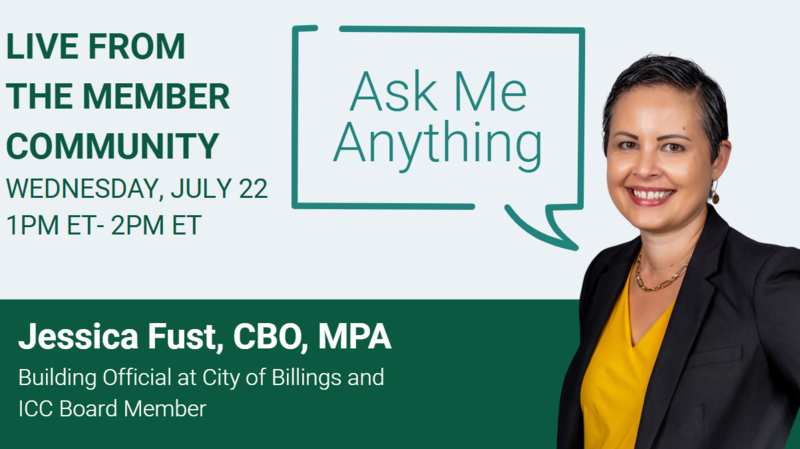
Q&A With Jessica Fust
What advice do you have for someone thinking about moving from the private sector to a municipality?
Fust: If you love public service and serving your community, this is the job for you. I would caution that along with the joy that you may have in serving your community, there comes with it added scrutiny and criticism – often unfairly. You do need to have somewhat of a tough skin to do this job, so having strong core values and purpose is critical on those difficult days. But overall, I believe you won’t have a better experience and opportunity to make a difference in people’s lives than working in the public sector.
What do think the most important issue is that ICC can improve on?
Fust: I think a critical challenge for ICC right now is communicating the importance of the codes and maintaining the codes while there are challenges from communities and states that want to reduce the level of protection for building occupants. The building codes have been so successful at protecting people and property that there are those who think they can be reduced because there continues to be fewer and fewer injuries and deaths associated with unsafe buildings. Therefore, it’s critical that we emphasize the fact that we are in this favorable situation because of the codes.
What advice do you have for architects who are trying to improve and eventually master their knowledge and understanding of the building code?
Fust: The best advice I can give is to ask questions. Every time you get correction items from a plan review, call the plans examiner and go through the items that you missed or don’t understand. Ask them to explain the code and their reasoning. I worked for an architecture firm where we did work all over the country and the greatest code education I got was from calling and talking to plans examiners.
What do you find to be the most rewarding things about the building safety profession industry?
Fust: I absolutely love serving my community. How lucky am I to be the Building Official for my hometown?! My work directly affects my family, friends, and the community I love. Another thing I find very rewarding is the education aspect – whether it’s teaching a new inspector about the code, educating an architect who didn’t understand a particular code, or walking a homeowner through code requirements for their project. I believe that educating people about the code and building safety is just as important as enforcing the code. Especially when I’m able to explain the ‘why’ behind the different code requirements so that people understand it.
What have you learned about the building safety profession from your service on the ICC Board of Directors?
Fust: I’m still completing my first year of board service and learning a lot! What I have really enjoyed is the opportunity to visit other states, regions, and chapters and learn about their issues, concerns, and successes. It has increased my understanding of the differences and similarities throughout the building safety profession and broadened my perspective – which I believe will be an asset as I continue my board service.
What is something you are most looking forward to doing or participating in before the end of your first term?
Fust: I’m looking forward to the outcome of the IRC ‘deep-dive’ that is currently underway. I think there will be information from that effort that could direct some of our future policy decisions. Affordable housing is a concern and a high priority for communities across the country and ICC is a leader in facilitating housing affordability and resiliency.
What advice would you offer to someone with 40 years of plumbing and mechanical experience—as an engineer, plumber, and business owner—who is pursuing M2 Commercial Mechanical and P2 Commercial Plumbing certifications? I would also appreciate your perspective on how much explanation or guidance an inspector should provide to licensed tradespeople, particularly when all parties have been examined under the same codes. As a new inspector, I want to be sure my approach is fair, professional, and effective. Would this perspective benefit from adjustment?
Fust: One of the most challenging things we face in our line of work is how to appropriately apply the code when a situation isn’t exactly black and white. Some people do really struggle with not following the exact letter of the code. I had an inspector quit because he never really got the hang of not always being ‘to the letter’ of the code. I would say it takes a lot of time and experience, education, and training to get to the point where you are confident in making those calls that reside in the ‘gray areas’ of the code. Part of our job is also education of the code for those we work with. If there is an opportunity to educate someone on the code, I think that’s appropriate to explain and provide guidance. I would start from a place of curiosity – ask them to explain why they did something a certain way. It may be a learning experience for you as well.
What is one of the biggest daily challenges your department faces, and how do you address it?
Fust: One of the biggest challenges we face daily is resources and staffing. We run a fairly lean department with 18 staff including inspectors, plans examiners, and permit techs for a community of over 125,000 people. We have to be flexible and adaptable because we never really know what each day will bring. During slower times of the year, we will focus on cross-training and team building. I will have inspectors answer phones at the front counter and have the plans examiners and permit techs go out in the field so they have a good idea of what each other deals with on a day-to-day basis. The pay-off from this is that the team is able to communicate well and solve problems quickly and effectively when they arise.
In your opinion, what role can the I-Codes® and standards publishers play in reducing real or perceived barriers to affordable housing?
Fust: I think we need to be deliberate about the messaging. Some people want to frame the codes as barriers to affordable housing, when they are anything but. The codes ensure a minimum standard of health, safety, and resiliency, which is exactly what everyone should want for housing. There are many other factors involved in the cost of housing, separate from required codes and standards.
Subscribe to the Building Safety Journal Weekly newsletter, here.
ICC members can join the FREE member community, here (use existing myICC username and password).
About the Author
The International Code Council is a nonprofit association that provides a wide range of building safety solutions, including product evaluation, accreditation, certification, codification and training. It develops model codes and standards used worldwide to construct safe, sustainable, affordable and resilient structures.