Ask Me Anything: Your Questions About the Master Code Professional Certification and More, Answered
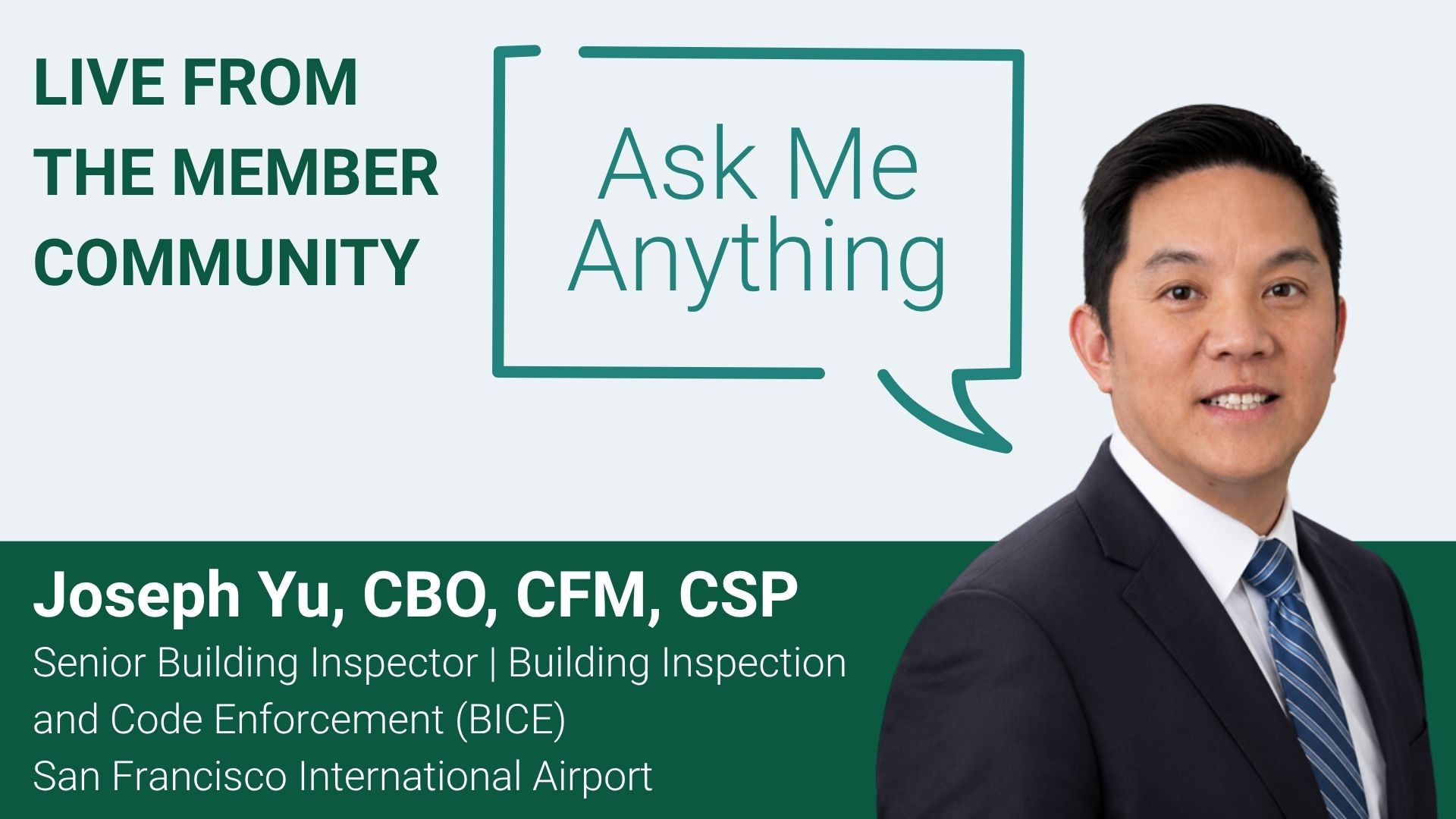
Member-submitted questions about building codes, problem solving and more are answered by Senior Building Inspector for the San Francisco International Airport, Joseph Yu.
Joseph Yu, CBO, CFM, CSP, Senior Building Inspector for the San Francisco International Airport, joined us on our “Ask Me Anything” series on the International Code Council’s (ICC) online member community to answer member-submitted questions.
Members submitted questions about:
- Building Codes & Accessibility
- ICC Certifications & Professional Credentials – Continued pursuit of certifications to expand technical knowledge and expertise (including the Master Code Professional certification)
- Problem Solving – Applying code requirements to complicated or unusual field and plan review conditions
- Communication with Contractors & Design Professionals – Explaining code requirements and providing clear correction guidance
From insights on the Master Code Professional certification, ICC exams and field inspection, here’s a recap of his answers.
Editor’s Note: Some of the questions and answers have been edited for length. View the original “Ask Me Anything” post in “Talkin’ Shop” in the online member community, here.
Q&A With Joseph Yu
When did you feel like you fit in and feel comfortable with performing inspections? Any advice for someone new to the industry?
Yu: You already have experience and knowledge that got you into the position. Remember, no inspector knows everything, and you’re not expected to either.
Do your best, keep learning, and don’t be afraid to ask questions when you’re unsure. Treat contractors, coworkers and the public the way you would want to be treated—with respect and patience. If you stay humble, continue learning and treat people fairly, you’ll build trust and succeed in your job. I’m sure you got it in you!
Airports seem to be unique buildings. What conditions have you found tend to be the toughest or take the most focus to meet code compliance?
Yu: Thank you for your question. The airport is very complicated because it is so interconnected. Each area is protected by different alarm zones, smoke control and type of construction designs. We have areas of high-rise buildings, atriums and smoke control for a high rise/low rise. So, because of the complicated code decisions of the past, it can be hard to find solutions for alterations and additions.
But this also makes the work exciting!
What were the kind of exams you started with? What do you recommend for a path to start and study material?
Yu: I started with the ICC certifications relevant to my role — ones like Building Inspector and Building Plans Examiner — before working toward more specialized exams as I gained experience. My recommended path is to start with the fundamentals — building codes first, since almost everything else builds on that foundation — then branch into the specific trades or disciplines your role covers.
For study material, I like a mix of practice quizzes, YouTube videos and free online training. Practice quizzes are great because they show you exactly how questions are worded and where your gaps are. YouTube has a lot of instructors who break down code sections in plain language, which helps when the code book itself feels dense. And there’s a good amount of free trainings out there — ICC and some manufacturer or association sites — that cover real-world application, not just the code text. I really liked the 3C-Ren (Tri county Energy Network) free training. It helped me get ICC Residential Energy Inspector/Plan Examiner and Green Building Certifications as well.
And honestly, the more tests you take, the easier it gets. Each one builds your test-taking instincts as much as your knowledge base.
What’s the transition from field inspector to plan check like?
Yu: I make sure to dive into the codes relevant to that role and talk to people already doing it to get a real sense of the day-to-day.
As for the transition from field inspector to plan check — it’s really the same knowledge, just applied differently. You already have the foundation from the field; plan check just sharpens it and takes it deeper. Instead of reacting to what’s already built, you’re getting ahead of it — catching things on paper before they ever become a problem on site. That shift made me a better inspector overall, because it forced me to think more like a problem solver.
My advice is to stay curious. Lean on your coworkers, ask questions and don’t be afraid to learn from people who’ve been doing it longer. You already have what you need to succeed — plan check just builds on it and makes you sharper.
What is it like beginning as a field inspector and inspecting construction you’re not familiar with?
Yu: It was humbling — no amount of classroom knowledge prepares you for what you actually see in the field. When I ran into something unfamiliar, I didn’t guess. I asked questions, checked the code books on the spot, and leaned on more experienced inspectors when something looked off. That habit of staying curious instead of assuming I knew it all is what built my confidence over time.
In this industry you have a lot of wonderful coworkers and mentors that can help you.
What inspired you to pursue the Master Code Professional (MCP)?
Yu: I reached a point where I wanted to grow beyond what my day-to-day work was demanding of me. I was comfortable, but I didn’t want to stay comfortable — I wanted a real challenge that would push my skills further and validate what I’d learned in a structured way. Pursuing the certification felt like the right next step: it gave me a clear, rigorous benchmark to work toward, and it forced me to deepen knowledge I’d only picked up informally on the job. It was as much about proving something to myself as it was about the ICC Certification.
The benefit comes afterward in the job opportunities it opens up. That’s why I believe in investing in yourself. You’d be surprised what you’re capable of once you push yourself to do it.
Subscribe to the Building Safety Journal Weekly newsletter, here.
ICC members can join the FREE member community, here (use existing myICC username and password).
About the Author
The International Code Council is a nonprofit association that provides a wide range of building safety solutions, including product evaluation, accreditation, certification, codification and training. It develops model codes and standards used worldwide to construct safe, sustainable, affordable and resilient structures.