Closing the Communication Gap: How Facility and Security Teams Can Strengthen Campus Infrastructure
Why reliable in-building communications and integration are becoming a facility manager priority.
For facility managers across colleges and universities, supporting campus safety has always been part of the role. But as threats evolve, facility infrastructure and its integration are becoming increasingly central to operational readiness.
Security teams today rely on an expanding ecosystem of systems and technologies, including:
- Two-way radio systems
- Dispatch and command centers
- Emergency notification platforms
- Campus safety apps
- Video surveillance and access control
- Mobile and cellular communications
Each of these tools supports campus safety. But their effectiveness depends on a foundational element: reliable communication and seamless integration across systems, teams, and responders.
This is where many facility managers responsible for campus security face a primary challenge.
Security technology investments continue to grow, but communication coverage inside buildings often remains inconsistent. When communication fails, integration breaks down. And when integration breaks down, response strategies become fragmented.
Security teams frequently encounter communication gaps in:
- Stairwells
- Basements and mechanical spaces
- Parking garages
- Residence halls
- Athletic venues
- Older academic buildings
These are not just inconvenient locations. They are often the exact environments where incidents unfold.
When communication fails, even well-designed security strategies can falter.
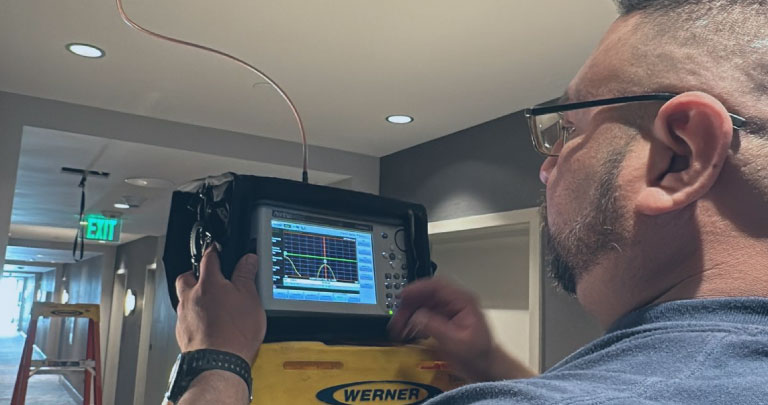
Why Public Safety DAS and Cellular DAS Are Central to Campus Strategy
To address these vulnerabilities, higher education institutions are increasingly turning to in-building wireless systems such as Public Safety DAS/ERCES and Cellular DAS. These solutions amplify and distribute radio and cellular signals throughout buildings, eliminating communication dead zones and supporting both emergency response and daily operations.
These technologies are becoming foundational to campus safety and operational continuity.
Public Safety DAS |ERCES
Emergency Responder Communication Enhancement Systems (ERCES), commonly implemented as Distributed Antenna Systems (DAS), are designed to support radio communication for:
- Campus police
- Security teams
- Fire departments
- EMS
- Municipal and State responders
These systems are engineered to meet fire and life safety requirements, including those established by the International Fire Code® (IFC) and the National Fire Protection Association (NFPA).
Public Safety DAS extends coverage into challenging environments such as:
- Stairwells
- Basements
- Parking garages
- Mechanical spaces
- Large venues
This ensures security teams and first responders can communicate reliably during incidents, improving coordination, response time, and officer safety.
Cellular DAS
While public safety DAS supports responders, Cellular DAS enhances communication for the broader campus community.
Cellular DAS strengthens:
- Emergency notifications
- Campus safety applications
- Incident reporting
- Security team mobility
- Student and staff communication
In many incidents, cellular communication becomes a secondary or redundant pathway, making reliable coverage critical for operational resilience.
A Comprehensive Communication and Integration Layer
Together, Public Safety DAS and Cellular DAS create a communication canopy that supports:
- Security teams
- Emergency responders
- Dispatch operations
- Facility operations
- Students and faculty
This layered approach strengthens integration across systems and improves campus-wide response coordination.
Why Facilities Teams Are Becoming Central to Wireless Infrastructure
Historically, in-building wireless systems were viewed as IT or public safety responsibilities.
Today, facilities teams are increasingly responsible for:
- Integrating systems during construction and renovation
- Coordinating vendor installation
- Ensuring code compliance
- Supporting lifecycle management
- Planning ongoing annual maintenance and upgrades
Building materials such as concrete, steel and low-emissivity glass can significantly weaken signals. Renovations and new construction can also introduce new communication gaps.
Because facility managers oversee building infrastructure, they are uniquely positioned to address communication challenges and support integrated security strategies.
In many institutions, in-building wireless infrastructure is now considered a core building system, similar to fire alarms, access control, and emergency power.
Practical Operational Considerations for Facility Managers
As campuses evaluate in-building communication infrastructure, several operational considerations should guide planning:
Engage Security Teams Early. Security leaders often have firsthand knowledge of communication gaps and operational challenges.
Identify High-Risk Areas. Focus on stairwells, basements, garages, and large gathering spaces.
Plan for Multi-Agency Integration. Ensure interoperability with municipal responders.
Coordinate Long-Term Maintenance. Wireless systems require ongoing monitoring and lifecycle management.
Align Infrastructure With Response Strategies. Communication systems should support dispatch, incident command, and coordinated response.
Why Lifecycle Support Matters
Installing DAS or ERCES infrastructure is only the first step. These systems require:
- Ongoing maintenance
- Annual testing and inspection
- Recertification for compliance
- Performance monitoring
- Rapid issue resolution
Selecting an experienced vendor will help overcome common mistakes. Facility leaders should look for partners capable of:
- Coordinated installation with minimal disruption
- Ongoing lifecycle management
- Compliance expertise
- Long-term support and service
Because these systems support life-safety operations, reliability and vendor experience are key.
Long-Term Planning and Testing Are Essential
In-building wireless systems are not “set-and-forget” technologies. Maintaining effectiveness requires:
- Annual testing by qualified individuals
- Regular performance validation
- System upgrades as buildings evolve
- Recertification to meet fire code requirements
Long-term planning helps ensure communication systems remain reliable as campus infrastructure changes.
Reliable in-building communication infrastructure supports:
- Emergency response effectiveness
- Campus security operations
- Compliance with fire and life safety codes
- Daily operational coordination
- Student and staff safety
A Foundational Technology for Long-Term Resilience
When communication works, security teams respond more effectively. When communication fails, response coordination suffers.
For facility leaders, investing in reliable in-building wireless infrastructure is becoming one of the most important steps in strengthening campus safety and operational resilience.
As campus environments evolve, facilities teams have an opportunity to lead by ensuring communication systems support both everyday operations and critical incidents.
Reliable communications are no longer just a technical upgrade. They are becoming foundational to campus safety, security, and long-term resilience.
About the Author

Director, Business Development BDA/DAS. To learn more about MCA, visit callmc.com. Craig Sikes can be reached at craigsikes@callmc.com or 844.276.7770.