Increased Pipe Gradient: Is it a Practical Response to Reduced Flush Volumes?
The results obtained in the research demonstrate that increasing pipe gradient can effectively compensate for the reduced hydraulic energy of modern water-efficient WC flushes.
In response to global water conservation initiatives introduced over the past few decades, the volume of water used by water closets (WCs) has significantly reduced.
In Australia, since 1990, the standard WC flush volume has reduced from a single option 9 L flush to modern dual flush systems with a full flush of 4.5 L and 3 L half flush. The reductions in flush volume have also run parallel to the redesigning and improved engineering of WC pans and cisterns with today’s models outperforming their older versions with respect to waste clearance while using far less water. While these changes have provided substantial environmental benefits, they have also altered the hydraulic behavior of sanitary drainage systems downstream of the WC. Waste out of sight shouldn’t necessarily be out of mind.
These reduced flush volumes result in lower discharge flows, lower water fill heights within the pipe and reduced hydraulic energy in sanitary drainage systems. In practice, this means less momentum and hydraulic energy available to transport solids through the system.
Over time, this can increase the likelihood of solids being deposited leading to blockages, odor issues and maintenance concerns.
Historical Assumptions About Pipe Gradient
Within the plumbing and drainage community there has long been an industry belief from some suggesting that excessive pipe gradient could be detrimental to drainage performance. The idea often brought up was that if a pipe were too steep, the water would outrun the solid waste, leaving it stranded in the pipe.
While an increased gradient does in fact coincide with a surge in velocity of the water, this theory assumes a two-phase system consisting solely of water and solid waste transported concurrently along the pipe. In reality, at least in most parts of the Western world, a flush of solid waste from a WC is accompanied by toilet tissue paper. This tissue paper in most ideal cases, forms a barrier between much of the available cistern flush volume upstream of it with the downstream section incorporating the solid waste, the volume of water held in the WC trap along with a small amount of additional flush volume that has passed the paper and solid during the flushing process. This paper barrier effectively reduces the flow of water past the solid and aids the transport of the waste. Past research has coined the term ‘Sliding Dam’ (Littlewood & Butler, 2003).
As such, the interaction between toilet tissue and the flush wave challenges the long-held assumption by some that steeper gradients promote solid deposition, instead indicating that effective transport can be maintained under higher slopes.
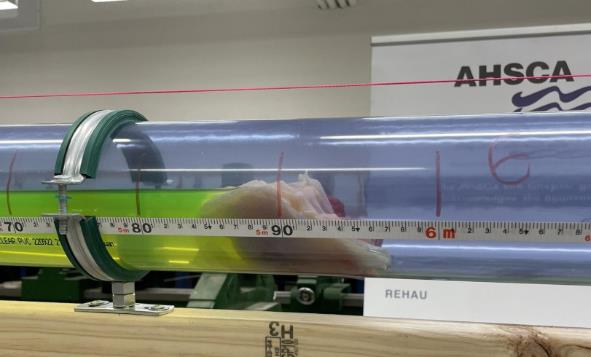
Past Research and History of Sanitary Drainage Solid Transport Experimentation
There have been numerous studies over the past three decades examining the impact of reduced WC flush volumes on sanitary drainage system performance.
Initial investigations coincided with the introduction of water-efficient fixtures in the early 2000s, while more recent work has been undertaken by the Plumbing Efficiency Research Coalition (PERC). While these studies have provided invaluable data for the plumbing industry along with accompanied code changes or at least the potential for changes in the future, these studies have worked with common sanitary drainage gradients used in day-to-day plumbing systems which typically utilize less than two percent of the gravitational force available.
The lack of publicly available data at the higher gradients provided a noticeable research gap that called for further investigation.
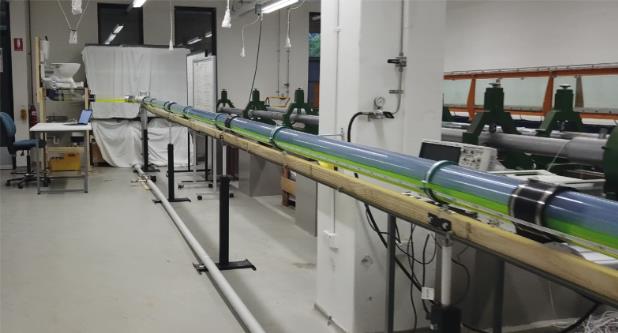
Research Scope: “Compensating for Reduced Flush Volumes: Restoring Solid Transport in Sanitary Drainage Systems Through Increased Pipe Gradient”
Considering this research gap, research conducted at Curtin University in Perth, Western Australia, investigated whether modern 4.5 L flush volumes could convey solids to the same distances achieved prior to water-efficiency measures in Australia, when 9 L flush volumes were the industry standard, by increasing the gradient of the pipe alone. The research also examined whether the gradient required to achieve this was realistically possible in practice (using Australian building characteristics, sewer junction depths and industry guidelines). It’s important to have a drain that clears solid waste on the first flush; however, if the fall required to achieve this exceeds the depth of the municipal sewer junction, then its practical use becomes limited.
The project involved the construction of a test rig frame supporting a single 100 mm diameter pipe, being the size commonly used in Australia for WC drainage pipes and made from translucent uPVC. Due to the likelihood that real plumbing drainage installations in the field include at least one change in direction within the system, the rig utilized this configuration at its upstream end to hopefully yield more credibility and confidence with the results.
In addition to the wastewater-related components, the system also incorporated air pressure and air velocity data acquisition to support the experimental results and to verify any airflow effects associated with the increased velocities resulting from steeper pipe gradients.
The simulated solid test media used was modelled on the Maximum Performance (MaP) protocol, with ingredients consisting of miso paste and soy flour prepared following guidance from Bill Gauley at MaP in Canada.
Direct Comparison Between 4.5 L and 9 L Flushes
While multiple cistern flush volumes were tested in the study (4, 4.5, 6 and 9 L), the comparison between the 4.5 L and 9 L cases was one of the primary objectives of the research given the Australian context, and provides perhaps the clearest demonstration of the disparity in transport performance between current Water Efficiency Labelling Scheme (WELS) rated toilets and the larger flush volumes used for Australian WCs prior to the implementation of water-efficiency measures.
The research indicated that the 9 L flush provides more than a 900 percent increase in conveyance efficiency.
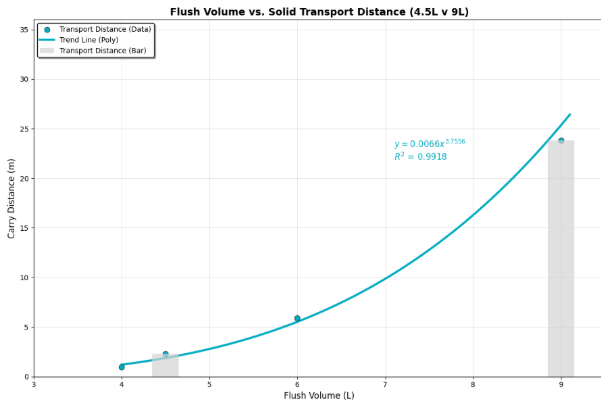
Verdict: Can Transport be Restored for a 4.5 L WC to that of its 9 L Predecessor?
Yes, it can! As expected, the results obtained in the research demonstrate that increasing pipe gradient can effectively compensate for the reduced hydraulic energy of modern water-efficient WC flushes. Quantitative analysis of the test rig identified a clear threshold at which a 4.5 L flush is capable of achieving solid transport performance comparable to that of a 9 L flush at the minimum and code required gradient in accordance with Australian standards of 1:60 (1.65 percent).
Final validation of this threshold is currently underway, with detailed results to be presented in forthcoming research.
But are these steeper grades realistically possible? It depends on the specific installation area of course. However, for example, in many residential developments, typical building guidelines and minimum stipulated municipal sewer connection levels (at least in Australia where this research was conducted) will allow sanitary drainage pipes to be installed at gradients well in excess of the code minimum requirement of 1:60, often by a factor of two or more.
It should also be noted that the experimental results suggest that such steep gradients may not be necessary throughout the entire system. Short upstream pipe runs near fixtures often achieve adequate solid clearance at conventional slopes or slightly above the minimum, while steeper gradients may be more beneficial in downstream sections within the ground fill where solids have lost momentum and the risk of deposition increases.
The findings discovered through the research provide empirical evidence that increasing pipe gradient can effectively restore the solid transport performance of reduced flush systems. The results support the potential inclusion of supplementary design guidance for Australian or worldwide plumbing and drainage industry practice, enabling engineers and designers to better optimize pipe gradients for the modern water efficient WCs of today.
To stay updated on the latest PMG industry news, subscribe to ICC’s PMG newsletter here.
About the Author

Steve Wright is a hydraulic services engineer originally from Australia, currently consulting out of The Hague in the Netherlands. He holds a First Class Honours degree in Civil and Construction Engineering, along with diplomas in both Fire Systems and Hydraulic Services Design and is also a licensed plumber. His work focuses on sanitary and roof drainage research and design, combining mathematical analysis and computational fluid dynamics to better understand, visualize and improve system performance.