Low‑Ambient Derating in Heat Pumps: Capacity Loss and Balance‑Point Calculation for Auxiliary Heat Requirements
The derating curve is not merely a performance characteristic, it is a design tool that shapes equipment selection, auxiliary heat sizing and overall system architecture.
Heat pump technology has become a defining component of modern HVAC engineering in regions of the country where buildings are transitioning toward electrification and higher efficiency. Although all heat pumps rely on the vapor‑compression cycle, the way they reject heat – either to outdoor air or to a controlled water loop – creates substantial differences in performance, installation strategy and long‑term operating behavior.
These differences become even more pronounced when considering how air‑source heat pumps derate in low ambient temperatures, a factor that increasingly shapes system selection in cold‑climate regions.
Air-Cooled Versus Water-Cooled Heat Pumps, Explained
Air‑cooled heat pumps reject heat directly to the outdoor environment, which means their performance is tied to fluctuating ambient conditions. As outdoor temperatures rise, condensing pressures increase, reducing efficiency and raising compressor lift.
Water‑cooled heat pumps, by contrast, reject heat to a stable water loop maintained by a cooling tower, dry cooler or geothermal field. Because water has higher thermal conductivity and a narrower temperature range, these systems operate at lower condensing temperatures and achieve higher COP and EER values. This thermodynamic advantage explains why water‑cooled systems are often favored in large commercial buildings and high‑rise structures where mechanical room space is available and long‑term operating cost is a priority.
Installation Differences
The installation environment further differentiates the two systems. Air‑cooled units require outdoor placement with adequate airflow clearance, making them simple to install but more exposed to weather, debris, and acoustic concerns.
Water‑cooled systems require pumps, piping and a cooling water source, resulting in higher first cost but greater placement flexibility and quieter operation. Installation of this equipment in an indoor location, when feasible, also contributes to longer service life, while air‑cooled units typically experience more wear due to environmental exposure.
Performance Differences
A critical performance factor for air‑source heat pumps is capacity derating at low ambient temperatures. As outdoor air becomes colder, the amount of usable heat available decreases, forcing the heat pump to operate with a higher temperature lift between the outdoor coil and the indoor conditioned space. This reduces both heating capacity and efficiency. Frost accumulation on the outdoor coil triggers periodic defrost cycles, during which the system temporarily reverses operation, further reducing net heating output. Standard air‑source heat pumps may lose 10 to 20 percent of capacity at 35°F, 30 to 50 percent at 17°F, and more than half of their output as temperatures approach 0°F. Below 10°F, the derating curve bends sharply downward as the system approaches minimum allowable suction pressure and compressor operating limits.
By the Numbers
The following numerical example illustrates this behavior: A nominal 3-ton (36,000 Btu/h) heat pump rated at 47°F may deliver 31,000 Btu/h at 35°F, 27,000 Btu/h at 25°F, 22,000 Btu/h at 17°F, and only 17,000 Btu/h at 5°F. This corresponds to 100 percent, 86 percent, 75 percent, 61 percent, and 47 percent of nominal capacity, respectively. A cold‑climate inverter version of the same unit performs better, delivering 35,000 Btu/h at 35°F, 34,000 Btu/h at 25°F, 33,000 Btu/h at 17°F, and 30,000 Btu/h at 5°F which corresponds to 100 percent, 97 percent, 94 percent, 92 percent, and 83 percent of the heat pump capacity; still derating, but far more gradually.
See comparison charts for 3-ton (36,000 Btu/h) nominal and cold climate inverter air source heat pumps rated at 47ºF:
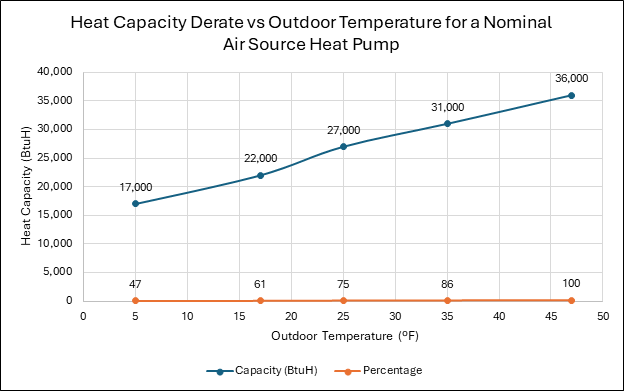
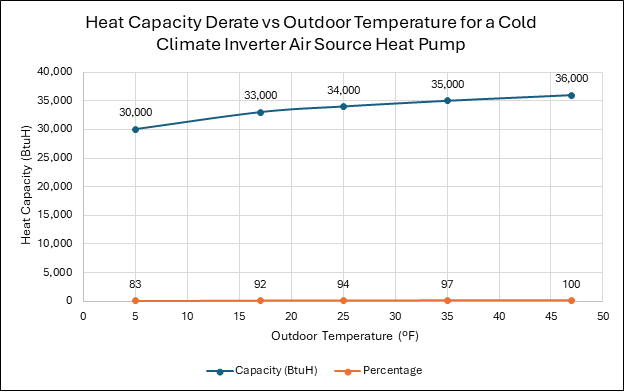
This derating behavior directly affects the building’s balance point, the temperature at which heat pump output equals the building’s heat loss.
Cold-Climate Engineering
Cold climate engineering requires careful consideration of envelope performance, emitter selection and system configuration. A tighter building envelope reduces the slope of the heat‑loss curve, lowering the balance point and reducing reliance on auxiliary heat.
Low‑temperature emitters such as radiant floors or oversized fan coils allow the heat pump to operate at lower supply temperatures, improving efficiency and reducing compressor lift. Reverse‑cycle defrost temporarily interrupts heating, and the frequency of these cycles increases as humidity rises and temperature falls. Demand‑based defrost strategies minimize unnecessary cycles and improve seasonal performance, which is especially important in humid continental climates.
System Selection
System selection in cold climates depends heavily on design temperature. In regions with design temperatures above 20°F, standard air‑source heat pumps are often sufficient. In climates with design temperatures between 0°F and 20°F, cold‑climate inverter heat pumps are preferred, with auxiliary heat expected during the coldest hours. In regions where design temperatures fall below 0°F, water‑source or geothermal systems become increasingly attractive because they avoid low‑ambient derating entirely. Hybrid systems that combine a heat pump with a boiler or furnace can also optimize performance by allowing the heat pump to operate in its efficient range while the auxiliary system handles extreme conditions.
Derating Curve Key Takeaways
Ultimately, the derating curve is not merely a performance characteristic. It is a design tool that shapes equipment selection, auxiliary heat sizing and overall system architecture.
Air‑cooled systems offer simplicity and lower first cost, making them suitable for residential and light commercial applications.
Water‑cooled systems deliver superior efficiency, quieter operation and longer lifespan, aligning with the needs of large commercial buildings and district energy systems. In cold climates, the impact of low‑ambient derating often becomes the deciding factor, pushing designers toward water‑source or geothermal solutions that maintain stable capacity regardless of outdoor temperature. Understanding these relationships allows engineers to design systems that balance efficiency, reliability and long‑term operating cost.
About the Author

Sahil Mahajan, PE, P.Eng., CPD, LEED Green Associate, has a Master of Science in Mechanical Engineering and is currently working at KEA Engineers in Iselin, New Jersey, as the Plumbing and Fire Protection Department Head. He has nearly 20 years of experience in HVAC, plumbing, and fire protection design and is a licensed Professional Engineer in the United States and Canada.