Sustainable Wastewater Solutions: Constructed Wetlands Versus SBR Systems in Slovenia
As the built environment professions grapple with decarbonization imperatives and increasingly stretched municipal budgets, the question of which wastewater treatment technology best serves smaller communities deserves renewed attention.
This article draws on operational monitoring data and cost records from two communal wastewater treatment facilities commissioned in Slovenia in 2015. The two plants — the Cvetkovci Constructed Wetland (CW, 700 PE) and the Središče ob Dravi Sequencing Batch Reactor (SBR, 2,200 PE) — employ fundamentally different technologies, yet both are rooted in biological treatment principles.
Their parallel operation offers a rare opportunity for direct, evidence-based comparison.
Two Philosophies of Biological Treatment
The SBR plant at Središče ob Dravi represents the engineered, high-automation end of the spectrum. Incoming wastewater passes through fine electromechanical screens and a combined sand trap and grease separator before entering two parallel sequencing basins, each cycling through aeration, settlement and decanting phases under programmable logic control. Chemical phosphorus precipitation using ferric chloride ensures tertiary-level treatment. The facility occupies approximately 900 m² (9,688 square feet) and requires a qualified technician present for around four hours daily.
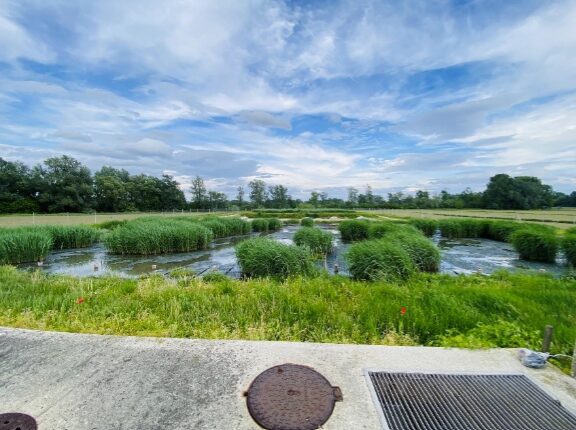
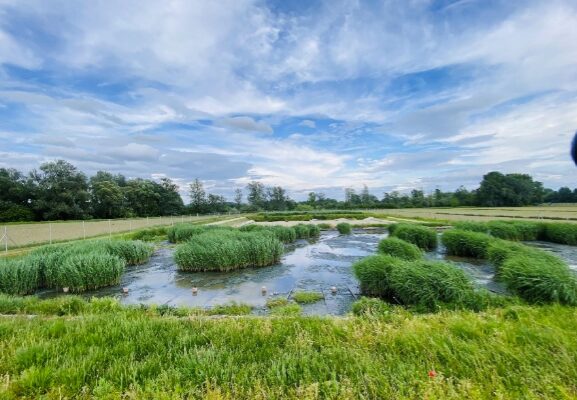
The Cvetkovci facility takes a diametrically different approach. Designed as a hybrid subsurface flow constructed wetland of the Limnowet® type, it combines vertical flow across a filter bed with horizontal flow through two parallel treatment beds and a final polishing bed, all planted with common reed (Phragmites australis). Pre-treatment is provided by a 200 m³ (7,063 cubic feet) three-chamber settler.
The total functional area of the plant is 3,600 m² (38,750 square feet), with the full site occupying 7,185 m² (77,339 square feet). Sludge from the settler is pumped in 10 cm layers onto an on-site composting bed, where it is treated by microorganisms before transfer to the regional plant at Ormož for final processing. Significantly, the primary treatment process requires no electrical power for aeration — the modest electricity demand of the Cvetkovci facility stems solely from the pump serving the vertical-flow filter bed, installed specifically to avoid deep excavation costs and to achieve the higher nitrification efficiency that vertical-flow systems provide.
Performance: Nature More Than Holds its Own
Both facilities were commissioned with first-measurement campaigns during their trial operation periods in 2015, followed by routine periodic monitoring in 2016. For the CW, the applicable regulatory threshold for a small communal plant (50–2,000 PE) is 150 mg O₂/l for COD and 30 mg O₂/l for BOD₅. The SBR, classified as a communal plant above 2,000 PE, must meet the tighter standard of 125 mg O₂/l for COD and 25 mg O₂/l for BOD₅, with minimum removal efficiencies of 80% and 90% respectively.
Both plants comfortably exceeded these standards throughout the monitoring period. The CW achieved average outlet COD values of 30 mg O₂/l and BOD₅ values of just 3 mg O₂/l during first measurements, improving to 29 mg O₂/l and 2 mg O₂/l respectively in periodic monitoring — corresponding to BOD₅ removal efficiency approaching 99.6%.
The SBR delivered average outlet COD of 18 mg O₂/l and BOD₅ of 7 mg O₂/l in initial testing, rising to 46 mg O₂/l COD and 10 mg O₂/l BOD₅ in periodic monitoring, the latter partly attributable to an anomalous inlet concentration spike (3,400 mg O₂/l COD on one occasion) consistent with an illegal gully emptying event or pump station flushing. One periodic measurement recorded an outlet BOD₅ of 30 mg O₂/l, marginally exceeding the SBR’s 25 mg O₂/l limit — the only regulatory exceedance observed across both facilities during the study period. Average removal efficiencies for both COD and BOD₅ exceeded 94% at both plants across all measurement campaigns.
These figures challenge a common assumption in the industry: that constructed wetlands are adequate for rural settings but necessarily inferior in treatment quality compared to activated-sludge technologies. Under the conditions observed here, the CW outperformed the SBR on organic matter removal, while both met or exceeded all regulatory thresholds.
Economics: Capital and Operational Cost Structure
A relative cost comparison, normalized per population equivalent, reveals the expected capital-cost advantage of the SBR in electromechanical content — but a clear civil-works premium over the CW. For the SBR, mechanical and process installations account for approximately 52% of total construction cost, with civil works at 34% and electrical installations at 14%. For the CW, the inverse applies: civil and earthworks (settler, beds, waterproofing) constitute around 90% of the build cost, while electromechanical content represents only 10%.
On a per-PE basis, the SBR investment is substantially higher overall, driven by the intensive equipment package. The CW’s capital advantage is most pronounced precisely where the SBR is most expensive: process machinery, instrumentation and installation.
Operational cost data from the first half of 2016, drawn from KPO’s service accounting broken down by municipality, confirms this pattern at the running-cost level. Total operational and maintenance costs for the SBR were found to be 36% higher than for the CW when normalized per PE. Electricity consumption alone was 51% higher at the SBR; fuel costs (vehicle and pump operations) were 86% higher. Statutory monitoring costs were 39% higher, reflecting the more intensive measurement frequency prescribed for larger plants. Only labor costs show a relatively modest differential — 27% higher at the SBR — because neither facility has a full-time resident operator.
Practical Implications for Building Services Professionals
Several conclusions emerge with direct relevance to practitioners engaged in building drainage, plumbing infrastructure and sustainable sanitation design.
For settlements below roughly 1,500–2,000 PE where land is available (a design footprint of 2–3 m² (22–32 square feet) per PE is the typical benchmark for CW systems), the constructed wetland offers a compelling combination: capital savings, negligible energy demand, low maintenance complexity, visual integration into the landscape and treatment performance genuinely comparable to mechanical alternatives. The substrate in the filter bed requires replacement every seven to ten years for the primary (vertical-flow) bed, and every 30–40 years for the horizontal-flow treatment and polishing beds — a long-cycle maintenance commitment that should be factored into whole-life cost assessment.
For urban or peri-urban locations where land is constrained, where tertiary nutrient removal is mandated, or where system flexibility and automated load-response are priorities, the SBR remains the appropriate choice. Its programmable cycle control allows precise management of nitrification and denitrification, and its compact footprint (roughly 900 m² (9,688 square feet) for a 2,200 PE plant) is difficult to match with natural systems.
The broader lesson from this comparative study is not that one technology is universally superior, but that rational site-specific selection — accounting for available land, capital budget, operational capacity, receiving water sensitivity and whole-life energy cost — should displace the reflexive preference for engineered complexity.
As International Code Council (ICC) PMG standards, such as the ICC 825 Private Sewage Disposal Systems Standard evolve to incorporate sustainability metrics alongside performance thresholds, the evidence suggests that nature-based solutions merit equal standing in the designer’s toolkit.
To learn more about water-related issues and how codes and standards can help, view the ICC’s PMG Webpage
To stay updated on the latest PMG industry news, subscribe to ICC’s PMG newsletter here.
About the Author
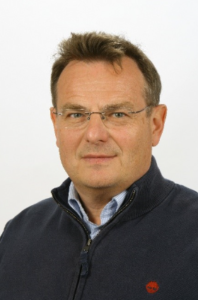
Matjaž P. Nekrep is a Slovenian civil engineer, researcher, and academic at the University of Maribor’s Faculty of Civil Engineering, Transportation Engineering and Architecture (FGPA). He specializes in hydraulics, hydrology, and sustainable water management systems. His research extensively explores green infrastructure and the application of unmanned aerial systems (UAS) for environmental monitoring. With a bibliography of over 300 units, he has been a long-term contributor to international research projects and a mentor to numerous engineers in the field of hydrotechnics.