Where the Plumbing Trade Meets the Drawing Board
What began as a camera crew and a YouTube series has since expanded to include members from every region of the world. Now, members of the International Plumbers Network (IPN) have returned to where it all started: the Pfister’s Faucets headquarters. Over the course of a day, those members spent time in the design and testing labs and contributed to an open discussion about the future of the plumbing trade. On July 31, 2026, a group of members visited the Watts Learning Centre in Sydney, Australia, with a second event taking place on Sept. 4, 2026, in Lake Forest, CA.
Starting the Day With “Why”
The group arrived in the morning, dropped their bags and introduced themselves over coffee. IPN President Mark Falcon opened the event by explaining why IPN exists.
The trade has always relied on relationships, the people who train, the peers called when a job goes sideways and the apprentices who get mentored along the way. IPN takes that circle and stretches it across companies, cities and even countries.
The network is built around four ideas:
- Relationships: Building a trusted network of peers
- Knowledge: Sharing practical ideas, training and best practices
- Opportunity: Creating pathways for plumbers, improvement for the industry and the next generation
- Voice: Strengthening the profession through a connected global community ran by plumbers for plumbers
Here’s how IPN events are putting all four to work.
It Starts With a Story
American Plumber Stories is Pfister’s docuseries about the people in the trade. Each episode follows a different plumber and their story: how they got into the trade, what they overcame to make it there and what the work has given them. Over five seasons it has grown from a U.S. series into an international one, with episodes getting increasingly more adventurous from Australia to Canada, and Hawaii to Alaska.
Along the way it did something no one planned. The plumbers who were filmed started talking to each other. Someone in Australia recognized the same issues as someone in California. Someone in Nepal had solved a problem a U.S. contractor was still fighting. Those relationships, built one episode at a time, became the IPN.
Watch the series that started it at americanplumberstories.com.
Education and Networking in Action
Most plumbers know a faucet/tap or valve from the install side: the box it arrives in, the installation process and the components that need maintenance a few years later.
But IPN members were able to get an exclusive look at where this all starts.
Pfister Faucets – Lake Forest, California
Pfister Faucets opened its headquarters in California to IPN for a full day of tours, working sessions and conversation to IPN Members from Australia, Nepal and the U.S. It was built on a simple idea: the people who design plumbing products and the people who install them should be in the same room more often.
Pfister’s leadership team then took the group through the parts of the building visitors rarely see.
Industrial Design
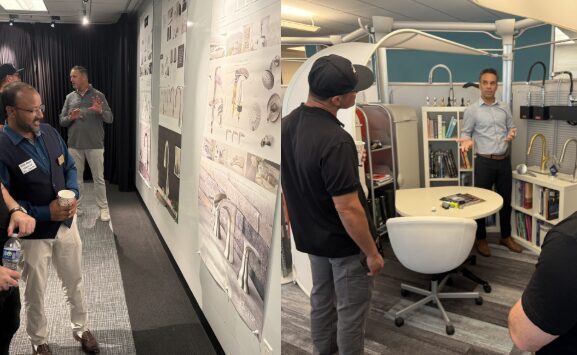
The first stop was the Industrial Design lab, where Pfister’s designers showed how a faucet goes from an inspiration board to development sketches to a finished product. The walls were covered with concepts: mood images, sketch progressions and renderings of kitchen and bath collections. Designers walked the group through the thinking behind them, and the plumbers asked the practical questions about installation and maintenance.
Rapid Prototyping and Engineering
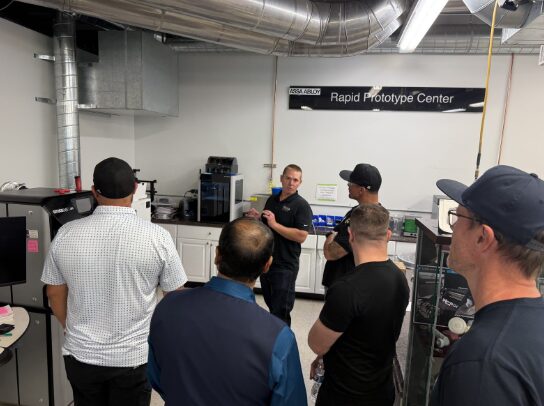
Next came the Rapid Prototype Center where 3D printers turn a designer’s file into a physical part the team can hold, test and refine. From there, the group moved into the Engineering Main Lab, the workbenches and test rigs where products are validated before they reach a supply house.
Test Laboratory
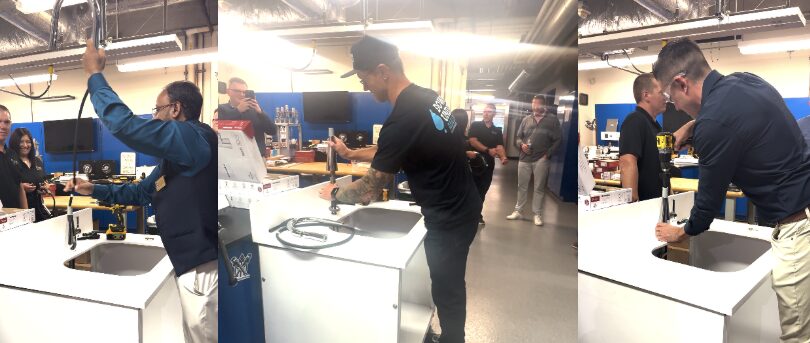
All quality plumbing products go through rigorous testing, but in this laboratory the IPN members were put to the test racing against each other for the quickest installation time.
Showroom Lab
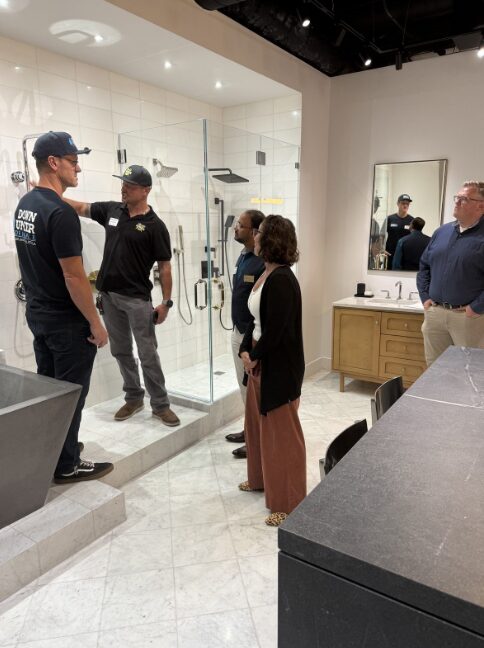
Pfister’s marketing team closed the tour with the Showroom Lab: a full bathroom and kitchen setting where finished products are shown the way a homeowner would see them. For contractors who sell and install these fixtures every day, it was a look at how a manufacturer thinks about presenting a product and a chance to talk about what actually works in the field.
Merch Swap
Before lunch, IPN members laid their company gear out on the front counter and traded shirts, hats and swag, a small tradition with a real point: every logo on that counter is a business someone built and it highlights the support plumbers can provide others in the industry. During lunch, the group watched the American Plumber Stories episode featuring Jorge Arias. Arias is IPN’s Regional Director for North America and watching his episode in the building where the series is made, sitting next to the people who made it, is about as close to the heart of this network as a day can get.
Plumbers at the Table
In a framework session, Pfister’s brand and product teams asked the IPN for input on everything from the packaging to the products. Another session focused on getting a plumber’s perspective on what’s next for American Plumber Stories, and the question underneath it: ‘How do we fill the pipeline for the future of plumbing?’. The series was built to show young people that this trade is a career worth choosing, and IPN members are the proof it points to. Recruiting, training and keeping the next generation is a problem both manufacturers and contractors share, so the people in the room were the right ones to answer it.
Watts Learning Centre – Sydney, Australia
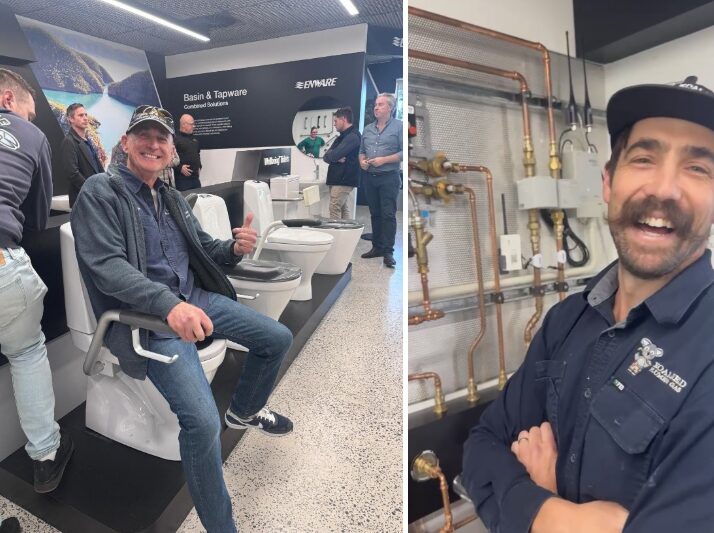
While the Los Angeles group explored Pfister’s headquarters, the Sydney delegation arrived at the Watts Works Learning Centre. This state-of-the-art facility is purpose-built for the plumbing and hydraulic industry, designed to showcase the latest in water management technology and safety systems from the Watts group.
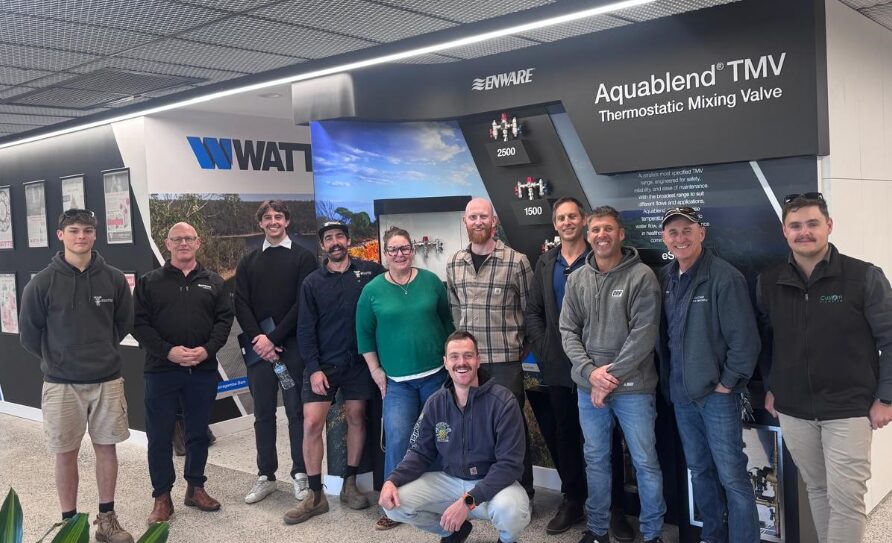
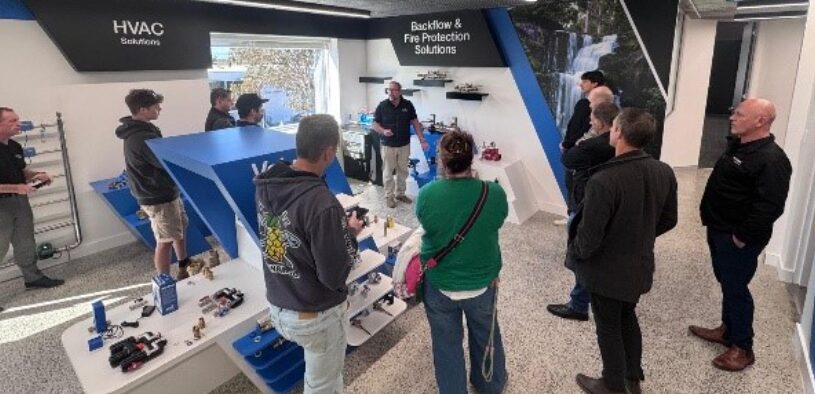
The day began with a deep dive into the engineering behind modern commercial plumbing. The Watts team walked the IPN members through the complexities of large-scale water management. Plumbers discussed the evolution and practical challenges of backflow prevention, thermostatic mixing valves (TMVs) and automatic control valves, asking direct questions about serviceability and long-term maintenance in the field.
The Wet Lab Experience
IPN members also got to get hands-on in the facility’s dedicated wet lab. This immersive environment allowed plumbers to interact with live systems real products. Members got to see physical demonstrations of products in operation and a dedicated area for backflow and thermostatic devices, testing the equipment exactly as they would on a commercial job site.
Demonstration Zones
The group then toured the operational demonstration zones, which highlighted finished commercial tapware, emergency safety showers and specialized wellbeing plumbing products.
This provided contractors a chance to evaluate the products from an installation perspective while discussing system design and client presentation with Watts technical experts.
IPN Members Only
At both events, IPN members had the opportunity to have an open conversation about the network, the events and where IPN goes next ensuring that the IPN continues to be built by plumbers for plumbers. Drawing from IPN’s broader initiatives, members in Sydney also learned about additional opportunities within the network, such as being involved in initiatives that inspire the next generation of tradespeople and connecting directly with other IPN members to help shape the future of the group.
Thank Yous and Looking Forward
Both events fostered the kind of manufacturer-contractor relationship that makes the trade stronger. The visits were only one day, but the outcome was incredible. Everyone was asked to meet someone new, share one idea that works in their market and keep the relationship going.
Learn more about IPN and register for future global networking events at internationalplumbersnetwork.org.
To stay updated on the latest PMG industry news, subscribe to ICC’s PMG newsletter here.
About the Author
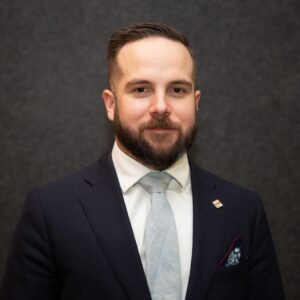
Tom Roberts is the Director of PMG Global operations with the International Code Council. Prior to this role, Tom was the Director responsible for the Plumbing Code of Australia with the Australian Building Codes Board. Tom is also the chair of Standards Australia’s WS-014 committee responsible for the AS/NZS 3500 series of Australian and New Zealand Standards.