Natural Disasters: Life and Career Changing Events for Code Officials Recap & Video
On Wednesday, May 27, 2026, the International Code Council (ICC) hosted a virtual webinar, Natural Disasters: Life and Career Changing Events for Code Officials, live from the City of Asheville Development Services Department in Asheville, North Carolina.
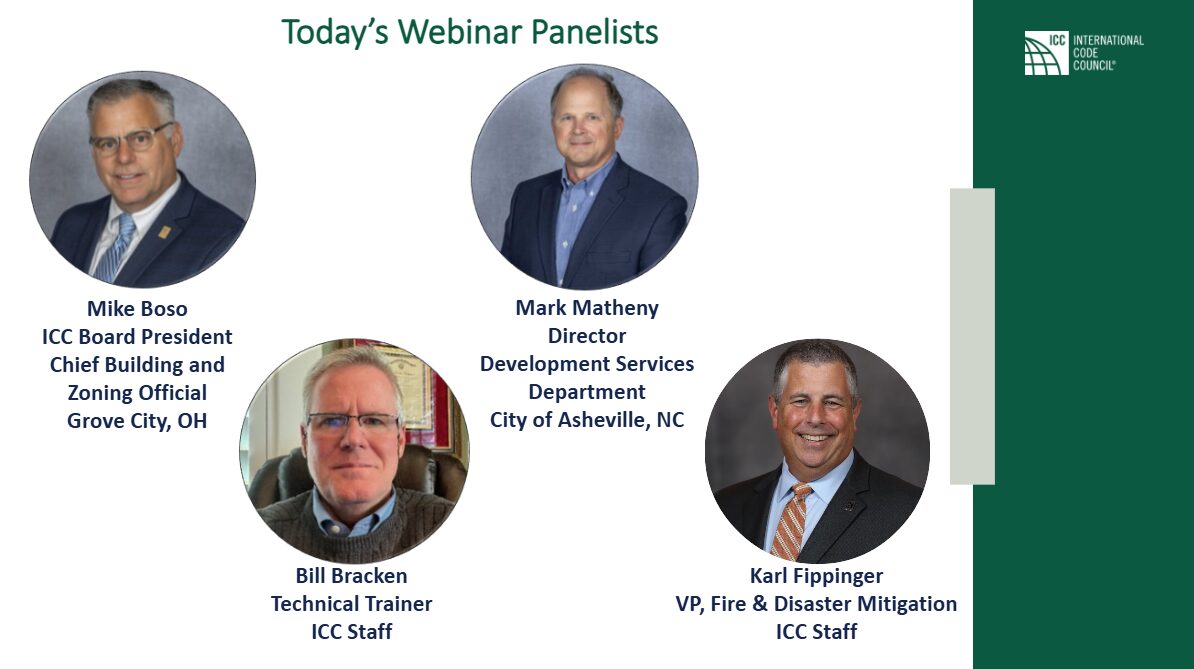
Webinar panelists included Mike Boso, ICC Board President and Chief Building Official of Grove City, Ohio, Bill Bracken, ICC Technical Trainer, and Mark Matheny, Director of Development Services Department for the City of Asheville.
The event was moderated by Karl Fippinger, Vice President, ICC Fire & Disaster Mitigation.
Preparing for Disaster
Building and fire code officials are critical to post-disaster response and recovery, as they manage structural safety evaluations, damage assessments, and permitting for repairs that directly affect the pace of community resilience, economic recovery, and reconstruction.
Panelists shared their insights on how to help communities prepare for, respond to, and recover from major natural disasters. With the City of Asheville’s recovery after Tropical Storm Helene being the main focus, attendees learned the role that mitigation and preparedness play in helping code officials protect their communities.
The entire webinar recording can be viewed here or below. Slides from the presentation can be accessed, here.
An example of the Tropical Storm Helene Recovery Resources one-pager can be downloaded, here.
Q&A with Panelists and Moderator
Participants had the opportunity to ask questions throughout the webinar. Many questions were answered during the Q&A portion of the presentation (begins at 51:30 in the recording), but here Fippinger and the panelists answered the remaining questions.
I visited Asheville about 14 years ago and it was beautiful. Just out of curiosity, was the Biltmore Estate affected?
Fippinger: Yes, the Biltmore Estate and Biltmore Village were both affected by Tropical Storm Helene.
After the storm, did you use the Federal Emergency Management Agency (FEMA) Residential Substantial Damage Estimator (RSDE) program for damage assistance for all IA structures?
Fippinger: The City of Asheville used a standard formula document to perform and assess residential Substantial Damage Estimate (SDE) determinations.
Was the permit process expedited for the properties that were damaged during this disaster?
Matheny: Yes, Emergency Permits were prioritized for damaged and destroyed properties. That was one of the many advantages of the City of Asheville’s approach to splitting work flows into disaster and non-disaster permit teams that included permit technicians, plan reviewers, and inspectors.
Is this type of information included in the current course plan for When Disaster Strikes?
Bracken: Yes. The When Disaster Strikes Institute is a comprehensive series of courses.
Did you have owners hiring firms to evaluate their building, and how did you handle that?
Matheny: The City of Asheville only encountered this situation a few times. Generally, this occurred when the owner or tenant desired a change from a red placard to a yellow placard or a yellow placard to a green placard. Each instance was for aesthetic reasons. Once was for insurance purposes. This served as an educational and learning experience for the building owner or tenant as personnel explained that their ATC-45 categorization of their building was only for purposes of the disaster event and not a condemnation order.
If the architects provide their American Institute of Architects (AIA) membership number, will you submit them to AIA for the continuing ed credit? If not, can I get a certificate of attendance?
Fippinger: ICC is offering Continuing Education Units (CEUs) for this webinar. Details will be provided in the post-webinar recap email from ICC. ICC will not be issuing certificates of attendance for the webinar.
How was it verified that the emergency permit request was directly related to storm damage?
Matheny: Emergency Permit requests were verified against the data collected by the City of Asheville Development Services Department in its ArcGIS Survey123 geospatial data collection tool. If the building was missed during the assessment phase, department personnel would perform a site visit and meet with the applicant.
What is the best way to channel interested volunteers with food and water distribution, clean-up, etc. and liability waivers needed?
Fippinger: Disaster donations and volunteers should be sent to and coordinated by emergency management officials. Often, emergency management will designate a specific voluntary organization to handle donations. While volunteers are an important part of response and interim recovery, emergency management cautions against spontaneous volunteers from self-dispatching and deploying directly to disaster areas without a sponsoring organization or defined purpose. Emergency management, faith-based groups and national voluntary organizations active in disaster are the best places for volunteers to offer their time, energy and services.
What is the role of AI for more effective and efficient preparation, recovery and lessons learned in disaster?
Matheny: AI certainly has a role in assisting with basic outlines, frameworks and templates. Accumulating national standards of care and best practices is another way that AI can feed preparedness, response and recovery. Working through specific scenarios by disaster type might also be helpful.
When Disaster Strikes
ICC’s When Disaster Strikes (WDS) program was created to increase awareness and provide training related to the code official’s post-disaster roles.
WDS guides participants through disaster scenarios, reviews documentation requirements and encourages discussion and experience sharing. Upon completion of the program, participants can be relied on to assist with performing post-disaster building safety evaluations.
Learn more about ICC’s Fire and Disaster Mitigation Team, here.
More information on WDS can be found here.
About the Author
The International Code Council is a nonprofit association that provides a wide range of building safety solutions, including product evaluation, accreditation, certification, codification and training. It develops model codes and standards used worldwide to construct safe, sustainable, affordable and resilient structures.