Ask Me Anything: Your Questions About Accessibility and More, Answered
Member-submitted questions about scoping requirements, technical criteria and more are answered by Vice President of ICC Credentialing, Kim Paarlberg.
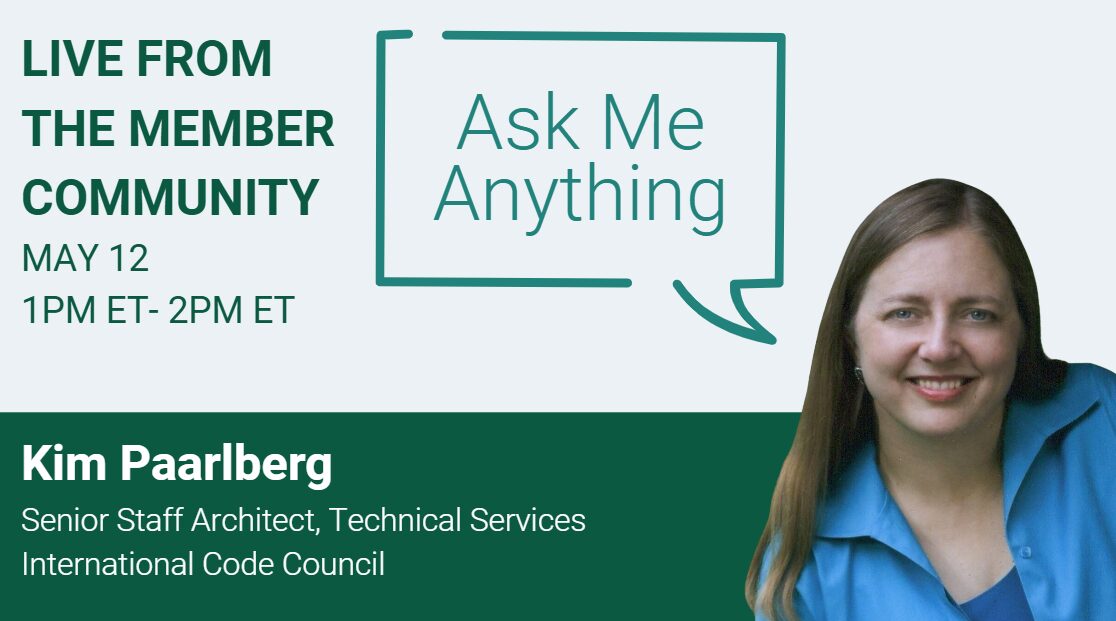
Kim Paarlberg, Senior Staff Architect with Technical Services, joined us on our “Ask Me Anything” series on the International Code Council’s (ICC) online member community to answer member-submitted questions.
With a focus on Means of Egress/Accessibility, her experience with ICC includes work in the plan review and code development departments with responsibilities for code development, providing code interpretations and instructing technical seminars. She is also responsible for authoring and reviewing instruction materials, code commentary and publication articles.
Members submitted questions about:
- Scoping requirements (what, where and how many) for accessibility in the 2024 IBC and IEBC.
- Technical criteria (how to) in the 2017 ICC A117.1.
- New and revised technical criteria in the recently completed 2026 ICC A117.1.
From insights on automatic door requirements, the A117.1 standard and adult changing tables, here’s a recap of her answers.
Editor’s Note: Some of the questions and answers have been edited for length. View the original “Ask Me Anything” post in “Talkin’ Shop” in the online member community, here.
Q&A With Kim Paarlberg
Is there a question you get asked most often regarding compliance with Chapter 10 of the International Building Code® (IBC)?
Paarlberg: Most of the questions on IBC Chapter 10 are related to stairways. The concepts related to exit access stairways, both as supplemental or required means of egress, are still an area that people seem to be working through.
How can members get more involved with ICC’s standard development process?
Paarlberg: The IBC code change process is open to everyone. You can independently enter a code change (IBC Chapter 11 changes are due January 2027 and International Existing Building Code® (IEBC) Chapter 3 changes are due January 2028), or work with many different associations that also submit code changes.
You can participate in a work group associated with the accessibility standards. The A117.1 Standard: Accessible and Usable Buildings and Facilities had work groups during the last cycle that worked on assisted toileting, adult changing tables, accessible toileting and bathing requirements and signage. All meetings are open to the public.
ICC is currently working on a new standard with Canada. The A118 Standard: Acoustics Accessibility is primarily focused on accessibility related to person with hearing or vision impairments.
You can sign up as an interested party at ICC Committee Application – ICC, so you can receive all emails and communications for the groups you are interested in.
What are the biggest concerns today with accessibility?
Paarlberg: Accessibility in design can improve the quality of life for everyone. For example, a curb ramp helps people that use wheelchairs; people that have a walker, canes or crutches; the parent with the stroller; the child on a bike. Everyone will either be living with a disability or helping a family member or friend with a disability sometime during their life. That is why inclusive design is so important for every place we want to go for work, community, play or live.
Is there movement in pushing for more requirements associated with accessible egress requirements beyond what we provide today in the codes?
Paarlberg: When a building is altered to improve the accessible route into the building, that route is also an improvement for egress. While that is not the same level of egress as required for new construction, it is an improvement.
The IEBC, in a Level III alteration, does ask for a two-way communication system to be added at the elevators in a sprinklered building. In most sprinklered buildings, that would be the last piece to meet accessible means of egress in new construction. In non-sprinklered buildings, that is an improvement in communication for anyone who needs assistance.
Buildings that are new enough to have an accessible means of egress have to maintain it. For older buildings, it is not required to be added.
At this point, for existing building that do not have that second accessible means of egress, the fire and safety evacuation plans required in the International Fire Code® (IFC) is the most affirmative means to have everyone included in all evacuation plans and fire drills.
We would suggest to people that adding exterior areas for assisted rescue at those second exits on the grade level would be an option as part of the fire and safety evacuation plans and would add options for people who cannot use stairs. However, a lot of that depends on the project, access to all areas of the site and the extent of the alteration.
Is there an ADA exemption possible for the non-public/ living area of a fire station?
Paarlberg: The ADA is a federal law, and there are no plans for updating at this time. A fire station is still considered a Title II building, and that requires an accessible route to all floors.
While the IBC, Section 1104.4 does have an exception for the accessible route to the 2nd floor of less than 3,000 sq. ft., that exception is not permitted to be used for government buildings, which would include a fire station. So for vertical access, the ADA and IBC are the same.
The IBC has recognized that the living area of the fire station is more along the line of a permanent resident, so the 2024 IBC considers this area a Group R-2 congregate residence (Section 310.3). That allows for some adaptable features in the living spaces.
There are now requirements for automatic doors in the IBC. Have there been any clarifications on where this required?
Paarlberg: The 2021 IBC required automatic doors on all accessible public entrances for Group A-1 through A-4 with an occupant load of greater than 300, and Group B, M and R-1 with an occupant load of greater than 500.
The 2024 IBC added clarifications for mixed occupancy buildings and buildings with separate tenant entrances, such as a strip mall.
In addition, there were revisions in the 2027 codes to clarify the difference between a public entrance and a restricted entrance. Having some type of secured entry does not make that door a restricted entrance.
Automatic doors can be fully automatic (motion sensor or flood pad activated) or low-power automatic (button on the wall activated).
When will the new edition of the A117.1 be available?
Paarlberg: The 2026 A117.1 is completed with the development committee. The publication should be out in early fall and will be referenced in the 2017 I-codes.
How are the scoping and technical provisions for adult changing tables addressed in the code and standard?
Paarlberg: In the 2024 IBC and IEBC, adult changing tables were scoped (what, where, and how many) for the first time. There was a Supplement 1 for the 2017 A117.1 to address the technical criteria (how to).
In the 2027 IBC and IEBC, scoping for adult changing tables has not changed. The International Plumbing Code® (IPC) now includes requirements for when adult changing tables are provided. The technical criteria for accessibility has been incorporated into the 2026 ICC A117.1.
With the updates in the 2024 IBC and upcoming 2026 A117.1, what accessibility changes do you think will most impact local permitting offices and day-to-day plan review workflows?
Paarlberg: There are a lot of great improvements/clarifications in the 2026 ICC A1171. There was significant work done on the plumbing provisions to improve clarity and address additional options for design. There is a new approach to look at access to outlets over counters in kitchens and bathrooms. Hopefully the new standard will improve understanding so that the time for plan review and inspections can be more efficient and effective.
What are the major points design professionals should apply from the 2024 IBC for accessibility and usability for existing and historical buildings?
Paarlberg: For existing buildings there are three major points:
- Alternations – Basically, if you alter it, you fix it. For example – if you move an existing door, it should meet maneuvering clearances. If you put in a new door, it has to have maneuvering clearance, 32″ clear width, lever hardware, 10″ bottom rail, etc.
- Since you are altering, make some improvements to get to and/or the space you are altering. For example – that door you did not move, could get new lever hardware, or it could be changed to an automatic opener. (The intent is to not break the project just for accessibility, so there are exceptions – the main one being a 20% maximum cost for these additional improvements.) The intent is to make buildings as accessible as you can over time. Since you are dealing with existing buildings, there are allowances for technical infeasibility, site constraints and historic significance. Some buildings will never comply – but we make them better.
- And when you look at improvement options, don’t think just wheelchair access – lever handles help people with arthritis in their hands; braille signage helps people with vision impairments; assistive listening systems can help people with hearing impairments, etc.
What do you think will be the next major advancement in accessibility?
Paarlberg: The 2026 edition of the ICC A117.1 includes provisions for people with disabilities that need assistance. That is in addition to the past versions of the ICC A117.1 that were concentrating on independence and inclusion. These new areas include assisted toileting and bathing (primarily for people in nursing homes who are not strong enough to self-transfer) and adult changing tables (primarily for families out with older children or young adults that cannot use typical toileting facilities).
The technologies for assistive equipment and advances in medicine are moving very quickly. How to allow for everyone to participate in work, community and social activities will need to be revised to address these new options.
Subscribe to the Building Safety Journal Weekly newsletter, here.
ICC members can join the FREE member community, here (use existing myICC username and password).
About the Author
The International Code Council is a nonprofit association that provides a wide range of building safety solutions, including product evaluation, accreditation, certification, codification and training. It develops model codes and standards used worldwide to construct safe, sustainable, affordable and resilient structures.