DOE Water Heater and Furnace Efficiency Rules Drive a Nationwide Shift to Condensing Technologies
While the efficiency gains of modern combustion equipment are substantial, the transition toward high‑efficiency condensing appliances introduces practical challenges that codes, standards and the industry continue to address.
The U.S. Department of Energy (DOE) has finalized updated federal energy efficiency standards for commercial and consumer water heaters and consumer gas furnaces.
These changes will increasingly turn routine replacements into retrofit projects with new venting, condensate, and drainage implications.
Key compliance milestones include:
- Oct. 6, 2026: Commercial water heating equipment
- Dec. 18, 2028: Non‑weatherized and mobile home gas furnaces
- May 6, 2029: Consumer water heaters
While the efficiency gains of modern combustion equipment are substantial, the transition toward high‑efficiency condensing appliances introduces practical challenges that codes, standards and the industry continue to address. One of the most significant is the proper management of combustion condensate, a byproduct formed when flue gases are cooled below their dew point. This condensate is low‑pH, acidic, corrosive and incompatible with many traditional plumbing materials unless neutralized prior to discharge.
Research in wastewater treatment, including findings referenced by the United States Environmental Protection Agency (EPA), shows that acidic discharges can disrupt biological treatment processes by harming the microbial communities responsible for breaking down organic material. These microbes are essential not only in municipal treatment plants but also in onsite and decentralized systems. Sustained low‑pH inputs can depress microbial activity, reduce treatment efficiency and create system imbalance.
At a Glance: What Changes and When
2026 — Commercial Water Heaters
Most commercial gas water heaters transition to condensing designs, bringing widespread use of new Category IV venting material and comprehensive combustion condensate management. This includes proper drainage design, corrosion‑resistant materials and condensate neutralizers in most applications to raise pH before discharge. Many systems will require condensate pumps to route neutralized condensate to approved drainage points where no floor drain exists.
2028 — Consumer Furnaces
Non‑weatherized and mobile home gas furnaces move to 95% AFUE, effectively requiring Category IV condensing technology. This often triggers non‑like‑for‑like replacements, including new venting systems, compliant terminations and full condensate management, collection, neutralization, drainage piping and pumps where needed.
Mobile home installations face additional constraints due to listed vent/roof‑jack systems and termination limitations.
2029 — Residential Water Heaters
Larger electric storage water heaters shift toward heat pump water heater (HPWH) technology. This introduces significant airflow and make-up air requirements, along with management of cold exhaust air, noise, moisture and increased equipment sizing. Many installations will require ducting or relocation to ensure proper performance and occupant comfort (HPWHs do not produce acidic combustion condensate).
Already in Effect — Commercial Boilers
Commercial gas‑fired boilers underwent a major DOE efficiency update in 2020 (effective 2023), accelerating the transition toward condensing boiler designs. This shift brought widespread use of Category IV venting, combustion condensate production, and the need for neutralization, drainage design, compatible materials and condensate pumps.
Why Condensate Deserves More Attention Than It Gets
Condensate from fuel‑burning condensing appliances is fundamentally different from the water that forms on cooling or evaporator coils. Combustion condensate contains dissolved flue‑gas byproducts, producing a low‑pH, corrosive liquid capable of damaging piping, drains, vent components and fixtures if not neutralized before entering the plumbing system.
By contrast, condensate from HVAC cooling coils is simply moisture removed from indoor air and is typically non‑acidic. Treating both as “just condensate” can mask corrosion, accelerate material deterioration, and lead to long‑term failures. This is especially in retrofit installations where existing materials may not be compatible with acidic discharge.
When using approved receptors (lavatory tailpiece, tub waste/overflow, floor sink/drain, mop sink, hub drain, standpipe, utility/service sink, etc.), the condensate effluent must be compatible with all materials it contacts along the entire path.
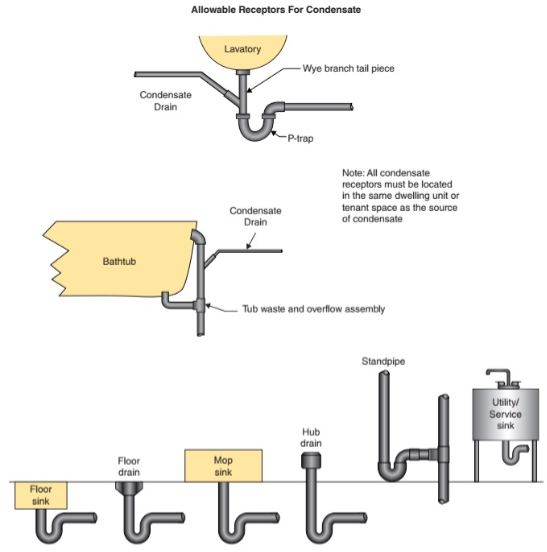
Replacement Work Increasingly Becomes Retrofit Work
Common retrofit impacts include:
Condensate Disposal Pathways
- Existing buildings often lack floor drains near appliances.
- Elevations may not support gravity drainage.
- Condensate pumps become necessary, raising questions about routing, discharge points, air‑gap/air-break backflow protection and long‑term reliability.
- Buildings with septic or onsite wastewater systems must account for biological sensitivity, repeated acidic discharges can depress tank or soil treatment area pH and inhibit microbial breakdown processes.
New Venting Systems and Materials
- Condensing equipment requires completely different vent materials than non-condensing equipment.
- Because Category IV appliances cannot remain on a common vent, common vent systems are eliminated, and any existing non‑condensing equipment will require its own new, code‑compliant venting system.
This is due to common vents being sized for use by both natural draft appliances and when one is taken from the common vent, it now becomes too large for the remaining appliance flue-gas volume and temperature leading to weak draft, backdraft and spillage of combustion products into the home and non-compliance with the International Fuel Gas Code® (IFGC).
Inspection Challenges: A Rapidly Evolving Skill Set
As condensing equipment becomes standard, inspectors will increasingly encounter:
- Improper or unlisted vent materials, especially where Category IV venting is required
- Minimum clearances for replacement appliances where new equipment meeting the updated thermal efficiency requirements may be larger and more difficult to install in the same locations, creating compliance issues
- Missing, undersized, or depleted neutralizers, noting that neutralizer sizing must match condensate production and media requires replacement
- Condensate pumps installations without proper routing, air‑gap or air-break backflow protection, or with missing/incorrect check valves
- Venting systems lacking the required positive slope back to the appliance for proper condensate drainage
- Discharges routed to municipal or onsite wastewater systems without neutralization, posing risks to biological treatment processes and potentially violating local pretreatment expectations
Inspection and Plan Review Implications for 95% AFUE Condensing Furnace Installations
As the market shifts toward condensing furnaces, replacement installations will increasingly resemble retrofit projects. Inspectors and plans examiners should expect venting, common vent abandonment and condensate disposal to be central compliance issues.
A) Non-Weatherized (Typical Dwelling) Gas Furnace — What to Verify
- Appliance category and venting basis: Confirm the furnace is a listed Category IV (condensing) appliance when 95% AFUE applies. Use the manufacturer’s instructions as the governing installation document.
- No mixing of venting systems: Natural draft/common vents are not compatible with positive-pressure portions of a venting system. Watch for legacy B-vent or masonry chimney connections on condensing units.
- Plastic venting material identification: Where plastic piping is used for venting, confirm the appliance is listed for use with the vent material and the installation instructions must identify the specific plastic material, or the vent material must be listed and labeled in accordance with UL 1738); local amendments may be stricter. Always check existing plastic vent material for replacements to ensure it is compatible with replacement appliances.
- Condensation drainage in venting systems: Confirm the vent is installed to manage condensate (slope, drainage provisions) per the appliance/vent listing, ensure neutralizer is installed prior to disposal into plumbing systems (consider neutralizer location for access and serviceability).
B) What This Often Means for Replacement Installations (Practical Retrofit Impacts)
- New vent routing and terminations:Installing a condensing Category IV furnace typically requires new sidewall or roof vent terminations and listed Category IV vent materials. In many cases, existing chimneys become orphaned and must be capped, relined for remaining appliances, or otherwise abandoned.
- Condensate pathway creation: Provide an approved disposal point. Where no gravity drain exists, a pump and a reliable discharge route become part of the scope.
C) Mobile Home Gas Furnace Replacements — Additional Considerations
- Regulatory context: Manufactured homes are commonly subject tothe U.S. Department of Housing and Urban Development (HUD) Manufactured Home Construction and Safety Standards (24 CFR Part 3280) for heating/fuel-burning systems, even when local codes govern site-installed work. Coordinate scope and authority with the Authority Having Jurisdiction and any state manufactured housing program.
- Listed components and roof jack systems: HUD requirements emphasize venting accomplished by an integral listed system or a system of listed components (including roof jack), installed per listing and manufacturer instructions; verify all joints are secure and aligned and venting does not terminate underneath the home. (24 CFR 3280.710).
- Appliance standards and compatibility: HUD references standards for appliances and components; confirm the replacement furnace is listed/marked for manufactured (mobile) home use where required and that the installation matches the home’s designed return/supply and combustion separation strategy. (24 CFR 3280.703; ANSI/CSA Z21.47 listing context).
- Condensing retrofit realities: If a 95% AFUE replacement drives a move to condensing technology, expect additional constraints: limited chase space for new vent routing, tighter clearances and fewer approved drain locations for condensate. Condensate management (neutralizers installation, trap, corrosion-resistant piping, pump where needed) is often the gating item.
To learn more about water-related issues and how codes and standards can help, view the ICC’s PMG Webpage
To stay updated on the latest PMG industry news, subscribe to ICC’s PMG newsletter here.
About the Author

Mark Fasel is a director, PMG technical resources for the International Code Council, where he serves as a subject matter expert to the plumbing, mechanical, fuel gas, swimming pool and spa codes.