From Temperature Control to Hydraulic Robustness: Rethinking Drinking Water Installations
The industry does not face a temperature problem, rather a hydraulic problem that manifests as a temperature issue.
For decades, the design of drinking water installations in buildings has been dominated by one central paradigm: temperature control. Cold water must remain below 25 °C, and hot water must be maintained above 60 °C to limit microbial risks such as Legionella. These principles are deeply embedded in standards and guidelines worldwide and have long served as the foundation for safe system design. However, this paradigm is increasingly insufficient.
In modern buildings, new challenges are emerging, including improved insulation, reduced water consumption, intermittent use, and extreme weather events. These factors fundamentally alter how water systems behave. As a result, installations that are fully compliant on paper can still fail in practice.
This raises an important question: Are we still addressing the right problem? In many installations, water quality is no longer governed by temperature limits, but by the absence of effective flow. The industry must shift its focus from temperature control to a new leading principle: hydraulic robustness.
The Hidden Driver: Stagnation
Stagnation is often treated as a secondary effect, something that occurs only in unused pipes or dead legs. In reality, it is a dominant mechanism governing water quality in modern installations.
When water remains insufficiently renewed, it gradually equilibrates with the ambient temperature. In many buildings, this ambient temperature exceeds 25 °C, making compliance structurally difficult. However, the impact of stagnation goes far beyond temperature.
Stagnation promotes:
- biofilm development,
- microbial amplification,
- interaction with pipe materials
- and loss of disinfectant residual (where applicable).
In other words, stagnation is not a symptom, but the root cause.
Dynamic Stagnation: Stagnation During Use
A critical and often overlooked phenomenon is dynamic stagnation.
Traditionally, stagnation is associated with no use. However, in many installations, stagnation occurs precisely during operation. Water is being used, yet parts of the system receive little to no effective flow.
This occurs when:
- flow concentrates in specific branches
- circulation is insufficient or poorly distributed
- hydraulic resistance varies across the system
- draw-off patterns override circulation flow
As a result, certain sections become hydraulically inactive, even though the system appears to be functioning. Water is moving but not being renewed. This challenges the assumption that water use guarantees water quality.
Figure 1 illustrates how large parts of drinking water installations may experience prolonged periods of low or no effective flow (< 0.2 m/s), even during normal operation. These conditions may occur sequentially across multiple sections, resulting in cumulative stagnation and insufficient system-wide renewal.
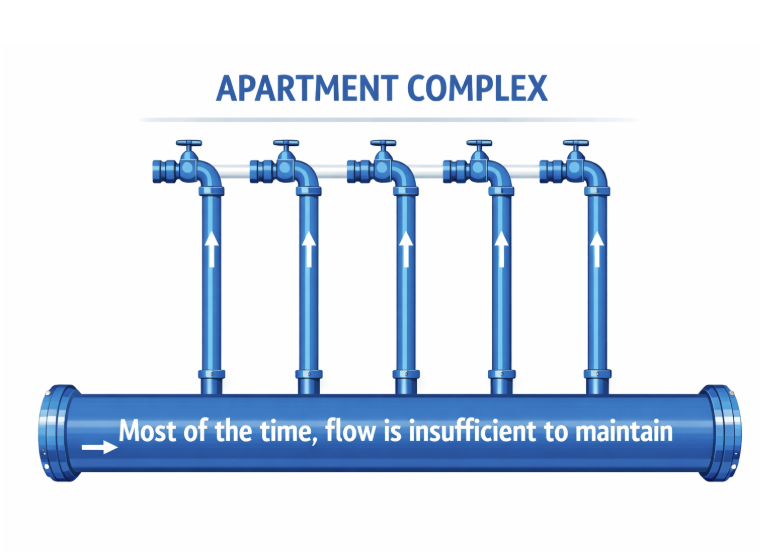
Under real operating conditions, flow is unevenly distributed. As a result, significant portions of the system may experience sustained low-flow conditions, leading to limited renewal and the formation of extended stagnation zones.
This illustrates a fundamental principle: flow does not inherently guarantee effective renewal.
A changing climate significantly reinforces these effects. Rising outdoor temperatures increase soil and distribution temperatures, directly affecting the temperature of incoming drinking water. Field observations show that supply temperatures exceeding 25 °C are becoming more frequent, particularly in urban environments.
Inside buildings, the situation is further aggravated by:
- high levels of thermal insulation
- lack of passive cooling
- warm technical shafts and ceiling voids
As a result, cold water systems are increasingly exposed to temperatures that favor microbial growth.
This is not a local issue; it is a global shift in boundary conditions.
Limitations of Current Design Approaches
Current design frameworks primarily focus on temperature thresholds, flushing regimes and material selection.
While these measures are important, they share a fundamental limitation: they assume relatively stable system behavior.
In reality, building water systems operate under highly dynamic conditions:
- peak demand versus partial load
- intermittent usage patterns
- fluctuating occupancy
Under partial load conditions, circulation systems often lose effectiveness. Flow distribution changes, and certain branches may receive little or no renewal.
This leads to localized stagnation within systems that are technically compliant.
From Temperature Control to Hydraulic Robustness
To address these challenges, a shift in design philosophy is necessary.
Hydraulic robustness means designing systems that maintain effective flow under all operating conditions—not just at design peak.
A hydraulically robust system:
- prevents low-flow or no-flow zones
- ensures continuous or sufficient water renewal
- remains functional under partial load conditions
- responds effectively to variable usage patterns
This requires moving beyond static design assumptions and embracing the dynamic nature of real-world operation.
Figure 2 demonstrates how insufficient hydraulic robustness results in unstable flow conditions in circulation loops, including low-flow zones and flow reversal, leading to reduced renewal and local cooling.
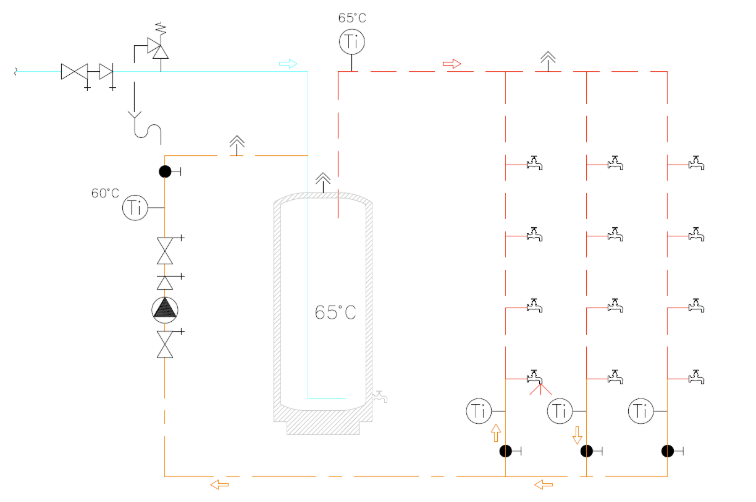
In systems lacking hydraulic robustness, flow distribution becomes unstable. Circulation loops may experience low or no effective flow, and local flow reversal can occur. As a result, parts of the system undergo insufficient renewal and are prone to cooling and increased stagnation risk.
These hydraulic effects are not limited to conventional hot water systems but equally apply to emerging concepts such as cooled potable water circulation systems.
Towards New Performance Indicators
Supporting this transition requires new ways of evaluating system performance. Traditional indicators such as temperature and flow velocity are insufficient on their own. Instead, performance should be assessed based on how water moves through the system over time.
Emerging concepts include:
- stagnation degree
- flow continuity factors
- hydraulic risk indicators
These indicators aim to quantify how effectively water is renewed, rather than simply measuring instantaneous conditions. They provide a more realistic representation of system behavior and risk.
Implications for Practice
For designers, engineers and policymakers, this shift has several important implications:
- Design for dynamic conditions: Systems must perform under partial load, not just at peak demand.
- Reduce system complexity: Excessive branching and small-diameter loops increase stagnation risk.
- Ensure hydraulic balance: Flow distribution must be actively controlled and verified.
- Integrate monitoring and control: Measuring both temperature and flow is essential to detect stagnation.
- Re-evaluate existing guidelines: Standards should be complemented with hydraulic performance criteria.
As long as design approaches focus primarily on temperature, they will continue to address symptoms rather than causes. By adopting hydraulic robustness as a core principle, the industry can move beyond compliance and towards truly resilient and performance-based drinking water systems.
To learn more about water-related issues and how codes and standards can help, view the ICC’s PMG Webpage
To stay updated on the latest PMG industry news, subscribe to ICC’s PMG newsletter here.
About the Author

Onno Leever is director of Leever Installatie Adviseurs B.V. in the Netherlands and specializes in drinking water installations in buildings. His work focuses on hydraulic behavior, stagnation mechanisms, and climate-related risks. He is actively involved in standards development and contributes to professional publications and education, with a particular focus on bridging the gap between design assumptions and real-world system performance.