NIST Receives New Patent for Microbe-Killing Water Heater
Researchers at the National Institute of Standards and Technology (NIST) have just been granted a patent for a water heater system that kills a class of harmful bacteria, reducing the risk of Legionnaires’ disease and other life-threatening infections, while reducing the associated risk of scalding.
Editor’s Note: This article was first published on NIST.gov on July 14, 2026. Click here for the original article.
It’s easy to take hot running water for granted. Simply twist a knob, and it comes pouring out. But hot plumbing comes with a risk — the potential growth of harmful bacteria. Researchers at the National Institute of Standards and Technology (NIST) have just been granted a patent for a water heater system that kills a class of harmful bacteria, reducing the risk of Legionnaires’ disease and other life-threatening infections, while reducing the associated risk of scalding.
Plumbing Has Changed
Residential plumbing has changed dramatically in the last few decades. Although there are more toilets, faucets, showers and appliances in the average modern home, those fixtures don’t use as much water as they used to. For example, many old showerheads sprayed more than five gallons of water per minute, while showerheads sold since the ’90s use less than half that amount. These changes reduce water bills, but the size of the pipes that supply those fixtures have not changed to match. More pipes and less flow means that water stays in a building’s pipes for longer. This warm water between your water heater and your shower (or any other outlet) creates ideal conditions for harmful bacteria such as Legionella pneumophila to grow.
Legionella Thrives in Warm Water
Legionella pneumophila lives naturally at low concentrations in many water sources such as rivers and soil. This bacterium thrives in warm water, so it can build up in plumbing systems. If water with a high concentration of Legionella pneumophila gets spread through the air in tiny droplets (aerosolized), it can enter your lungs and infect you with Legionnaires’ disease.
This illness — and the bacteria that cause it — was first discovered by the CDC in 1976 after a major outbreak at a convention for the American Legion, which is where the disease gets its name. It’s a severe type of pneumonia with a fatality rate of 10%. The elderly and immunocompromised are particularly vulnerable.
There are a little over 6,000 confirmed cases of Legionnaires’ disease in the U.S. per year. The real number could be 10 times higher or more because Legionnaires’ isn’t routinely tested for, but the disease is still relatively rare. “Code professionals and plumbing engineers work hard to prevent exposure that could result in outbreaks,” said Dave Yashar, the NIST mechanical engineer who invented the new water heater. “But it can be a complicated problem to keep in check, so we’ve come up with a way to do it more efficiently.”
The New Water Heater Design
Controlling water temperature throughout the entire plumbing system is the main way bacterial growth is kept at bay. Deciding what temperature a water heater should be set to is a delicate balancing act. If it’s too hot, the heater will use more energy and the water could burn residents. If it’s not hot enough, bacteria could become a problem.
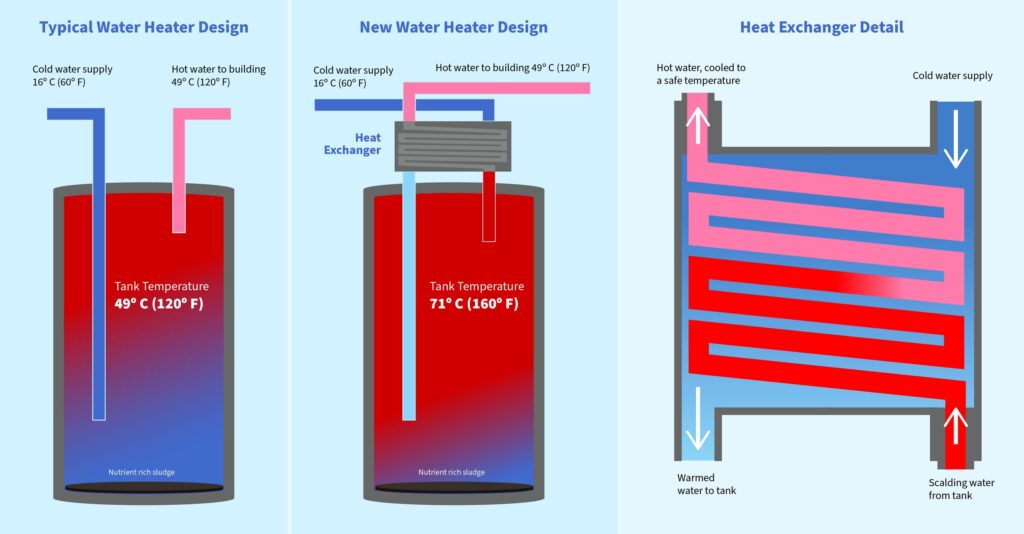
Legionella pneumophila thrives in temperatures between 20 and 45 degrees Celsius (68-113 degrees Fahrenheit). Typically, water heaters are set to 49 C (120 F) in residential settings and slightly warmer in high-occupancy facilities. These temperatures in the hot water tank will slow bacterial growth and may kill some Legionella pneumophila, but not completely. Once the water leaves the heater and enters the building’s piping network, water in the pipes cools to the ideal temperature for Legionella, allowing surviving bacteria to multiply.
David Yashar’s patent describes a kind of water heater that can safely raise water to a much higher temperature of 70 C (160 F), hot enough to kill nearly all Legionella almost instantly. Some hearty heat-resistant microbes can survive at those temperatures, but they aren’t a major health concern. Then immediately after the water leaves the tank, a heat exchanger cools the outgoing water to a safe temperature before sending it off to faucets, showers and other house fixtures.
A heat exchanger is a device that transfers heat between two fluids without having them come in direct contact with each other. Imagine a long, twisty straw full of hot water passing through a box of cold water. The hot water cools down as it flows through the straw, and the cold water in the box heats up. The heat exchanger makes it possible to cool the water to a safe temperature without introducing live Legionella from any other supply.
This system does not waste energy because extra heat is put back into the water heater. It’s also inherently safe from scalding because the pipes are arranged in a way that makes it impossible for hot water to leave without first being cooled to a safe temperature.
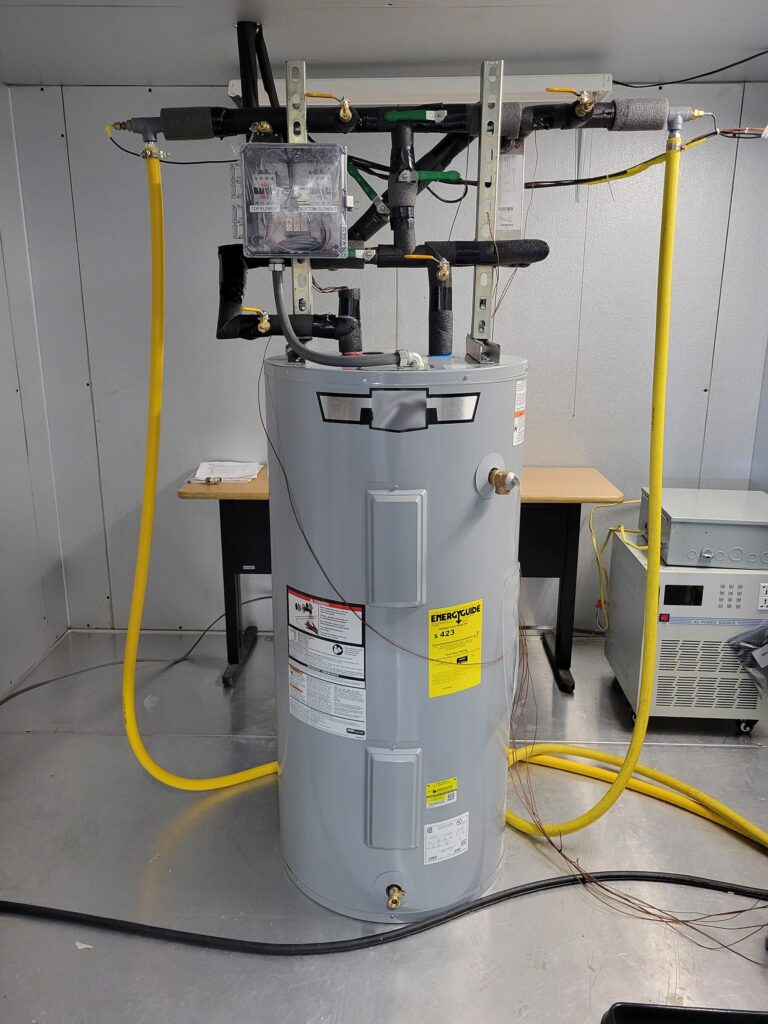
The design overall is relatively inexpensive. “We built our residential-size prototype by modifying an off-the-shelf water heater with around $100 of additional components,” said Yashar, “and those costs could be brought down by a manufacturer.” Although this new design would work with single-family water heaters, Yashar believes it will be most useful in larger facilities like nursing homes and hotels. Managers of those buildings generally need to take costly, active steps to make sure that they prevent bacteria like Legionella from building up in their plumbing systems, and this design could provide a cost-effective, passive alternative approach.
“Hot water is an essential part of everyday life,” said Yashar. “It’s exciting to bring a new innovation to an old technology.”
To learn more about water-related issues and how codes and standards can help, view the ICC’s PMG Webpage
To stay updated on the latest PMG industry news, subscribe to ICC’s PMG newsletter here.