Ask Me Anything: Your Questions About Careers in Building Safety and More, Answered
Henry L. Green, Hon. AIA, answers member-submitted questions about his career, the role of permit technicians, mentorship and more.
Henry L. Green, Hon. AIA, former president of the International Code Council (ICC) and National Institute of Building Sciences (NIBS), joined us on ICC’s online member community to answer member-submitted questions.
From insights on how he navigated his career, to mentorship and certification and exam preparation, here’s a recap of his answers.
Editor’s Note: Some of the questions and answers have been edited for length. View the original “Ask Me Anything” post in “Talkin’ Shop” in the online member community, here.
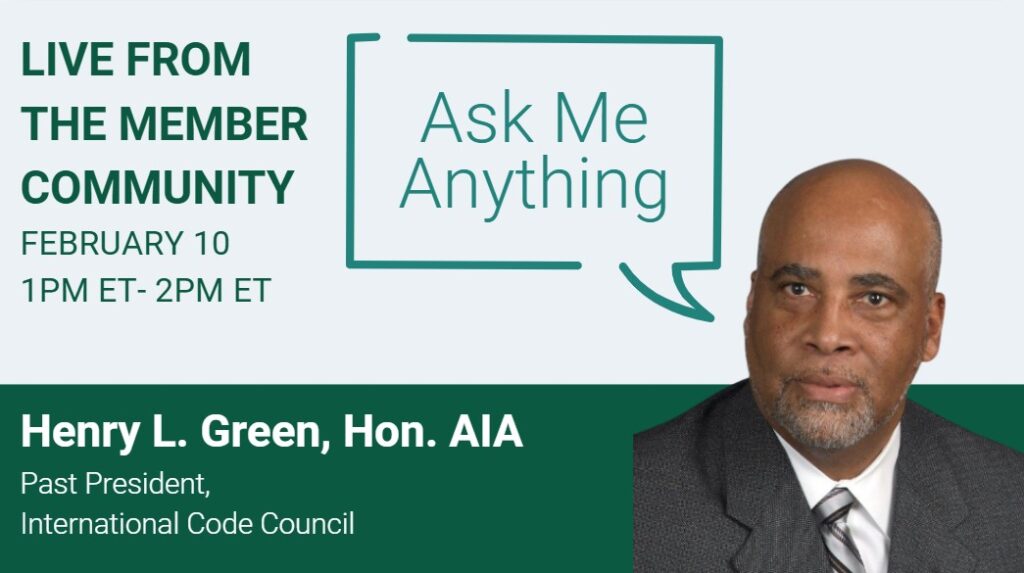
Q&A With Henry L. Green
What is your biggest takeaway from serving as President and CEO of NIBS?
Green: Our profession is one that has a broad and wide-ranging responsibility. We have the opportunity to develop and apply standards that make our world safer. Having a broader view of the built environment as President and CEO of the Institute afforded a look inside of some the most complex issues facing the built environment. This includes how we as design and construction professionals can equip our buildings and structures to meet the many challenges of nature and human-caused disasters.
I also had the opportunity to make presentations before Congressional Committees on the various issues facing the built environment. This unique opportunity gave me an inside perspective on how the Federal Government sees the U.S. and its responsibility to address the many issues facing our built environment.
In the role of leadership of these organizations I had the opportunity to see how the building industry can shape our society and provide for a healthier, safer life for all.
What was your favorite subject in high school?
Green: Residential Development and Radio. The Residential Development course was a three-hour block designed to give high school students a jump-start in design and construction as a career path. Mr. Taborski was our instructor who did more than instruct, he taught us about life as well. Some of my colleagues from that experience are still active in my life.
You may not know this, but I was hoping to become a radio personality. The Radio program provided the opportunity to develop a program that was aired during the morning hours of school and at lunchtime. It also gave the students access to one of the largest radio stations in the U.S., WJR Radio Detroit, where we were given time on the radio with the host to see how a real station operated. I have many fond memories of that time.
What role do you think permit technicians could play in advancing consistency and trust in the built environment at a national level?
Green: Permit Technicians have taken on a greater role in the construction process. Being a part of the construction team assists in gaining greater consistency in processing and application of the codes and standards that result in a safer and more sustainable built environment.
You can also help in the public’s understanding of the permitting process and what is needed to successfully navigate the construction permitting process.
Permit technicians could also take a greater step in the administrative section of the codes by offering ways to streamline the process and assist in avoiding delays in processing.
Your path from the Bureau of Construction Codes with the State of Michigan, through the ranks of leadership at ICC, and culminating as President of NIBS, serves as an incredible model for ICC members and stakeholders in our industry. What advice would you offer to someone considering a career in building safety?
Green: My career has been a curious path. It began as an architectural draftsman, then I became a building inspector, then managed state code programs and became the Director of the code program for the State of Michigan. Each assignment has given me various perspectives that led to my eventual role as President of ICC and CEO of the National Institute of Building Sciences.
At each station, I was afforded various opportunities that formed my growth and understanding of the construction industry and public safety in the built environment.
Having served in several sectors of the building industry has broadened my understanding and provided me with a holistic view of our profession and the industry. I would recommend that anyone pursuing a career in the building industry take a board view approach and not limit their imagination or goals.
Did you have a mentor and how did it benefit you?
Green: I was very fortunate to have more than one mentor. These gentlemen date back to my earliest days in the building industry – from my first experiences with a job superintendent who taught me how to evaluate real world issues on my first construction job, to the numerous code exchanges at hearings that led to a mutual outcome that benefited the design and construction industry.
There are so many that naming one would not do justice to all of those who have assisted me along my life’s path. Given this is a discussion around codes and standards, I cannot name just one person who I would call a mentor, I would need to name four in this sector of my life: David Collins, who was a guide early and throughout my days in this business we call our profession; Herman Bennett, a close friend who was my chief mechanical inspector; Ron Burton, who many of you may have known or have heard about, Ron was a true friend and offered guidance and suggestions that assisted in my professional growth; and finally, Jim Sealy, the “Big Time Dallas Architect” who gave insight and wisdom to numerous perplexing issues along my path.
Having the benefit of these gentlemen who were willing to share and provide insight has afforded me with a career that I can say I am proud of.
Do you have a favorite memory or achievement as ICC Board President?
Green: My fondest memory is the 2005 Annual Conference in Detroit, where I was sworn in as President of ICC. This began a year of sharing the ICC message, overseeing the growth of ICC, joining the various ICC chapters throughout the U.S. to have a greater understanding of their hopes and needs and engagement with our allied partners, culminating in the 2006 Annual Conference in Orlando, Florida at Disney World.
If you could travel anywhere in the world, where would you go?
Green: With extensive travel to the far east (Australia, Hong Kong and Japan), Caribbean and across the U.S., Canada and Switzerland, I would say my next adventure is Italy and France.
Do you have any tips for certification exam prep?
Green: Having assisted in exam development questions, I am going to defer responding to this question, except to say: study, study, study. Attend as many educational sessions as you can to gain a better insight into the code and management of code programs. Attendance at code hearings is another source to enhance your code understanding.
I want to start a club at my college, there is a lot of construction occurring on campus, and I want to take advantage of it. Do you have any suggestions?
Green: Perhaps you should approach a dean or professor at your college and suggest to them that having this kind of program would enhance the student’s learning experience with real world applications. While attending college I was fortunate to have a professor who supported my work at a design/build firm which afforded me some class credits.
Subscribe to the Building Safety Journal Weekly newsletter, here.
ICC members can join the FREE member community, here (use existing myICC username and password).
About the Author
The International Code Council is a nonprofit association that provides a wide range of building safety solutions, including product evaluation, accreditation, certification, codification and training. It develops model codes and standards used worldwide to construct safe, sustainable, affordable and resilient structures.