Evaluation of ASCE 7‑22 Equivalent Lateral Force Procedures: Method 2 Versus Method 1
Here we examine the differences between the two methods and compare the resulting seismic response coefficient values across a range of site classes, structural periods, and geographic regions.
ASCE 7‑22 introduced Method 1 for determining the seismic base shear in the Equivalent Lateral Force (ELF) procedure, based directly on multi‑period design response spectra, while retaining the traditional method of base shear calculation based on two‑period design response spectra as Method 2.
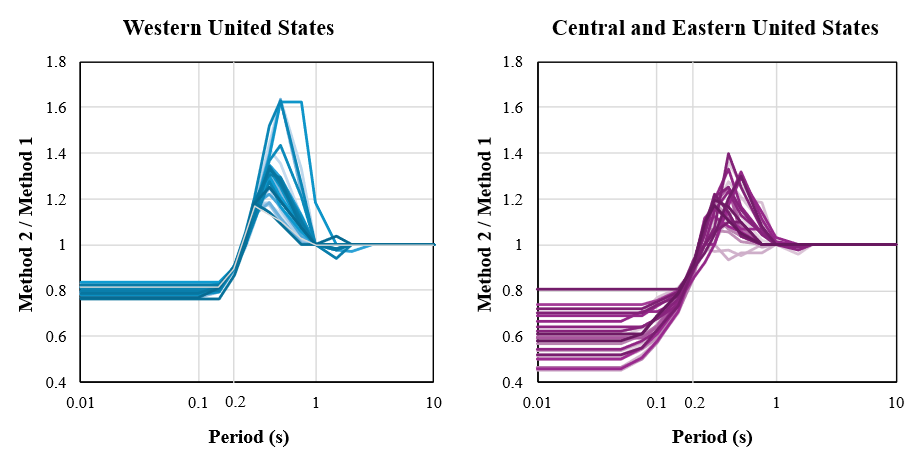
This paper evaluates the commonly held perception that Method 1 generally produces higher seismic base shear demands than Method 2 at short periods. Seismic response coefficients (design base shear divided by seismic weigh) were computed using both methods for 56 locations across the Western United States (WUS) and Central and Eastern United States (CEUS) for Site Classes A, B, C, D, and E. The results demonstrate that neither method is uniformly more conservative.
Method 1 produces higher base shear values at very short periods when spectral peaks occur below 0.2 s, a period range not representative of most building structures, whereas Method 2 often yields significantly higher base shear values at intermediate periods. At longer periods, differences diminish, and the two methods typically converge as minimum design base shear requirements of ASCE 7 govern. This study identifies the conditions under which one method may produce larger seismic response coefficients than the other and clarifies the influence of the shape of the multi‑period response spectrum on the calculated base shear.
The paper also discusses a proposed change for the 2027 International Building Code®, which is intended to mitigate the effects of short‑period spectral spikes present in the ASCE 7‑22 multi‑period design response spectra at periods below 0.2 s. This code change will effectively result in Method 1 and Method 2 producing identical base shear values up to the period at which the design spectral response acceleration reaches its maximum value and then decreases to SDS.
About the Author

Dr. S. K. Ghosh, Ph.D., is known internationally for his work in earthquake engineering. He has influenced seismic design provisions in the United States for many years by serving on or chairing numerous committees and advisory panels. He specializes in the analysis and design, including wind and earthquake resistant design, of reinforced and prestressed concrete structures. Dr. Ghosh is active on many national technical committees, is an honorary member of ACI, and is a fellow of ASCE, SEI, and PCI. He is a consulting member of ACI Committee 318, Standard Building Code, and an emeritus member of the ASCE 7 Standard Committee (Minimum Design Loads for Buildings and Other Structures). He is a former member of the Boards of Direction of the Building Seismic Safety Council, the American Concrete Institute, the Earthquake Engineering Research Institute and the Board of Governors of SEI. In addition to authoring many publications in the area of structural design, he has investigated and reported on structural performance in many significant earthquakes.

Bodhi Rudra is a licensed Professional Engineer in Michigan and the Manager of Engineering at S. K. Ghosh Associates (SKGA) LLC. He holds a BE and MS in Structural Engineering and has over eight years of experience in structural design, building code consultancy, software development, and finite element analysis. Bodhi has contributed to major international projects, including building code enforcement in Bangladesh, development of Oman’s building code, and updates to the Unified Facilities Criteria (UFC) for the U.S. military. He also assisted in developing structural provisions for the Republic of the Marshall Islands. Bodhi has authored publications in material science and structural engineering and frequently presents on seismic design, providing expert guidance on seismic requirements and detailing.