A117.1‑2026: The International Code Council to Release Major Updates to the Nation’s Leading Accessibility Standard
The International Code Council (ICC) is releasing a new edition of the A117.1 Standard for Accessible and Usable Buildings and Facilities in Fall 2026. The A117.1-2026 will be referenced in the 2027 International Codes® (I-Codes®).
This standard is designed to ensure that people with physical disabilities can independently approach, enter and use a site, facility, building or element.
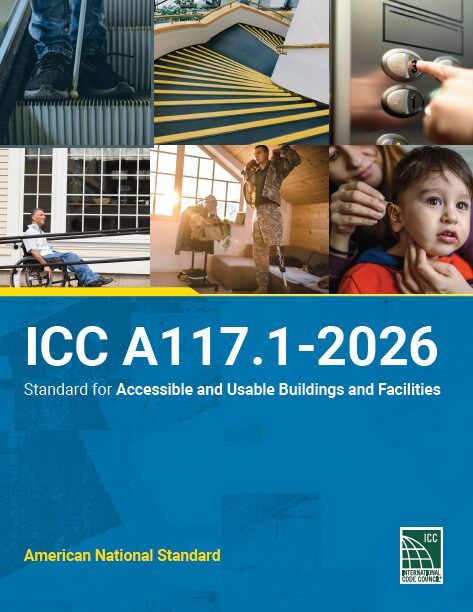
ICC A117.1-2026 Standard for Accessible and Usable Buildings and Facilities
A117.1-2026 is intended for adoption by government agencies and organizations that develop model codes, promoting uniformity in technical accessibility criteria across building codes and related regulations.
Its technical criteria address a wide range of disabilities, including:
- limited mobility
- reliance on walking aids
- blindness or visual impairment
- deafness or hearing impairment
- incoordination
- limitations in reach or manipulation
- reduced stamina
- sensory processing challenges
- and variations in body size
Through these requirements, the standard provides a consistent framework for creating environments that are accessible, usable and inclusive.
This edition continues the long-standing alignment of the standard with the 2010 ADA Standard and Fair Housing Design Guidelines while integrating provisions that reflect evolving technologies, community needs and modern building practices.
What’s New in A117.1-2026
There are definitions for all the building blocks included in Chapter 3 of the standard. This criteria is referred to throughout the standard and includes the clear floor space, turning spaces, knee and toes clearances, protruding objects, etc. With the defined terms being italicized, designers will have a clearer understanding of where the building blocks are implemented.
Access requirements for electrical controls and outlets over counters within common use kitchens as well as kitchens within Accessible, Type A and Type B units have been extensively revised. The intent is to allow for kitchen design to concentrate on access to appliances, sinks and work surfaces, rather than being determined by the reach over obstruction requirements for the outlets.
Elevator requirements have been coordinated and expanded to include new technologies.
Electric vehicle (EV) charging stations have been coordinated with guidance from the U.S. Access Board.
Contrast requirements for stripes on stairways and signage have been revised to include criteria for contrast based on a formula using light reflectance values.
Chapter 6, Plumbing, has added options for clarity, new technologies and improved access. Center controls for water closets are addressed. Bathing fixtures now include three options for accessible bathtubs, five options for accessible showers and improved criteria for controls and hand shower mounts.
The standard now includes provisions addressing assisted-toileting and bathing. These criteria are scoped for facilities where the elderly live and are cared for, such as assisted living, nursing homes and rehabilitation facilities.
The technical provisions for adult changing stations originally published as Supplement 1 to the 2017 ICC A117.1 are included in Chapter 6. The technical criteria have been updated to reference a new safety standard for assistive tables, IAPMO A1390.
Criteria for items not previously addressed such as rinsing showers, pet washing stations, self-service checkout counters, and waste chutes now have technical criteria for locations where they are provided.
Communities Without Limits
ICC’s Building Safety Month Week 4 theme is “Communities Without Limits” and showcases the importance of accessibility in building construction and design.
Communities without limits embrace built environments that are welcoming, intuitive and enjoyable by all. This begins with eliminating physical, sensory and cognitive barriers that prevent people from fully navigating homes, buildings and public spaces to their fullest extent.
The updated A117.1-2026 standard will help improve accessibility in the places we work, play and live.
Learn more about Week 4 of Building Safety Month here.
About the Author

Kimberly Paarlberg is a senior staff architect in Technical Services with the International Code Council. Her experience with the Code Council includes work in the code development department and training. Paarlberg serves as code development secretary for the IBC General and Means of Egress/Accessibility and the IRC Building. She is the Code Council representative for development of the referenced technical standard for accessibility, ICC A117.1 “Accessible and Usable Buildings and Facilities.” Paarlberg writes interpretations, commentaries and articles about a wide variety of accessibility issues.