Stationary Generators: The Carbon Monoxide Poisoning Hazard and Recommendations for Mitigation
This article highlights some of the important findings in a report, published in June 2025, by the U.S. Consumer Product Safety Commission (CPSC) that characterizes the carbon monoxide (CO) poisoning hazard posed by stationary generators.
This article highlights some of the important findings in a report, published in June 2025, by the U.S. Consumer Product Safety Commission (CPSC) that characterizes the carbon monoxide (CO) poisoning hazard posed by stationary generators.
The findings are based on a rash of residential CO exposures that occurred following widespread power outages in the greater New Orleans area caused by Hurricane Ida in summer of 2021.
Background on Stationary Generators
Stationary generators are products permanently installed outside the home or other structures to provide power in the event of a loss of utility power. Stationary generators for residential installations are alternatively referred to as residential, home, whole-home, house, backup, standby, home standby (HSB), emergency, fixed, or permanent generators. A stationary generator has an engine that converts the chemical energy of the fuel powering the engine into rotational energy, which, in turn, is converted into electrical power. The engines in residential stationary generators are fueled by either natural gas (NG) or liquid propane (LP), and like all combustion engines, their exhaust contains CO, a toxic gas.
CO is called the “invisible killer” because it is colorless and odorless. When CO is inhaled, it preferentially binds with hemoglobin in the bloodstream, effectively displacing oxygen from red blood cells, causing hypoxia. Mild CO poisoning may manifest as nonspecific flu-like symptoms; worsening symptoms are headache, lightheadedness, nausea, and fatigue; and more severe symptoms are vomiting, confusion, loss of consciousness, coma, and ultimately, death. People who have been exposed to CO may choose not to seek medical treatment and initially may even seem to recover without any ill effects; however, depending on the severity of their exposure, the exposure can cause delayed yet lasting and adverse health effects after apparent initial recovery.
Stationary generators typically are installed by licensed tradesmen. Retail outlets and dealers of stationary generators commonly offer to arrange their installation for the consumer, but having an installer under contract is not necessarily a precondition for the consumer to purchase the generator and to have it delivered to the consumer’s home. The authority having jurisdiction (AHJ) may require a permit before a generator can be installed and, as part of the permitting process, may require an approved inspection of the electrical and fuel connections after installation, before the consumer can use the generator. Any permitting and inspection processes for stationary generators that an AHJ may require will be specific to the applicable codes and standards adopted by that jurisdiction. Many states, cities, and local jurisdictions adopt National Fire Protection Association (NFPA) 70: The National Electrical Code (NEC), which covers the connection of the generator output to the electrical distribution system.
A voluntary industry consensus safety standard for stationary generators, UL 2200 Standard for Safety: Stationary Generator Assemblies, addresses a number of different hazards, but notably, it does not have any requirements that address the CO hazard. The Scope of UL 2200 covers generators intended for installation and use with, among other codes and standards, NFPA 37 Standard for the Installation and Use of Stationary Combustion Engines and Gas Turbines. Neither UL 2200 nor NFPA 37, nor any other standard or code, address the hazard of CO from stationary generators infiltrating into spaces that can be occupied.
Section 4.1.4 of NFPA 37, which pertains to engines located outdoors, requires engines and their enclosures to be at least five feet from any openings in the walls of structures and from any structures having combustible walls, to mitigate the risk of fire that these products pose to those structures. However, the standard includes exceptions that allow for generators to be installed less than five feet from a wall if (1) the wall has a fire rating of at least one hour, (2) a fire test demonstrates that a fire originating at the engine will not ignite combustible structures, or (3) calculations performed under engineering supervision demonstrate that a fire originating at the engine will not ignite combustible structures.
UL 2200 does not require installation instructions to state that the generator must be installed according to NFPA 37; however, manufacturers’ installation manuals typically reference the clearances between the generator enclosure and nearby structures in NFPA 37. Although the installation manual may list certain building codes and standards that must or should be followed or consulted, the installation ultimately must comply with codes and standards adopted by the local jurisdiction, as well as any applicable state or local laws.
Hurricane Ida: A Case Study
Hurricane Ida made landfall as a category-4 hurricane in August 2021 and caused widespread power outages to more than a million people. Fire departments were inundated with 9-1-1 calls from residents due to the CO from the exhaust of their stationary generator infiltrating into their home in dangerous concentrations and activating their home’s CO alarm. With cooperation from the Louisiana State Fire Marshal’s office, CPSC staff initiated an investigation and subsequently received information on 256 homes that reported at least one incident of CO exposure within the home. The home’s stationary generator was identified as the source of CO in 105 of these homes. A portable generator was the CO source in 65 homes, and for the remainder of the homes, the CO source was either a generator of unspecified type or a source was not identified in the fire departments’ documentation and a CPSC field investigator was unable to reach a resident to obtain more information. The most commonly identified stationary generator was fueled by natural gas and had a 22 kilowatt (kW) power rating. When the stationary generator manufacturer was identified, nearly all (54 out of 56) were made by the same manufacturer. CPSC’s Clearinghouse sent these manufacturers the documents of each incident involving their generator.
Fire departments started responding to 9-1-1 calls for the 105 homes with a stationary generator the day after the power outage began and continued to do so every day for 10 days, with two additional 9-1-1 calls four days after that 10-day period. The fire department reportedly was on-scene for approximately 30 minutes, on average. For many homes, the fire department made recommendations to the residents, which included moving the generator further from the home or to not turn on the generator and stay elsewhere until utility power is restored. For 85 homes it was documented that the home’s CO alarm activated. Twelve homes had residents with CO poisoning symptoms; one resident at one home was admitted to the hospital for one night and at another home a resident was treated and released. Residents at several homes had extended family members staying at their house during the power outage specifically because a stationary generator was providing power to the home.
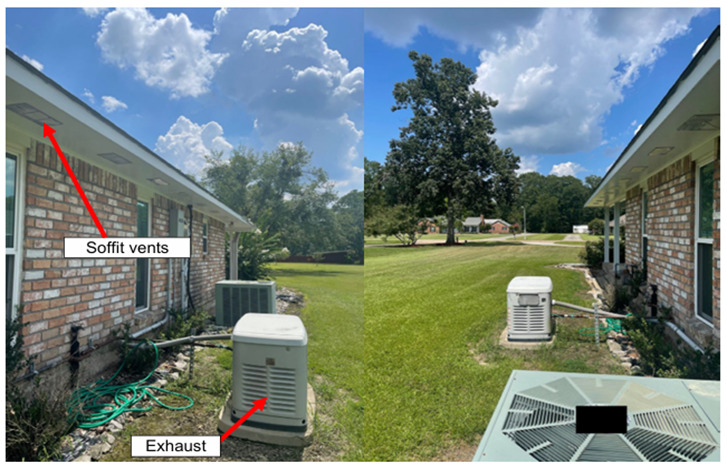
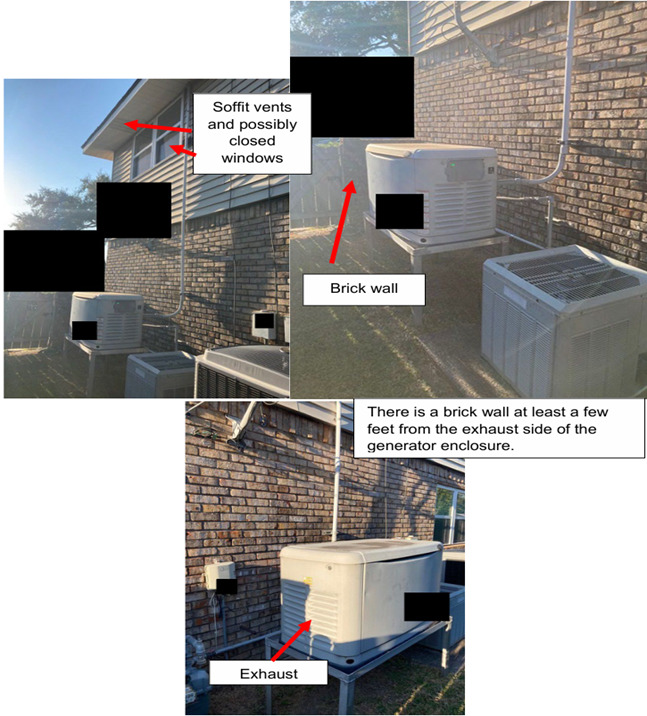
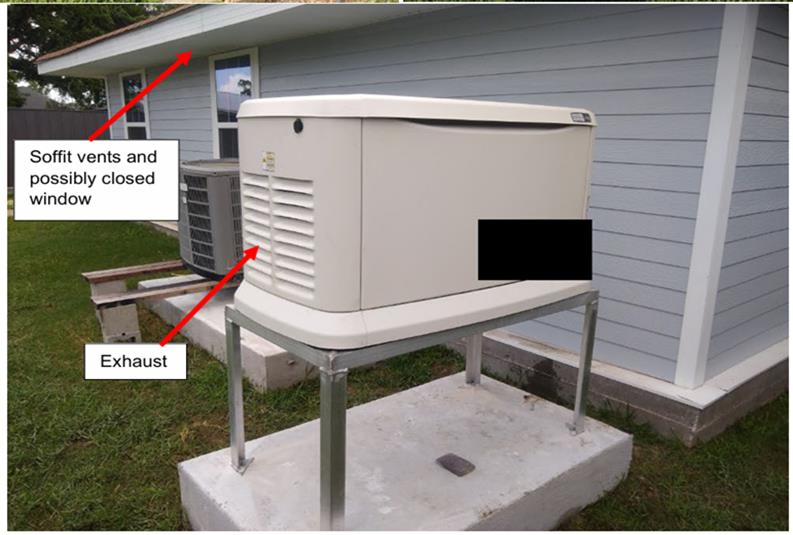
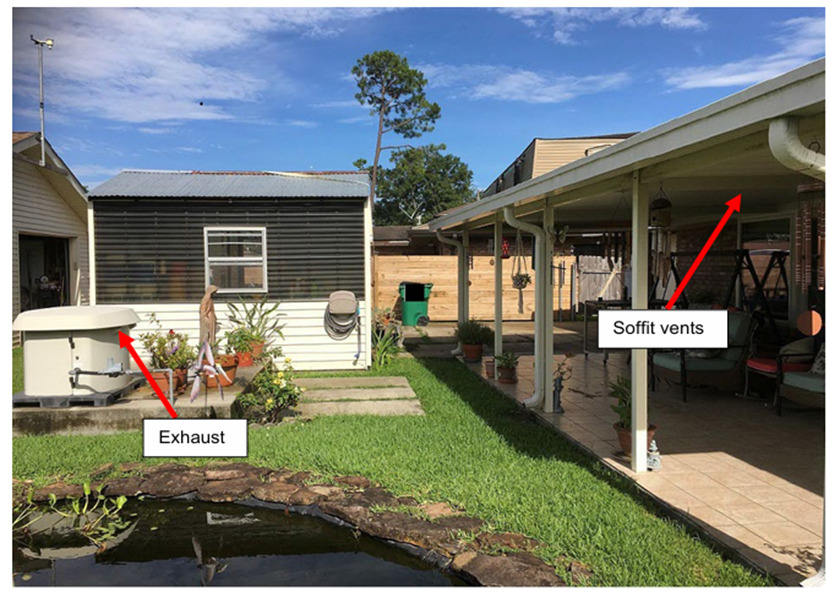
For homes in which it was documented how the stationary generator’s exhaust came into the house, most reported that it entered through soffit vents. Additional or other surmised pathways included an exhaust fan vent, a dryer vent, the space around a window air conditioning unit, underneath the house, and through a closed door or window. The clearance between the generator enclosure and openings into the home was provided for 49 of the homes. Forty-one had a clearance greater than five feet, with 13 of those having a clearance 10 feet or greater. For 29 homes, photos were provided of the incident generator’s installation. Figures 1 through 4 provide photos of 4 of them, each showing their installation relative to the house and the openings in which the CO entered the house.
Figure 1 shows the generator’s enclosure oriented such that the exhaust flows along the house wall, which is a common orientation. This installation shows that the exhaust spread laterally by at least 6 feet since that is approximately how far the enclosure is from the house wall. Figure 2 shows the same orientation of the enclosure relative to the house but a brick wall is located a few feet away from the exhaust side of the enclosure, which caused the exhaust to be deflected upward 15 to 20 feet to closed second-floor windows and the soffit vents above them. Figure 3 shows an enclosure orientation that has the exhaust pointed directly away from the home, with the exhaust side approximately 6 to 7 feet from the house. Figure 4 shows a generator with a different configuration than those of Figures 1 through 3; the exhaust flows from under the lid on the side facing the house. The exhaust had traveled 26 feet to the enter the soffit vents. In all these cases, the CO infiltrated indoors in high enough concentrations to result in the homes’ CO alarms activating.
In the aftermath of Hurricane Ida, several Louisiana state and local officials expressed eagerness to find a safe installation distance for stationary generators from both the victims’ homes and neighbors’ homes, so that a state law requiring such distances could be drafted. At that time, however, there was no research to support the effort. In 2022 the Louisiana State Legislature passed a state law requiring any house sold or leased after January 1, 2023, to have at least one CO alarm. Also, the Louisiana State Uniform Construction Code Council adopted an amendment to the 2021 International Residential Code® (IRC) to require the installation of CO alarms at the same time any whole-home, standby generator is installed. This change also went into effect on January 1, 2023.
Discussion
The incidents show the exhaust traveled more than 25 feet away from the enclosure, spread laterally by at least six feet, and rose vertically more than 10 feet, and even over 20 feet when there was an obstruction that deflected the exhaust stream upward, causing the CO to infiltrate indoors in high enough concentrations to result in the homes’ CO alarms activating. The incidents clearly demonstrate that the five ft. enclosure-to opening clearance is inadequate.
These incidents are not isolated. Hurricane Beryl made landfall near Matagorda, Texas, on July 8, 2024, as a category-1 hurricane that caused 2.8 million electricity customers in the Houston area to lose power, and even eight days later approximately 226,000 homes were still without power. Calls to 9-1-1 about CO incidents were reported to be spiking. CPSC Field staff acquired reports from many (though not all) fire departments for the CO-related 9-1-1 calls they responded to in only the first five days of the power outage. A stationary generator was the source of CO at 153 of these homes. A portable generator was the source in 162 homes, and for 169 homes, the CO source was either a generator of unspecified type or a source was not identified in the fire departments’ documentation. Solutions are urgently needed to address this CO infiltration hazard, particularly since stationary generator sales are predicted to continue to increase in future years,
Efforts made starting over a decade ago have been unsuccessful. CPSC staff and other stakeholders submitted proposals, referred to as public inputs (PI), to the NEC in 2014, and to NFPA 37 in 2015 and 2018, to address the hazard by way of increasing clearances and other installation requirements to minimize the risk of CO infiltrating into dwellings. All the PI’s were rejected as out of scope since NFPA does not address the CO hazard; however, both the NEC and NFPA added related informational notes. References to the public inputs, committee resolutions, and a presentation opposing the PIs made by a stationary generator manufacturer’s representative to the NFPA technical committee are provided in the CPSC report.
The CPSC report spurred staff efforts to have UL 2200 address the CO infiltration hazard. In the report, staff recommends two approaches. The first approach is the development of installation requirements that will establish minimum allowable clearances between the exhaust side of the generator enclosure and openings into structures that can be entered or occupied, to minimize the risk of exhaust infiltration, taking into account the orientation of the exhaust side of the generator enclosure relative to the structure’s openings, as well as any obstructions that might impact the flow of exhaust between the enclosure and the structure. The report also recommends requirements for on-product markings that identify the exhaust side of the generator enclosure and that indicate the required distance from that side of the enclosure to which the homeowner should not place obstructions. Furthermore, staff also recommends that stationary generator manufacturers provide consumers and installers with comprehensive information about the CO poisoning hazard, including the clearance requirements, in their product advertising, marketing, on-product packaging, and installation manuals. Providing consumers with this information would allow them to make an informed decision before purchasing the generator.
For the second approach, staff recommends that UL 2200 have a requirement that stationary generators have engines with substantially reduced CO emission rates. Different engine manufacturers have in the past certified natural gas and propane-fueled engines that appear to be suitable for stationary generator applications which have CO emission rates that are approximately 90 percent less than the engines currently used. If such reduced CO emission rate engines were used in stationary generators, the increased clearances established in the first approach likely could be substantially reduced, or possibly may not apply. Comprehensive information about the CO hazard should still be required in product literature as well as on-product markings. Regardless of which approach is chosen, it should never be assumed that CO from a stationary generator cannot infiltrate the home; therefore, all homes should have CO alarms. CPSC staff’s letter sent to UL in July 2025 with a link to the report and a request for the formation of a working group to develop these recommendations into requirements for UL 2200 has not resulted in any action.
CPSC staff also sent a similar letter in July 2025 to the technical committee for NFPA 37 recommending that the clearance between the stationary generator and openings into structures be increased from the current 5 feet to at least 25 feet, which is similar to the referenced PI’s submitted years ago. NFPA communicated to CPSC staff that the recommendation would have to be submitted as a PI during the next code revision cycle for the standard.
The IRC deals with CO in residential settings by way of CO alarm requirements provided in Section R311. Similarly, for commercial buildings, the International Building Code® and the International Fire Code® provide CO detection requirements in Section 915. There is no doubt that CO alarms save lives, but it is imperative to reduce the sources that create the risk of CO poisoning to begin with. This is the approach with the fire hazard: smoke alarms are well known to save lives but reducing the sources that create the risk of fire continues to be recognized as the primary means of addressing the fire hazard.
Addressing This Hazard
Given the current situation, other avenues must be pursued. Will state and local jurisdictions consider adopting clearance requirements that will minimize the risk of dangerous CO concentrations infiltrating indoors? Or, given that many communities do not have the spacing needed to accommodate the necessary clearances, will they encourage stationary generator manufacturers to use engines with significantly reduced CO emission rates in their products? Continuing with the status quo of relying on CO alarms seems unwise because such reliance still leaves consumers exposed to dangerous CO levels and having to find ways to contend with the CO hazard presented by their stationary generator until utility power is restored.
Furthermore, these incidents put an undue burden on the community resources, such as fire departments and emergency medical services, especially since they occur in high frequency and during times of disaster, when first responders must be available to respond to a myriad of emergencies.
The CPSC report that this article is based upon is available here. A file containing all the raw data from the Hurricane Ida CO incidents discussed in the CPSC report can be downloaded here.
About the Author

Janet Buyer is a mechanical engineer who recently retired from the U.S. Consumer Product Safety Commission, an independent federal regulatory agency which has jurisdiction over thousands of types of consumer products, including those used in and around the home, in schools, outdoors and in the workplace. She worked for CPSC, in the Directorate for Engineering Sciences, Division of Mechanical and Combustion Engineering, and most of her work focused on products associated with the hazard of carbon monoxide poisoning.