Skip to Main Content
Building Safety Journal Logo

Building Safety Journal - International Code Council

Main Menu

Menu

      • April, 2026 Articles
      • March, 2026 Articles
      • February, 2026 Articles
      • January, 2026 Articles
      • December, 2025 Articles
      • November, 2025 Articles
      • 2026 Articles
      • 2025 Articles
      • Deep Dives
      • Member News
      • Personal Perspectives
      • Quick Hits
      • Technical Topics
      • Press Releases
      • Sponsored Content
      • View All
      • Buildings, Construction, Architecture/Design
      • Fire, Wildland-Urban Interface
      • Plumbing, Mechanical, Fuel Gas, Pools/Spas
      • Energy, Solar, Green, Sustainability
      • Disaster Preparedness, Mitigation, Resiliency
  • Subscribe
    • ICC Family of Solutions
    • ICCSafe
    • myICC
    • Digital Codes
    • cdpACCESS
    • Store
    • Support

Join today!

Keep up-to-date on crucial industry news, innovative training and expert technical advice with a free subscription to the award-winning Building Safety Journal.

Subscribe

Sign In or Register Here

Provide your email address
Provide your password
Answer the math challenge
Please enter your e-mail address below. We will email you a link to reset your password.
Provide your email address
Answer the math challenge
To complete your registration, please verify your email address.
Answer the math challenge

We have emailed the address you provided. Please click the link in the email to confirm your email address.

Your account has been marked for password reset. Please change your password.
Provide your new password
Verify your new password
Answer the math challenge 2 plus nine

Only registered ICC members have access to this article at this time.

Explore all the benefits that ICC Membership has to offer and become a member today to gain access to this exciting content.

If you're already an ICC member Sign In Now.

Can We Help?

  • Reset My Password
  • I Need More Help

Code Corner: 2024 IPSDC Chapter 8: Tanks

The Code Corner explores sections of the International Codes® each month, focusing on key elements of these essential codes. This month, we’re spotlighting the scope of Chapter 8 of the 2024 International Private Sewage Disposal Code®.

May 27th, 2026
by Gary Gauthier
  • Technical Topics

The International Codes® (I-Codes®), developed by the International Code Council (ICC), are a family of fifteen coordinated, modern building safety codes that help ensure the design and construction of safe, sustainable and affordable structures.    

The I-Codes are the most widely adopted set of model codes globally, implemented in all 50 U.S. states and many countries around the world.     

The Building Safety Journal’s series, Code Corner, explores sections of the I-Codes each month, focusing on key elements of these essential codes. This month, we’re spotlighting the scope of Chapter 8 of the 2024 International Private Sewage Disposal Code® (IPSDC®): Tanks. 

Tanks are an integral part of any private sewage disposal system whether they serve as treatment (septic) tanks, pump tanks or holding tanks for leveling the peaks in flow to the system.  

Where tanks are used for treatment, the dimensions, volume and location of internal features are very important to ensure that the solid wastes are kept within the tank so as to not clog the effluent distribution system. Where tanks are used for holding purposes, they must be sized large enough to accommodate the total of peak flows coming from a building and adequate retention between servicing. Chapter 8 provides the necessary requirements for tanks. 

802.2 Design of septic tanks 

Septic tanks shall not have less than two compartments. The inlet compartment shall not be less than two-thirds of the total capacity of the tank, not less than a 500-gallon (1893 L) liquid capacity and not less than 3 feet (914 mm) wide and 5 feet (1524 mm) long. The secondary compartment of a septic tank shall have not less than a capacity of 250 gallons (946 L) and not more than one-third of the total capacity. The secondary compartment of septic tanks having a capacity of more than 1,500 gallons (5678 L) shall be not less than 5 feet (1524 mm) long. The liquid depth shall be not less than 30 inches (762 mm) and a maximum average of 6 feet (1829 mm). The total depth shall be not less than 8 inches (203 mm) greater than the liquid depth. Rectangular tanks shall be constructed with the longest dimensions parallel to the direction of the flow. Cylindrical tanks shall be not less than 48 inches (1219 mm) in diameter. 

Effluent treatment tanks must have two compartments with a baffle to provide for settling or retention of solids in the first compartment. The first compartment must have a volume capacity of at least two-thirds of the total capacity of the tank with a minimum 500-gallon capacity and not less than 3 feet wide by 5 feet long. The second compartment must be not more than one-third of the total capacity of the tank with a minimum of 250-gallon capacity. If the second compartment of the tank is more than 1,500 gallons, then the compartment must be at least 5 feet in length. The liquid depth of the tank (depth from the bottom of the inlet pipe to the bottom of the tank) must be a minimum of 30 inches and a maximum average of 6 feet. The total depth of the tanks must be at least 8 inches greater than the liquid depth. For rectangular tank design, tanks must be constructed with the longest dimension parallel to the direction of flow. Cylindrical tanks must be at least 48 inches in diameter (see Commentary Figure 802.2). 
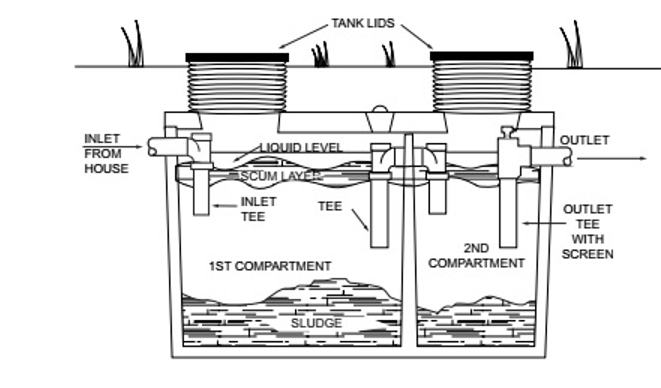
Commentary Figure 802.2—Septic Tank Design

To stay updated on the latest PMG industry news, subscribe to ICC’s PMG newsletter here.   

About the Author

Gary Gauthier
Gary has over 40 years of experience working within the Construction and Plumbing Industry. He is a seasoned Construction Project Manager as well as a Licensed Master Plumber in Massachusetts, New Hampshire, Maine and Vermont. In addition, Gary holds an Unrestricted Construction Supervisor’s License (CSL) within the state of Massachusetts and completely understands the significance of code correlation. Lastly, while working with the International Code Council, he is currently an Adult Educational Master Plumbing & Fuel Gas Instructor and Continuing Education Instructor in the Commonwealth of Massachusetts. Member of the International Code Council PMG Team responsible for developing, coordinating, directing and implementing programs to ensure the successful completion of the Government Relations goals and objectives as they apply to the International Plumbing Code, International Mechanical Code, International Fuel Gas Code, International Swimming Pool and Spa Code, and the International Private Sewage Disposal Code (and related services and programs of the International Code Council).
Submissions
Check out upcoming BSJ topics and send us articles for consideration:
Or send by email

Want to advertise in the BSJ?
Click Here

Share on Facebook
Facebook
Tweet about this on Twitter
Twitter
Share on LinkedIn
Linkedin

  • 26 25960 BSM BSJ Website 270x270 WAD FINAL
  • 26 25989 MTS Nash BSJ 270x270 WAD FINAL
  • Digital ICC Ad 270x270 1
  • 25 25503 CORP Code Enforcement Program BSJ Ad 270x270 WAD FINAL
  • 25 25461 MEM Community BSJ 270x270 WAD FINAL Week1
  • sponsors 270
International Code Council

Subscribe to the Building Safety Journal

Subscribe

Connect with Us

  • LinkedIn
  • Facebook
  • X
  • YouTube
  • Instagram

oneICC

  • International Code Council
  • ICC Evaluation Service
  • International Accreditation Service
  • General Code
  • S. K. Gosh Associates
  • ICC NTA
  • Alliance for National & Community Resilience
  • ICC Community Development
  • American Legal Publishing
  • Privacy Policy
  • Terms of Use
  • Contact Us
  • Accessibility Policy
PyG84rlEKC2xbibB_4NUPCErI-z0P86LOOUX1fhsyU4=.html