How Toilet Paper and Other Flushed Objects Impact the Performance of Toilet Drainlines
Our consumer society has progressively invented new products, many of which end up being flushed down the toilet – greatly impacting the performance of toilet drainlines.
In theory, a toilet bowl should only receive urine, feces and toilet paper. In reality, our consumer society has progressively invented new products, many of which end up being flushed down the toilet – greatly impacting the performance of toilet drainlines.
Fatbergs, Wipes, Toys and More
A study conducted in Finland revealed that various items, including soccer balls, mobile phones, children’s toys, mattress parts, glasses, artificial dentures, clothes and medicine, reached wastewater treatment plants through building drainage systems. Other authors add additional objects to this list, such as cotton swabs, face masks, paper towels, cleaning cloths, baby wipes, diaper liners, dog waste bags and cleaning wipes, in significant quantities.
In recent years, the disposal of products such as fat, oil and grease (FOG) through building drainage systems has increased, resulting in significant blockages in public networks. The situation is worsening to the point that a specific term has been created for these blockages: “fatbergs”(a term even included in the Oxford English Dictionary in 2015). In January 2019, a fatberg approximately 60 meters in size, blocking the sewer, was discovered in the town of Sidmouth, U.K. It was a lump of fat aggregated with wet wipes, sanitary towels and other household products that should have been disposed of in the regular trash, not down the toilet. In 2017, a fatberg was discovered in East London and was estimated to weigh 130 tons and stretch 250 meters.
The studies of Joksimovic et al. demonstrate that heavier products, such as those within the product categories of baby wipes, cleaning cloths, cleaning wipes, cleansing cloths, cleansing wipes, diaper liners and paper towels, often require multiple flushes to clear the drainlines. Test results with cleaning cloths indicate the need for about four flushes, on average. Products with slightly lower mass, such as those in the categories of toilet paper, dog waste bags and tissues, often unclogged in the plumbing system in one or two flushes.
Potential Solutions
Given this situation and the tendency for it to worsen, one conclusion seems obvious: increasing the volume of flushes can be advantageous, if not necessary. This conclusion, however, clashes with another current trend: the need to conserve freshwater in many regions of the planet, driven by sustainability concerns, which has led, for example, to a continuous reduction in the volume of flushing cisterns in recent decades (Pimentel-Rodrigues et al.). Taking the situation in Europe as a reference, there is a trend towards stabilization at volumes close to 6 L (with the adoption of dual flush 3/6 L), but there are also models on the market with a full flush of only 4 L or less.
How to reconcile these two opposing trends? The solution may involve the future adoption of higher-volume flushing cisterns, provided that only rainwater or reused water is used in these flushes, and not potable water.
Impacts of Toilet Paper on the Performance of Toilet Drain Lines
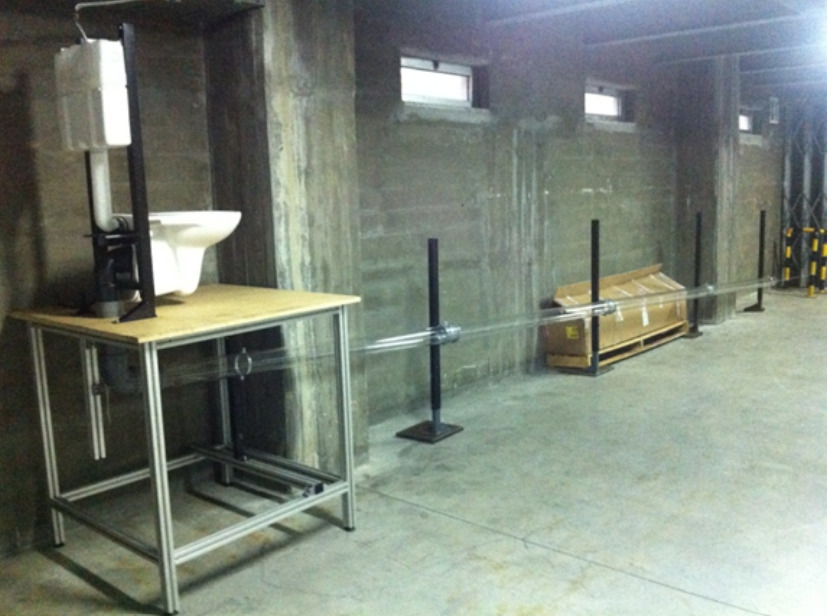
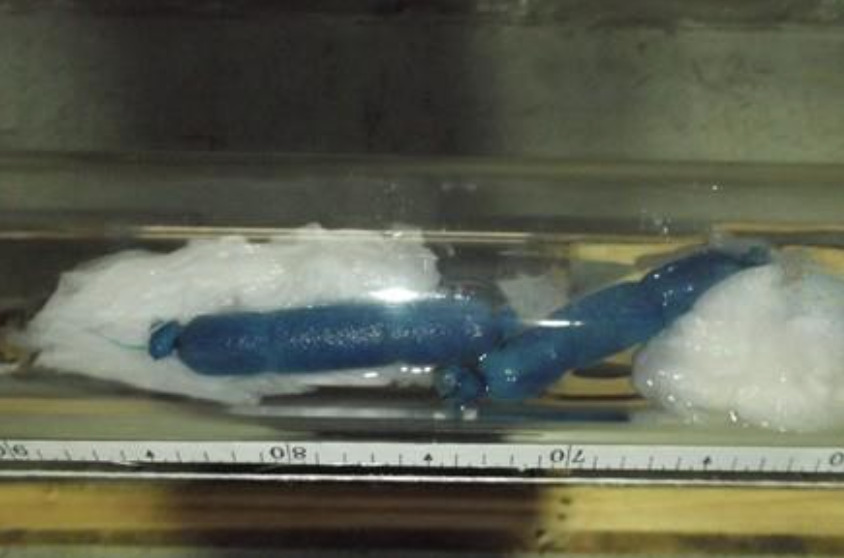
Even toilet paper can influence the performance of the toilet drain line. The results presented below are extracted from tests carried out in Portugal by ANQIP, with flushing cisterns of various volumes, 10-meter branches of 90 mm and 110 mm (PVC), with varying slopes between 1% and 4%, test solid specimens of 100 g and 160 g, and double-ply and triple-ply toilet paper (grammage of 7.13 g and 13.81 g, respectively).
In these tests, solid specimens were used in accordance with European standards, and the objective was to analyze whether the discharge was sufficient, in each possible configuration, to carry the solids along the entire drainline (10 meters). To summarize the results, only the conclusions obtained for 90 mm drainlines, slopes of 1% and 2% and 4 and 6 L flushing cisterns are presented in the following table (Table 1).
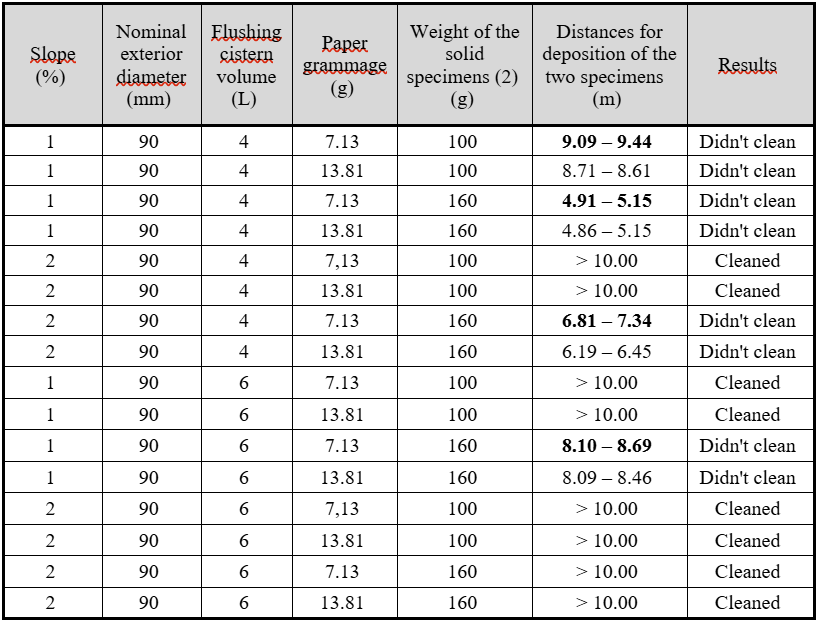
As can be observed, although the differences are not very significant, in situations where the dragging of solids does not allow for cleaning the entire drainline, the use of double-ply toilet paper always allows for greater dragging distances in the drainline, compared to triple-ply toilet paper.
Although this may not sound like the result of scientific research, the final recommendation, supported by testing, is that double-ply toilet paper appears to be a preferable option.
To access any of ICC’s PMG-related resources, click here. To subscribe to the PMG newsletter, click here.
References:
- Katko, T., Hukka, J., Juuti, P., Juuti, R., Nealer, E. (Eds.) (2025). Dispelling Myths about Water Services. IWA Publishing, London. ISBN: 9781789064162 (eBook).
- Joksimovic D., Khan A., Orr B. (2020). Inappropriate disposal of ‘flushable’ consumer products – reasons for concern. Water Science & Technology, 81(1), 102–108, https://doi.org/10.2166/wst.2020.087.
- Schaverien A. (2019). Scientists Solve a Puzzle: What’s Really in a Fatberg. The New York Times, October 4, 2019. https://www.nytimes.com/2019/10/04/world/europe/sidmouth-fatberg.html (accessed 29 October 2025).
- Taylor M. (2017). Total monster’: fatberg blocks London sewage system. Guardian, 12 September 2017. https://www.theguardian.com/environment/2017/sep/12/total-monster-concrete-fatberg-blocks-london-sewage-system (accessed 30 October 2025).
- Pimentel-Rodrigues, C., Silva-Afonso, A., Gago, H., Teles, J. (2025). Water efficiency in buildings: A review of the role of the flush cistern over time. In Proceedings CIB W062 2025 – Water Supply and Drainage for Buildings, Miami, USA, 24-27th August 2025.
- Silva-Afonso, A., Bernardo, J., Pimentel-Rodrigues, C. (2013). Implications of reduced flow volumes in building drainage: An experimental study, In Proceedings CIB W062 2013 – Water Supply and Drainage for Buildings, Nagano, Japan, 17-20th September 2013.