Preparing the Built Environment for Hydrogen Systems Growth
For industry associations, building and fire officials and the skilled trades, hydrogen systems growth represents both opportunity and responsibility. Technology is maturing quickly, and the workforce, regulatory community and safety ecosystem must keep pace.
Hydrogen systems are entering a period of rapid expansion, driven by falling production costs, new feedstocks and a widening set of applications across the U.S. and internationally.
For industry associations, building and fire officials and the skilled trades, this moment represents both opportunity and responsibility. Technology is maturing quickly, and the workforce, regulatory community and safety ecosystem must keep pace.

Expanding Production Pathways and Improving Affordability
Hydrogen’s affordability has improved significantly in the past five years as electrolyzer prices have declined (which is an electrochemical device that splits water into hydrogen and oxygen through a process called electrolysis), renewable electricity has become cheaper and new federal and state incentives have accelerated deployment.
The large-scale manufacturing of electrolyzers in the U.S., Europe and Asia is reducing capital costs, while innovations in high‑temperature electrolysis and modular systems are lowering operating costs.
At the same time, new sources of hydrogen are emerging beyond traditional steam methane reforming. These include:
- Green hydrogen from solar, wind, hydro and geothermal power, which is increasingly competitive in regions with abundant renewable resources.
- Pink and red hydrogen produced using nuclear energy, which offers high-capacity factors and grid‑stabilizing benefits.
- Waste‑to‑hydrogen and biomass‑derived hydrogen, which are gaining traction as circular‑economy solutions for municipalities and industrial operators.
- Methane pyrolysis, producing “turquoise hydrogen” with solid carbon byproducts that can be used in construction materials or advanced manufacturing.
These pathways are expanding the supply landscape and helping drive down delivered hydrogen prices, making adoption more feasible for commercial buildings, industrial facilities and transportation fleets.
New and Growing Applications in the U.S. and Abroad
Hydrogen’s versatility is fueling a wave of new applications across sectors:
- Building energy systems: Pilot projects in the U.S., U.K., Japan and Australia are testing hydrogen-ready boilers, blended hydrogen distribution and microgrids that integrate hydrogen storage for resilience.
- Industrial decarbonization: Steelmaking, cement production, glass manufacturing and chemical processing are adopting hydrogen as a high‑temperature, low‑carbon heat source.
- Transportation: Fuel cell electric vehicles (FCEVs) are expanding beyond passenger cars into heavy‑duty trucking, port drayage, rail and aviation ground support equipment.
- Backup and emergency power: Hospitals, data centers and critical infrastructure operators are turning to hydrogen fuel cells as cleaner, quieter alternatives to diesel generators.
- Maritime and aviation: International demonstration projects are exploring hydrogen‑powered vessels, synthetic aviation fuels and liquid hydrogen storage technologies.
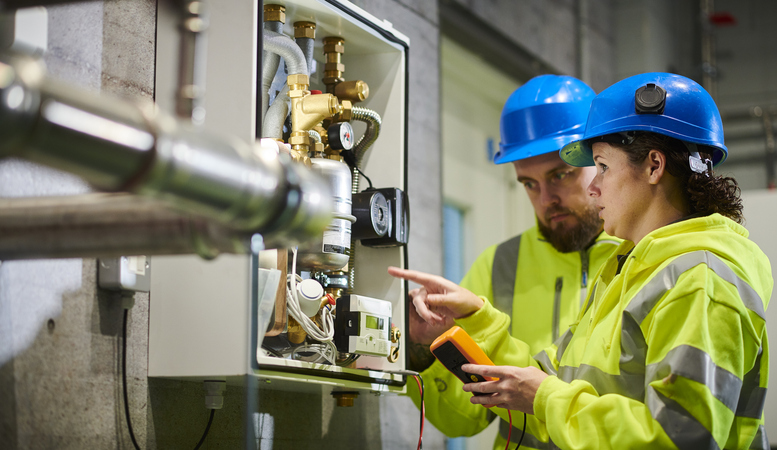
For building and fire officials, these applications introduce new considerations around siting, ventilation, leak detection, emergency response and workforce training. For the skilled trades, they create demand for technicians who understand hydrogen production, storage, piping, electrical integration and safety systems.
Workforce Readiness and the Role of Professional Qualifications
As hydrogen systems proliferate, the need for consistent, competency‑based qualifications becomes increasingly urgent.
The International Code Council (ICC), in collaboration with members of the American Institute of Chemical Engineers (AIChE) Hydrogen Safety Panel and the United Association of Journeymen and Apprentices of the Plumbing and Pipefitting Industry of the United States and Canada (UA) are developing ICC Guideline 8: Professional Qualifications for Hydrogen Systems in the Built Environment. A draft of this guideline will soon be released for public review and comment, offering stakeholders across industry, government and the trades an opportunity to shape the foundational expectations for hydrogen‑related roles.
ICC Guideline 8 will establish the foundational knowledge, skills and abilities needed for professionals who design, install, operate, review, inspect and maintain hydrogen systems in the built environment, providing guidance on system components, relevant codes and standards, safety and hazard mitigation practices and the competencies required to support safe and effective hydrogen deployment.
Importantly, this guideline will serve as the seed document for the forthcoming ANSI/ICC/CHS 1700 series standard, Professional Qualifications for Hydrogen Systems in the Built Environment. The 1700 series will establish a formal, consensus‑based framework that supports safe deployment, consistent training and clear expectations across jurisdictions and industries.
Why This Matters for Associations, Officials and Trades
Hydrogen’s growth is not theoretical; it is already reshaping the built environment. As affordability improves and new applications emerge, the professionals responsible for safety, installation and oversight must have access to clear, authoritative guidance.
Industry associations will play a central role in disseminating best practices and preparing their members for new market opportunities. Building and fire officials will be on the front lines of permitting and emergency response as hydrogen systems become more common in commercial and industrial settings. Skilled trades will be essential to installing and maintaining these systems safely and reliably.
The development of ICC Guideline 8 and the ANSI/ICC/CHS 1700 series represents a major step toward a unified national and international approach to hydrogen workforce qualifications that supports innovation while maintaining the highest standards of safety.
To stay updated on the latest PMG industry news, subscribe to ICC’s PMG newsletter here.
About the Author

Mark Fasel is a director, PMG technical resources for the International Code Council, where he serves as a subject matter expert to the plumbing, mechanical, fuel gas, swimming pool and spa codes.