Water Heater Sizing and Location: Code vs. Practicality
This article explores the intersection of code requirements and practical realities, offering insights for inspectors, installers and designers alike.
Water heaters are indispensable to any building plumbing system, yet their sizing and placement are often misunderstood or undervalued. While the International Plumbing Code® (IPC®) offers clear guidance on installation and performance expectations, real-world conditions frequently challenge strict compliance.
This article explores the intersection of code requirements and practical realities, offering insights for inspectors, installers and designers alike.
Water Heater Sizing: Balancing Draw and Recovery
The IPC does not mandate a specific method for sizing water heaters. Instead, it places the responsibility on the plumbing system designer to select equipment that meets the building’s operational demands.
For storage‑type water heaters, performance during peak demand is defined by two interrelated characteristics: draw capacity and recovery rate.
- Draw capacity is the initial volume of useful hot water available before outlet temperature declines due to incoming cold‑water mixing. Because cold water enters at the bottom and gradually blends with the stored hot water, a tank cannot deliver its full nominal volume at the thermostat setpoint. For example, a 50‑gallon storage heater typically delivers about 40 gallons of hot water before outlet temperature drops below a usable value.
- Recovery rate is the volume of cold water the heat source can reheat to the thermostat “cut‑out” temperature within one hour, determined by the heater’s input rating (e.g., wattage or BTU/hr) and the required temperature rise.
These two metrics combine to form the First‑Hour Rating (FHR), a Department of Energy (DOE) performance measure representing the approximate amount of hot water a storage water heater can supply during the first hour of peak demand. Historically, FHR was estimated using the relationship:
FHR ≈ (0.85 × tank capacity) + recovery
For example, for an electric storage heater with a 40‑gallon tank and a 4,500‑watt element, approximately 34 gallons are available as draw (40 × 0.85), and the heater can recover roughly 20 gallons in one hour, yielding a First‑Hour Rating of approximately 54 gallons.
Although traditional rules of thumb, such as using a 40‑ or 50‑gallon unit for typical three‑bedroom residences, remain common practice, the modern EnergyGuide label provides standardized DOE‑tested FHR values that enable designers and consumers to size water heaters more accurately and compare models consistently. Current DOE test procedures (revised in 2015) also align FHR reporting with the Uniform Energy Factor (UEF) framework, meaning older, pre‑2015 FHR values are not directly comparable to those appearing on today’s EnergyGuide labels.
Proper sizing ensures:
- Reliable hot water during peak use
- Energy efficiency by avoiding oversizing
- Fewer callbacks and greater user satisfaction
Designers should consult manufacturer specifications, DOE ratings, and building usage patterns to select appropriately sized units.
Location Requirements: Accessibility and Safety
IPC Section 501.4 mandates that water heaters be installed in locations that allow for observation, maintenance, service and replacement. Key considerations include:
- Minimum clearances for access
- 30″ x 30″ working space in front of the control side
- Prohibited locations, such as storage closets or bedrooms without sealed enclosures
- Elevation requirements in garages (typically 18″ above the floor for units with ignition sources, unless listed as Flammable Vapor Ignition Resistant)
Installers should also plan for future maintenance, especially in multi-family or commercial settings.
Energy Efficiency: Why Placement Matters
Water heater location significantly impacts energy use, heat loss and system longevity:
- Units in unconditioned spaces (e.g., garages, basements) lose heat more rapidly.
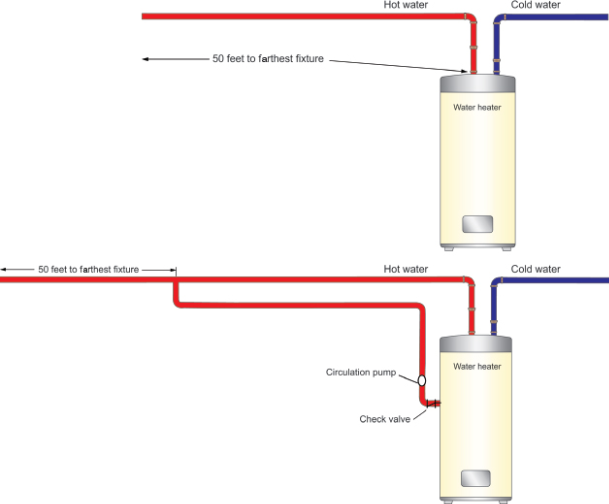
- Long pipe runs increase wait times and water waste.
- The IPC limits hot and tempered water piping to 50 feet; the International Residential Code® (IRC®) allows 100 feet, while the International Energy Conservation Code® (IECC®) imposes stricter limits (as low as four feet for two-inch piping and larger).
Best practice: Install water heaters in conditioned, insulated spaces near high-demand fixtures to reduce energy use and improve performance.
Inspections: Common Pitfalls
Inspectors frequently encounter:
- Improper venting or vent materials
- Inadequate access clearance
- Oversized electrical breakers
- Missing sediment traps on gas lines
- Loose or missing seismic strapping
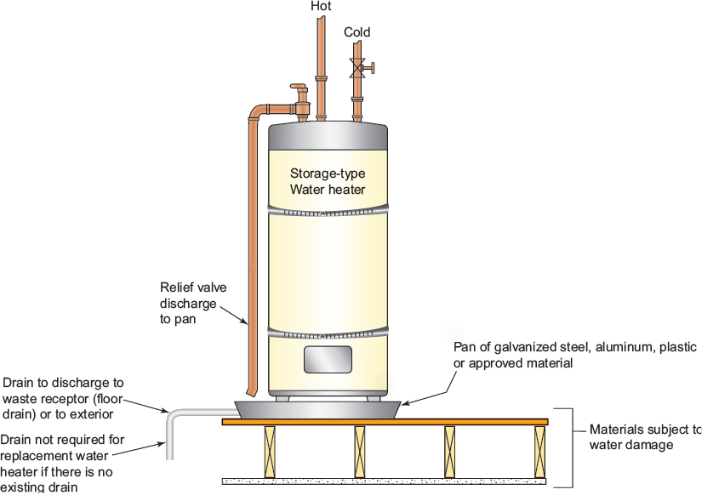
- Missing catch pans in damage-prone areas
- Incorrect catch pan drain terminations
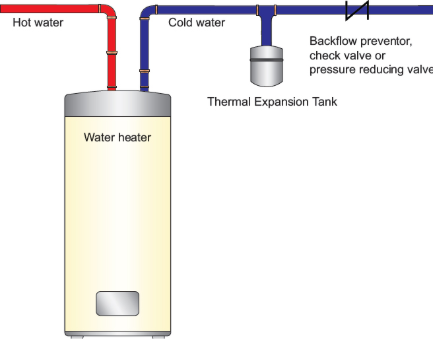
- Unsupported expansion tanks
- Improper or missing TPR discharge piping
Each of these issues reflects a failure to meet code requirements and can lead to hazardous conditions, reduced efficiency, failed inspections and costly remediation.
Code vs. Practicality: Bridging the Gap
While the IPC provides a solid framework, successful installations require thoughtful application:
- Designers must consider usage patterns, climate and layout.
- Installers should anticipate inspection criteria and future serviceability.
- Inspectors must balance code enforcement with practical feasibility.
Final Thoughts
Water heater sizing and placement are not just code checkboxes; they are foundational to the safety, efficiency and reliability of a building plumbing system. Proper sizing ensures consistent hot water delivery and energy savings, while strategic placement supports accessibility and long-term performance.
The IPC sets the standard, but it’s up to professionals to apply both technical expertise and practical judgment. By understanding draw capacity, recovery rate, location requirements and common inspection pitfalls, designers, installers and inspectors can work together to deliver systems that are not only code-compliant but also safe, efficient and built to last.
To access any of ICC’s PMG-related resources, click here. To subscribe to the PMG newsletter, click here.
About the Author

Mark Fasel is a director, PMG technical resources for the International Code Council, where he serves as a subject matter expert to the plumbing, mechanical, fuel gas, swimming pool and spa codes.