Code Corner: 2024 IPC Chapter 3: General Regulations
The Code Corner explores sections of the International Codes® each month, focusing on key elements of these essential codes. This month, we’re spotlighting the scope of Chapter 3 of the 2024 International Plumbing Code®.
The International Codes® (I-Codes®), developed by the International Code Council (ICC), are a family of fifteen coordinated, modern building safety codes that help ensure the design and construction of safe, sustainable and affordable structures.
The I-Codes are the most widely adopted set of model codes globally, implemented in all 50 U.S. states and many countries around the world.
The Building Safety Journal’s series, Code Corner, explores sections of the I-Codes each month, focusing on key elements of these essential codes. This month, we’re spotlighting the scope of Chapter 3 of the 2024 International Plumbing Code® (IPC®): General Regulations.
305.3 Pipes through foundation walls
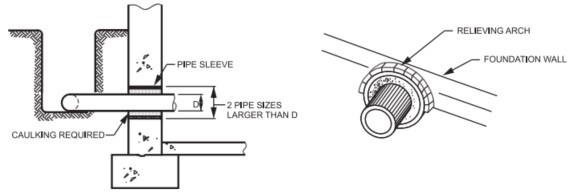
Any pipe that passes through a foundation wall shall be provided with a relieving arch, or a pipe sleeve pipe shall be built into the foundation wall. The sleeve shall be two pipe sizes greater than the pipe passing through the wall.
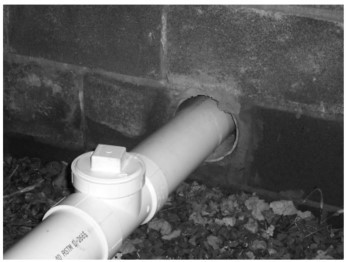
Piping installed through a foundation wall must be structurally protected from any transferred loading from the foundation wall. This protection must be provided by either a relieving arch or a pipe sleeve.
Where a pipe sleeve is used, it must be sized to be two pipe sizes larger than the pipe that passes through the pipe sleeve. For example, a 4-inch (102 mm) drainage pipe would require a 6-inch (152 mm) pipe sleeve. The annular space between the pipe sleeve and the pipe that passes through the sleeve will allow for any differential movement between the pipe and the wall. The pipe sleeve or relieving arch protects the pipe so that it will not be subjected to undue stresses that could cause it to rupture and leak [see Commentary Figures 305.3(1) and 305.3(2)].
In rare circumstances, it is necessary for a pipe to pass through a footing. For example, the slope of a building drain might not be able to be changed, resulting in the drainage pipe needing to pass through the footing. Although the code does not specifically address pipes passing through footings, the need for protecting pipes passing through footings is no different than for pipes passing through foundation walls. In these situations, protection of the pipe is not the only concern as the strength of footing could be compromised by the installation of a pipe sleeve or relieving arch. Any footing to be altered, either before or after placement of the footing, should be reviewed by a design professional to determine if footing design changes might be necessary to maintain the required footing strength.
Prior to 2012, the code required a relieving arch or a pipe sleeve for a pipe that passes under a footing. This was determined to be unnecessary as the footing already acts as a relieving arch to “span over” the area where the pipe passes under the footing. This is not to say that routing any size of or number of pipes under a footing is without consequences. Footings are designed to be uniformly supported by undisturbed or highly compacted soil. A trench for a pipe passing under the footing disrupts the uniform support for the footing. If the trench can be backfilled and compacted to the same level of compaction as the surrounding undisturbed or highly compacted soil, then the footing will be uniformly supported. But if the trench cannot be compacted sufficiently, such as where the trench is dug after the footing is in place, then the footing will not be uniformly supported by the soil; the footing will experience more stress than it was designed for. In actual practice, in a low-rise building where one or two “small” diameter pipes [≤ 8 inches (≤ 203 mm)] pass under a footing in the same area, the footing will most likely have sufficient reserve capacity to span the trench. Larger buildings typically requiring larger pipes will have footings that are already designed for spanning over the trenches of these larger pipes. There are no “rules of thumb” to know when a footing design should be analyzed for adequacy. Installers and code officials need to be aware of the possible consequences to the footings and, where necessary, consult with a design professional concerning the footing design.
About the Author

Gary has over 40 years of experience working within the Construction and Plumbing Industry. He is a seasoned Construction Project Manager as well as a Licensed Master Plumber in Massachusetts, New Hampshire, Maine and Vermont.
In addition, Gary holds an Unrestricted Construction Supervisor’s License (CSL) within the state of Massachusetts and completely understands the significance of code correlation. Lastly, while working with the International Code Council, he is currently an Adult Educational Master Plumbing & Fuel Gas Instructor and Continuing Education Instructor in the Commonwealth of Massachusetts.
Member of the International Code Council PMG Team responsible for developing, coordinating, directing and implementing programs to ensure the successful completion of the Government Relations goals and objectives as they apply to the International Plumbing Code, International Mechanical Code, International Fuel Gas Code, International Swimming Pool and Spa Code, and the International Private Sewage Disposal Code (and related services and programs of the International Code Council).