Affordable Housing: What Experts Say About Zoning & Permitting
Practitioners emphasized that many communities have already demonstrated meaningful results. These efforts—from adopting modern zoning standards to using digital tools that reduce permitting timelines—are helping get more homes built faster.
The United States has a shortage of between four to seven million homes, which contributes to why housing has become unaffordable for so many Americans. Two strategies to create more housing include updating local zoning regulations to be more straightforward and streamlining construction permitting processes.
In December 2025, the International Code Council (ICC), Pew Charitable Trusts, the National League of Cities and the American Planning Association convened a national roundtable to explore effective permitting and zoning practices that support affordability.
A recent ICC survey of approximately 120 professionals across 41 states showed strong momentum for reform, with more than 80 percent reporting that their jurisdictions had undertaken zoning, land use, or permitting updates within the past five years.
The event brought together local officials, national organizations and subject-matter experts. Participants included representatives from the National Association of Home Builders (NAHB), Habitat for Humanity, the U.S. Chamber of Commerce, the American Enterprise Institute, the Urban Institute, the National Zoning Atlas, the Mercatus Institute, AARP, the Niskanen Center and the National Housing Trust.
Across the discussions, practitioners emphasized that many communities have already demonstrated meaningful results. These efforts—from adopting modern zoning standards to using digital tools that reduce permitting timelines—are helping get more homes built faster.
“The solution to our housing shortage is simply allowing more homes […] and that means making our zoning more accommodating and making our permitting faster and simpler so that builders can provide the homes that American families need,” said Alex Horowitz, Project Director, Pew Charitable Trusts.
Case Study 1: San Antonio, Texas – Digital Tools and a One-Stop-Shop Streamline Fast Track Housing
San Antonio has become a national example for permitting innovation. Amin Tohmaz, Director of the Development Services Department, outlined how the city’s modern online portal centralizes applications, plan reviews, fee payment, tracking, scheduling, remote video inspection (RVI) and issuance of temporary certificates of occupancy (TCOs) and certificates of occupancy (COOs). These upgrades have significantly sped approval timelines.
“That expedited the whole process for us,” said Tohmaz.
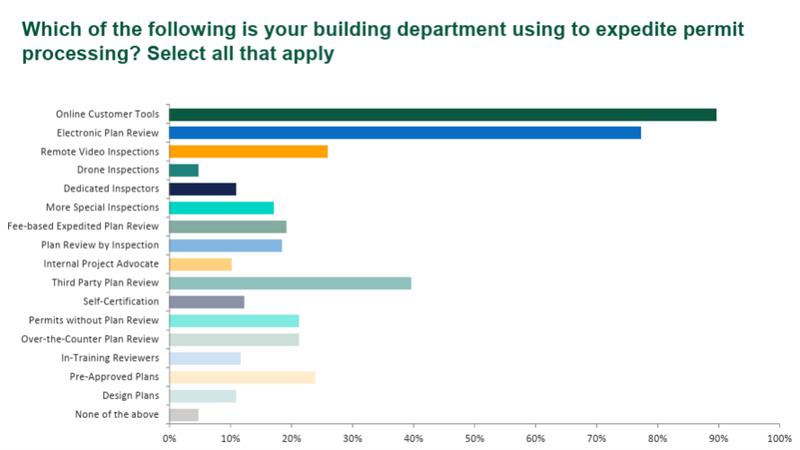
ICC’s survey results affirmed this trend, identifying online customer tools and electronic plan review as top strategies for accelerating approvals.
Supplementing these tools, Project Manager Jason Gray explained how San Antonio’s Affordable Housing Team supports development through pre-inspections and preliminary plan review, reducing surprises later in the process. A multidisciplinary “one-stop shop” ensures applicants receive coordinated guidance, while monthly industry check-ins facilitate communication.
The City’s high performance earned it Building Department Accreditation recognition from the International Accreditation Service and helped keep San Antonio among the nation’s highest producers of new, affordable housing.
Case Study 2: Fairfax County, Virginia – Permitting Efficiencies and Digital Investments Speed Construction
Fairfax County’s permitting improvements similarly demonstrate the impact of modern technology. Code Specialist Kyle Kratzer and Building Permits and Land Disturbance Manager Nicole McMahon highlighted the County’s Modified Process program, which allows partial permits for early-phase work such as rough grading or foundations prior to full site and building plan approval. Fairfax can also issue Temporary Certificate of Occupancies enabling partial occupancy and provides instant Certificate of Occupancies for residential units following final inspection.
Like San Antonio, Fairfax guides applicants through its online system to ensure consistent use. Reflecting on the County’s transition to a fully digital environment, McMahon noted, “we’ve made it to the other side of that and we’re able to see a lot of the benefits and the streamlining and efficiencies of this digital process.” Fairfax and San Antonio were top performers in a 2022 NAIOP (the Commercial Real Estate Development Association) Research Foundation study on building department transparency, accountability and consistency.
Many jurisdictions also described how pre-approved plan sets reduce review times. Cities such as Raleigh, San Antonio and Seattle offer pre-approved accessory dwelling unit (ADU) plans, while Fairfax provides ready-to-use plans for decks, basements, carport enclosures and retaining walls.
Do Permitting Shot Clocks Help or Hurt?
Nearly two-thirds of ICC survey respondents reported operating under mandated service timelines (permitting or inspection “shot clocks”), whether required by state policy or set internally. Missed deadlines can carry consequences, including loss of permit fees or authorization for applicants to use third-party plan reviewers or inspectors.
Views of roundtable participants on shot clocks varied. While some saw them as essential for accountability, others raised concerns about fairness when approvals depend on actions outside the building department’s control. Participants emphasized the need to align expectations across engineers, architects, builders and partner agencies. They also stressed that staffing levels, project complexity and applicant responsiveness must be accounted for to make timelines realistic and productive.
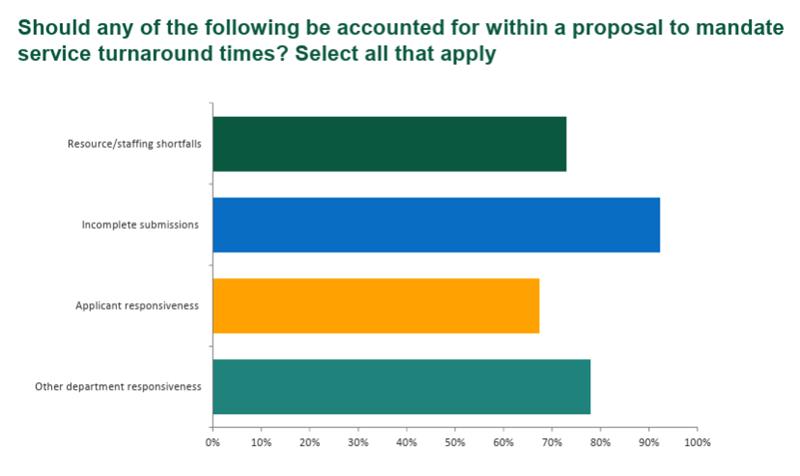
Survey findings reinforced these themes: respondents identified staffing shortfalls, incomplete submissions and delays from non-building department review agencies as critical factors that should be reflected in mandated review timelines.
Participants also weighed in on third-party review practices. While jurisdictions differed in how frequently they used third parties, an overwhelming 95 percent of survey respondents felt that reviewers/inspectors should hold relevant certifications to ensure competence and consistency as required of municipal employees.
Zoning Strategies That Address Affordable Housing Shortage
Speakers also spotlighted zoning reforms that open the door to more diverse and affordable housing types. Sara Bronin, Founder and CEO of Land Use Atlas, Inc., showcased the National Zoning Atlas, which now documents zoning standards for more than 8,900 jurisdictions—covering over half of the U.S. population.
Patrick Young, Director of Planning and Development for Raleigh, North Carolina, described Raleigh’s zoning reforms that aim to generate thousands of new homes. These include allowing duplexes, ADUs and townhomes by right, eliminating parking mandates, encouraging smaller home development and allowing modular housing in areas zoned for single-family homes. Raleigh’s efforts have been nationally recognized.
“What Raleigh did was make housing allowable, [not just] single family housing but all types of housing […] with a focus on what we call middle housing, which can fit in well in existing neighborhoods,” Patrick Young said.
Seattle is pursuing similar strategies. Rico Quirindongo, Director of the Office of Planning and Community Development, outlined major reforms underway in response to local and state directives. Three-quarters of Seattle’s residential land is zoned exclusively for detached single-family homes, but the city is proposing to allow triplexes, fourplexes, courtyard apartments, stacked flats and more flexible ADU development on that entitled land. Seattle has also removed land-use barriers to commercial-to-residential conversions. These changes have been positively received by housing advocates.
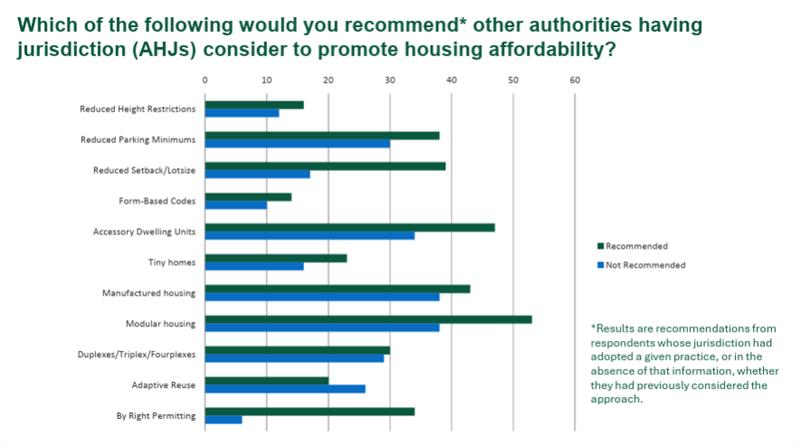
ICC’s survey respondents indicated broad support for expanding by-right approvals, especially for modular housing, ADUs and easing minimum lot size requirements—mirroring reform trends in cities like Raleigh and Seattle.
Get Involved: Shaping the International Zoning Code and Future Permitting Practices
Former and current members of the International Zoning Code® (IZC) development committee encouraged stakeholders to participate in future working groups to help integrate best practices into the IZC. As Senior Code Enforcement Officer for Anniston, AL, Tara Bryant observed, “Things are changing,” noting that this was especially the case regarding the growing use of tiny homes and ADUs. Kevin Gore, Chief Building Official for Perry, GA summed up the conversation: “We need to make the International Zoning Code more of a model code that can be adaptable.”
Survey respondents strongly agreed that consensus-based approaches promoting affordability should be incorporated into the IZC.
ICC invites practitioners to share their insights and experiences to help shape future IZC proposals and permitting best practices. Visit this page, enter your contact information, and under the “Committees” pull-down, please choose Code | BCAC- Building Code Action Committee – Zoning and Land Management for zoning proposals and/or Code | BCAC- Building Code Action Committee – Administration for permitting proposals. When you submit the form, you will receive a confirmation and notices of future subcommittee efforts.
ICC & Pew Zoning and Permitting Report to Publish in 2026
Pew and ICC are developing a detailed report that compiles lessons learned from the December roundtable. The forthcoming publication will highlight successful practices, common challenges, and practical approaches communities are using to improve permitting and zoning in support of housing affordability and increase production.
About the Author

Gabe Maser is the Executive Vice President of Innovation and Growth for the International Code Council, where he works across the organization to ensure products and services continue to evolve with emerging technologies, industry trends, and member needs. He previously led the development and implementation the Code Council's strategic priorities at the federal, state, and local levels, as the head of the Code Council's government relations department. Before joining the Code Council, he served as a regional director for market expansion and policy at Renovate America; as the director of federal-state relations for the Commonwealth of Massachusetts; a legislative assistant for a member of Congress; and an associate at Baker Botts L.L.P. Maser has a bachelor’s degree in biology from McGill University and a juris doctorate from Georgetown University Law Center. He is a licensed lawyer in the District of Columbia and Massachusetts.