Ask Me Anything: Your Questions About ICC Certifications and More, Answered
Member-submitted questions about certifications, renewals, exam delivery and more are answered by Vice President of ICC Credentialing, Autumn Saylor.
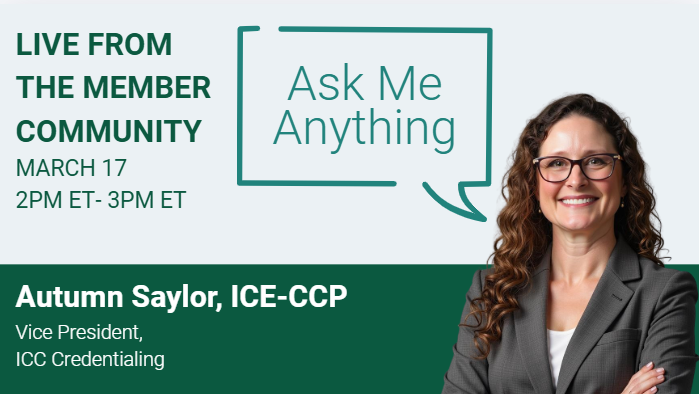
Autumn Saylor, ICE-CCP, Vice President of ICC Credentialing, joined us on our “Ask Me Anything” series on the International Code Council’s online member community to answer member-submitted questions.
Together with her team, she supports the building safety community by developing and managing credentialing examinations for professionals in code enforcement — including inspectors, plan reviewers and underground/aboveground storage tank inspectors and operators — as well as tradespersons and contractors.
Members submitted questions about:
- Certifications (exams, combination designations, etc.)
- Renewals (CEUs, process, verification, etc.)
- Exam delivery (PRONTO, references, etc.)
From insights on best practices when studying for an exam, advice for professionals in the field and implementing AI tools into exams, here’s a recap of her answers.
Editor’s Note: Some of the questions and answers have been edited for length. View the original “Ask Me Anything” post in “Talkin’ Shop” in the online member community, here.
Q&A With Autumn Saylor
I am currently a Certified Planning Technician through ICC. I am also currently attending CACEO’s Module I, II and III Code Enforcement Academy to get my certification with them. Would you also recommend I take the Code Enforcement classes through ICC, or would I just be paying to get the same information I already paid for?
Saylor: ICC recommends you first check with their local jurisdiction to understand the specific certification requirements for their area, as these can vary.
Regarding CACEO’s certifications compared to ICC’s, we cannot speak to the content or development process used in their program—only to how ICC certifications are created. ICC exams are developed and maintained by geographically diverse Examination Development Committees (EDCs) made up of subject matter experts from across the United States. This nationwide representation ensures that ICC certifications are portable and reflect the critical job tasks performed in jurisdictions across the country.
Before any exam is developed or experiences a major overhaul, ICC conducts a Job Task Analysis (JTA) or job task survey, which gathers input directly from professionals working in the field. This survey identifies the most essential tasks and knowledge areas for the role, and the exam is then built around those findings. This process ensures that the exam measures actual minimum competencies needed for practice.
How does someone challenge a question on the exam?
Saylor: If a candidate believes there is an issue with a question on their exam, they can submit an exam challenge form after their test. You are not expected to remember the full question, take notes, or provide exact wording.
Our staff can see which questions were presented on your individual exam, so we only need a few key words or a brief description to identify the item. If we cannot determine which question you are referring to based on the information you provide, we will follow up to gather a bit more detail.
This process allows candidates to bring concerns forward while still maintaining the security and integrity of the exam environment.
Is there a way to utilize state-specific certifications (like the California Plan Check) to obtain the international equivalent for combination certifications like Code Specialist or MCP?
Saylor: The answer to this really depends on which specific examination you’re referring to, so there isn’t a single “generic” response that applies to all situations. If you’d like to talk through your individual circumstances, please feel free to reach out to me directly at asaylor@iccsafe.org and I’m happy to help.
For candidates working with California‑specific exams, it may be helpful to know that ICC offers a transition route that allows you to transition your California credentials to the ICC equivalents.
I will be taking the Fire Inspector 1 2021 exam soon. Do you recommend both the 2021 International Fire Code® (IFC) and International Building Code® (IBC) for the exam or just the IFC? Can we use both digital codes and textbook?
Saylor: The first step in preparing for the exam is to review the exam information found in the Exam Catalog. This resource lists the approved references, which are the materials the Examination Development Committee (EDC) used when creating the exam questions.
The catalog also includes the Examination Content Outline. This outline identifies all topics covered on the exam. If a topic does not appear in the content outline, it will not be included in the exam.
When studying, use the content outline to guide your review of the approved references and to pinpoint the specific sections most likely to be tested. I recommend completing this process for all applicable references. For the 2021 Fire Inspector I exam, these include the 2021 IFC, the 2021 IBC, and Fire Inspection and Code Enforcement IFSTA – 9th Edition.
As for the DC for Exams, yes, you can use both hard copy and DC for Exams. In fact, we recommend having both on hand if you are new to DC for Exams. Note, the IFSTA manual is not on DC for Exams at this time.
I was wondering if the exams could be made less difficult?
Saylor: Thanks so much for reaching out and sharing your thoughts. We know preparing for an exam takes time, energy, and resources and we appreciate how committed candidates are to earning their certification.
ICC certifications are voluntary and are designed to confirm minimum competency in the most critical job tasks within the building safety industry. The exams aren’t meant to be “hard for the sake of being hard,” they’re focused on the essential knowledge needed to do the job safely and effectively. Because of that, questions are written to measure how well someone can apply key concepts in real situations, not just recall facts.
We continually review our exams to make sure the content reflects only the most important responsibilities in the field. The goal is to keep the exams fair, focused and aligned with the work professionals do every day.
We truly value the feedback from our candidates, and we’re always exploring ways to support people in their certification journey while still maintaining the standards that protect the integrity of the profession.
Who develops the certification exams and are they ever updated? if so, how often?
Saylor: ICC certification exams are developed by Examination Development Committees (EDCs), which are groups of subject matter experts working in the building safety industry. These experts bring real‑world experience to the table to ensure each exam reflects the essential knowledge and critical job tasks required in the field.
Yes, the exams are updated regularly. Examination content is reviewed on a continuous basis to keep it aligned with current codes, industry practices and professional responsibilities. This ongoing review process helps ensure the exams remain accurate, relevant and reflective of the minimum‑competency standards they are designed to measure.
Here in Garden City, Kansas, we were able to test at Garden City Community College and now we have to drive to a different jurisdiction which is well over two hours away. My question is: Can we get approved to go back to the college and test? It works for contractors, not sure why inspectors were removed from that?
Saylor: If Garden City Community College would like to become a test site for Meazure Learning, have them contact me directly and I can get them in touch with the correct person.
In addition to testing at a test site, jurisdictions have the ability to utilize our PRONTO at Work solution, which has been adopted by many jurisdictions. Information can be found on our website or by clicking here.
The online exam system provides digital access to many of the resources for many certification exams. However, some exams include resources that are not provided in a digital format during the exam. One example is the National Electrical Code (NFPA 70) for the commercial electrical inspector exam. Another is the Human Resources Management textbook for the CBO management exam. Exam candidates have to bring their own printed copy of these resources. This can be a barrier to taking the exam, as it is an extra expense for the candidate. Is ICC planning to provide digital access to more of the exam resources in the future?
Saylor: Since the inception of the Digital Codes for Exams product, ICC has continued working with organizations to include their references in the platform. This is a lengthy and detailed process; however, we remain confident that we will identify workable solutions for most, if not all, of the examination references.
Looking for good advice on taking the Fire Inspector 1 Exam via PRONTO. I have the ICC Study Guide and bought an Exam prep book. I will be taking the Fire Inspector Exam for the 2021 IFC version. Do I need to by the 2021 IBC as well for the exam?
Saylor: The first step in preparing for the exam is to review the exam information found in the Exam Catalog. This resource lists the approved references, which are the materials the Examination Development Committee (EDC) used when creating the exam questions.
The catalog also includes the Examination Content Outline. This outline identifies all topics covered on the exam. If a topic does not appear in the content outline, it will not be included in the exam.
When studying, use the content outline to guide your review of the approved references and to pinpoint the specific sections most likely to be tested. I recommend completing this process for all applicable references. For the 2021 Fire Inspector I exam, these include the 2021 IFC, the 2021 IBC, and Fire Inspection and Code Enforcement IFSTA – 9th Edition.
Is ICC exploring any AI-based tool inspectors could use in the field to ask code questions tied to specific state adoptions and code cycles? Many jurisdictions operate under modified versions of ICC codes — for example, North Carolina’s adopted 2018 codes with state amendments. A system that filters responses to the actual adopted code set would be extremely valuable for inspectors and plan reviewers.
Saylor: ICC is always looking for opportunities to deliver tools and processes that benefit our members across their code compliance needs. Within all Digital Codes Premium plans, the AI Navigator tool already allows users to ask compliance centric questions across International Codes® (I-Codes®) and State codes. The tool is embedded across the contents of supported titles as well at the section level, allowing users to ask questions or generate summaries across the written codes. Digital Codes Premium Complete trials are available for free to allow users to review these capabilities and apply to their code compliance queries.
Has ICC considered any solutions regarding the volume of referenced standards in the codes (ASTM, UL, ANSI, ACI, etc.)? These are often required for compliance but remain largely inaccessible to code officials, which makes it difficult to verify and apply the full compliance requirement in practice.
Saylor: ICC continues to collaborate with standards‑developing organizations (SDOs) to expand the availability of their standards on the Digital Codes Platform. At present, Digital Codes Premium provides access to more than 800 standards.
Are there any plans to improve the mobile usability of ICC digital code platforms so inspectors can quickly search, filter by jurisdiction and view amendments while performing inspections in the field?
Saylor: The Digital Codes platform is designed to be fully responsive so that it scales across mobile and tablet displays to ensure users can access all contents and features. ICC is always looking to improve the experience, so if there are specific feature considerations or recommendations, please make sure to share those with the ICC team.
As we begin seeing more digital options available through ICC Codes and various AI platforms, I was wondering how these methods may become part of the testing and certification process. Knowing where to look is key to finding info in a large hardcopy. Similarly, knowing what to ask expedites digital research. Are there plans for incorporating these new pathways into ICC exams and certifications?
Saylor: You’ve raised a great question, and AI is certainly a timely topic within the certification industry. At this point, ICC has not incorporated AI into the certification process. However, we are actively exploring opportunities where it could add value in the future, including potential use in developing practice questions.
We are also continually looking for ways to enhance the Digital Codes for Exams experience. Discussions have already begun on how we can improve the functionality so that it more closely mirrors the usability of a hard‑copy book, particularly for notes and indexing. Please feel free to reach out if you have additional questions or ideas.
Is there any training that is offered for the Code Enforcement Officer exams? Do we just study the three books and take the exam when we think we’re ready? It seems like there should be some form of training that is being offered like a self-study guide or an online class or even a YouTube training event that can help prepare us for this.
Saylor: For the new ICC examinations, we are continuing to develop additional training and preparation opportunities that will be available in the future. In the meantime, as with all ICC examinations, we encourage candidates to review the exam information found in the Exam Catalog. This resource lists the approved references, which are the materials the Examination Development Committee (EDC) used when creating the exam questions.
The catalog also includes the Examination Content Outline. This outline identifies all topics covered on the exam. If a topic does not appear in the content outline, it will not be included in the exam.
When studying, use the content outline to guide your review of the approved references and to pinpoint the specific sections most likely to be tested. I recommend completing this process for all applicable references.
What advice do you have for professionals trying to decide which certification path best aligns with their career goals?
Saylor: This is certainly a common concern for many individuals entering the industry. I recommend visiting our Safety 2.0 website, which highlights several workforce‑development initiatives and resources designed to support new professionals.
In particular, the Building Safety Career Path Initiative page is an excellent place to start. It provides an overview of the various types of building safety careers and includes a step‑by‑step guide to help individuals begin their journey in the building safety profession.
Subscribe to the Building Safety Journal Weekly newsletter, here.
ICC members can join the FREE member community, here (use existing myICC username and password).
About the Author
The International Code Council is a nonprofit association that provides a wide range of building safety solutions, including product evaluation, accreditation, certification, codification and training. It develops model codes and standards used worldwide to construct safe, sustainable, affordable and resilient structures.