Code Corner: 2024 IMC Chapter 13 Fuel Oil Piping and Storage
The Code Corner explores sections of the International Codes® (I-Codes®) each month, focusing on key elements of these essential codes. This month, we’re spotlighting the scope of Chapter 13 of the 2024 International Mechanical Code®.
The International Codes® (I-Codes®), developed by the International Code Council (ICC), are a family of fifteen coordinated, modern building safety codes that help ensure the design and construction of safe, sustainable and affordable structures.
The I-Codes are the most widely adopted set of model codes globally, implemented in all 50 U.S. states and many countries around the world.
The Building Safety Journal’s series, Code Corner, explores sections of the I-Codes each month, focusing on key elements of these essential codes. This month, we’re spotlighting the scope of Chapter 13 of the 2024 International Mechanical Code® (IMC®): Fuel Oil Piping and Storage.
1301.5 Tanks abandoned or removed
All exterior above-grade fill piping shall be removed when tanks are abandoned or removed. Tank abandonment and removal shall be in accordance with Section 5704.2.13 of the International Fire Code® (IFC®).
IFC Section 5704.2.13 provides the requirements for abandoning or removing fuel oil tanks. It does not, however, require the removal of the above-grade fill piping associated with the tanks. Although the code does not specifically address vent pipes, they should also be removed because they appear to be fill pipes.
Exterior fill piping must be removed due to the potential danger that hundreds of gallons of fuel oil could be accidentally delivered to a facility that did not request it. There have been instances of accidental filling where tanks have been removed but the fill pipe has remained. Oil delivery service personnel only see the exterior connection and may not be aware that the tank has been removed or disconnected. Piping must be removed, not just capped off; accidental filling has occurred when piping systems have been capped off. When fuel oil contamination occurs, the cost of repairs and cleanup is extremely high and, in some cases, has led to condemnation of such structures.
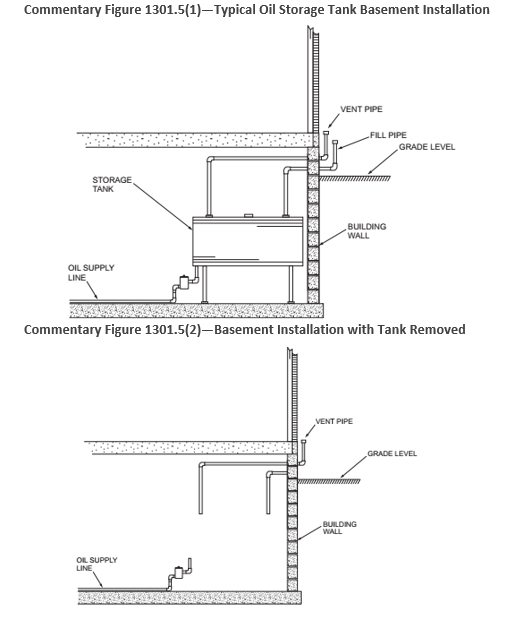
Commentary Figure 1301.5(1) shows a typical oil tank installation in a basement with the oil filler pipe and the vent pipe extending above ground outside the building. If the tank is removed and the fill pipe is left in place [see Commentary Figure 1301.5(2)], oil pumped through one of these pipes will fill the basement.
To learn more about ICC’s IMC, click here. To stay updated on the latest PMG industry news, subscribe to ICC’s PMG newsletter here.
About the Author

Gary has over 40 years of experience working within the Construction and Plumbing Industry. He is a seasoned Construction Project Manager as well as a Licensed Master Plumber in Massachusetts, New Hampshire, Maine and Vermont.
In addition, Gary holds an Unrestricted Construction Supervisor’s License (CSL) within the state of Massachusetts and completely understands the significance of code correlation. Lastly, while working with the International Code Council, he is currently an Adult Educational Master Plumbing & Fuel Gas Instructor and Continuing Education Instructor in the Commonwealth of Massachusetts.
Member of the International Code Council PMG Team responsible for developing, coordinating, directing and implementing programs to ensure the successful completion of the Government Relations goals and objectives as they apply to the International Plumbing Code, International Mechanical Code, International Fuel Gas Code, International Swimming Pool and Spa Code, and the International Private Sewage Disposal Code (and related services and programs of the International Code Council).