
Evaluation Reports
Product Compliance is a major pillar in the regulatory framework, and its importance only intensifies when new or innovative building materials/systems are not covered or addressed in the building codes. One way to accommodate the compliance procedure is to update the code to incorporate such changes; however, since the I-Codes are on a three-year update cycle, this option can be impractical and resource-intensive. The alternative approval process offered by the Evaluation Service Reports (ESRs) is a highly credible and rigorous solution. An ICC-ES Report (ESR) is a document that presents the product, scope of evaluation, proof of compliance, installation, and condition of use from a performance perspective. ESRs verify that building products comply with code requirements, acceptance criteria used to evaluate a product, how the product should be identified, installed and much more.

ICC-ES has expanded its scope of services to include evaluation to the following codes in the MENA region:
- United Arab Emirates (UAE): Dubai Building Code (DBC) set by Dubai Municipality and the Abu Dhabi International Building Code (ADIBC), set by the Abu-Dhabi Department of Municipality and Transport (AD-DMT).
- Kingdom of Saudi Arabia (KSA): Saudi Building Code (SBC) in the Kingdom of Saudi Arabi (KSA) set by the Saudi Building Code National Committee (SBCNC).
Visit ICC-ES’s ESRs online directory for more information on our evaluation scope.
Building Safety Regulatory Ecosystem Toolkit
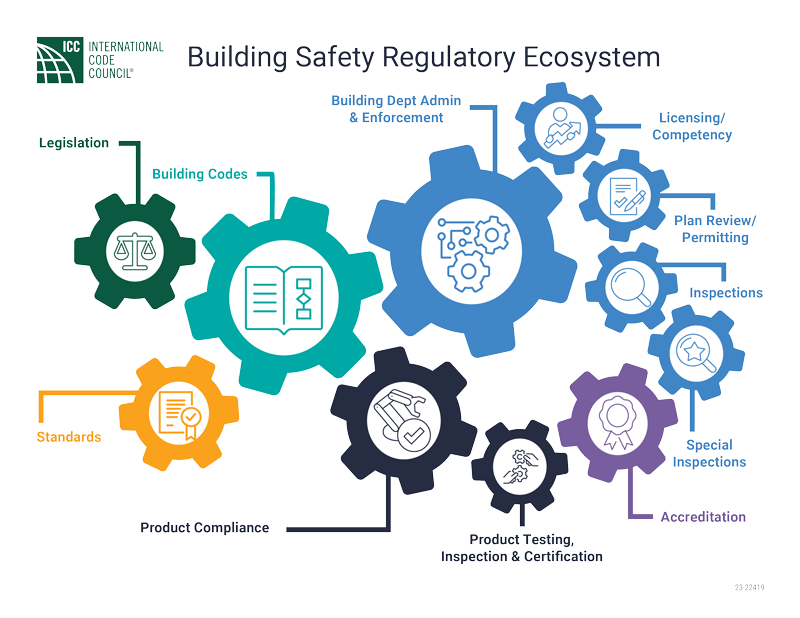
This free, online toolkit is designed to be used by jurisdictions around the world to identify and improve the elements of their building safety regulatory ecosystems most critically in need. All essential elements of an effective building safety regulatory ecosystem are represented in the graphic and briefly described below. This page is a work in progress. Please check back soon for more information.

Legislation
In most countries, a law or act is required to implement a set of building regulations and set forth the framework for their enforcement. This resource offers the principles that should be included in enabling legislation for an effective building control system.

Building Code & Standards
The building code used in a jurisdiction should be right-sized and enforceable, and the standards referenced in that code should be aligned with both the code and the availability of materials and common construction practices in that jurisdiction. This resource provides a guide for creating or adapting a building code and aligning it with appropriate construction standards.

Building Department Administration & Enforcement
In order to coordinate compliance efforts, regulatory authorities need to be established to ensure that the intent of the building regulations is realized and it results in safer, more resilient, sustainable and affordable buildings. This resource offers the essential components and functions of an effective building department administration and enforcement network.

Licensing & Competency
Jurisdictions require a method to define, measure and monitor the required competencies for the various types of practitioners and construction professionals operating within the building control system. This resource offers a list of considerations for assessment, licensing and credentialing rules for jurisdictions to consider based on the availability of internal and external resources.

Plan Review & Permitting
Building designs and sites must be approved through a clearly defined and delineated process that ensures proper application of the building codes during the planning stages of building development activities. This resource provides guidance on establishing and maintaining these processes, which can be used to generate revenue to underwrite the operations of building departments.
Evaluation Reports
Product Compliance is a major pillar in the regulatory framework, and its importance only intensifies when new or innovative building materials/systems are not covered or addressed in the building codes. One way to accommodate the compliance procedure is to update the code to incorporate such changes; however, since the I-Codes are on a three-year update cycle, this option can be impractical and resource-intensive. The alternative approval process offered by the Evaluation Service Reports (ESRs) is a highly credible and rigorous solution. An ICC-ES Report (ESR) is a document that presents the product, scope of evaluation, proof of compliance, installation, and condition of use from a performance perspective. ESRs verify that building products comply with code requirements, acceptance criteria used to evaluate a product, how the product should be identified, installed and much more.
ICC-ES has expanded its scope of services to include evaluation to the following codes in the MENA region:
- United Arab Emirates (UAE): Dubai Building Code (DBC) set by Dubai Municipality and the Abu Dhabi International Building Code (ADIBC), set by the Abu-Dhabi Department of Municipality and Transport (AD-DMT).
- Kingdom of Saudi Arabia (KSA): Saudi Building Code (SBC) in the Kingdom of Saudi Arabi (KSA) set by the Saudi Building Code National Committee (SBCNC).
Visit ICC-ES’s ESRs online directory for more information on our evaluation scope.

Inspections
Inspectors, and special inspectors for certain types of construction and construction processes, with the necessary competencies and enforcement powers, should be conducting on-site inspections at all critical stages throughout the construction process. This resource is a guideline for establishing and maintaining an effective building inspection system, including consideration for qualifications, training and credentialing.

Product Compliance
Based on the mandated codes and standards, the jurisdictional authority will need a system in place to ensure that products specified in a building’s design are compliant – ideally using ISO/IEC 17065 accredited conformity assessment bodies. This resource references international best practices and tools to help determine which products should be regulated and which approaches to ensuring compliance are most appropriate.

Testing, Inspection & Certification (TIC) Services
If construction product assurance is to be dependable and transparent , it is necessary to have a system in place to certify those regulated products for compliance with the regulations through documented, effective TIC Services. This resource offers a guideline for establishing and maintaining competency of a robust system for the testing, inspection and certification system for construction products and systems.
Evaluation Reports
Product Compliance is a major pillar in the regulatory framework, and its importance only intensifies when new or innovative building materials/systems are not covered or addressed in the building codes. One way to accommodate the compliance procedure is to update the code to incorporate such changes; however, since the I-Codes are on a three-year update cycle, this option can be impractical and resource-intensive. The alternative approval process offered by the Evaluation Service Reports (ESRs) is a highly credible and rigorous solution. An ICC-ES Report (ESR) is a document that presents the product, scope of evaluation, proof of compliance, installation, and condition of use from a performance perspective. ESRs verify that building products comply with code requirements, acceptance criteria used to evaluate a product, how the product should be identified, installed and much more.
ICC-ES has expanded its scope of services to include evaluation to the following codes in the MENA region:
- United Arab Emirates (UAE): Dubai Building Code (DBC) set by Dubai Municipality and the Abu Dhabi International Building Code (ADIBC), set by the Abu-Dhabi Department of Municipality and Transport (AD-DMT).
- Kingdom of Saudi Arabia (KSA): Saudi Building Code (SBC) in the Kingdom of Saudi Arabi (KSA) set by the Saudi Building Code National Committee (SBCNC).
Visit ICC-ES’s ESRs online directory for more information on our evaluation scope.

Accreditation
Entities (such as material testing laboratories, certification bodies, and inspection agencies) entrusted with compliance functions should be accredited to the appropriate ISO conformity assessment standard to ensure their impartiality and competence. This resource will help to determine accreditation requirements and to assess the best approach for establishing a system of accreditation.