
FEMA’s Building Resilient Infrastructure and Communities (BRIC) Grant Program
(Fiscal Years 2024 & 2025)
The Federal Emergency Management Agency (FEMA) released a new Notice of Funding Opportunity (NOFO) announcing $1 billion in federal funding available for State, Local, Tribal, and Territorial (SLTT) hazard mitigation activities to reduce future disaster costs.

Funds for Building Code Adoption and Enforcement
$81 million in BRIC funding for building code-related activities
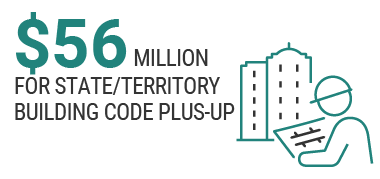
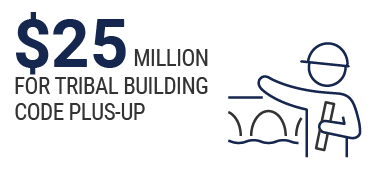
Specific building code activities that are directly tied to infrastructure may also be submitted under the State/Territory Allocation.
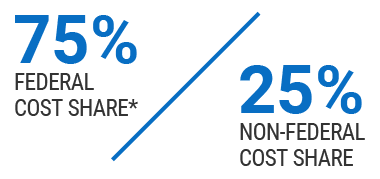
*limited federal cost share exceptions apply for small/impoverished communities and insular areas
Important Deadlines
- Applications are due to FEMA by July 23, 2026 at 3 PM ET.
- Local sub-applications are due in advance, with deadlines varying by State and Territory.
- Federally recognized tribes may submit applications directly to FEMA by July 23, 2026 or submit sub-applications through their state emergency management organization (state deadlines apply).
Getting Started
First, determine your local pre-application requirements and deadlines for FY 24 & 25 BRIC funding

Contact your State Hazard Mitigation Officer (SHMO)

Read the FY 24 & 25 BRIC Notice of Funding Opportunity (NOFO)

Review and develop a proposal for Building Code Plus-Up eligible activities
Building Code Plus-Up Eligible Activity Examples
Activities under this category should enable the adoption and enforcement of current or next most recent hazard-resistant consensus-based model building codes such as the International Building Code® (IBC) and the International Residential Code® (IRC) published by the International Code Council (ICC), either through Mandatory State-Wide or Territory Building Code Adoption Requirement or via Local Code Adoption Requirement (2021 or 2024 versions of IBC and IRC).
For any consensus-based codes, specifications or standards used to carry out these activities, the two most recently published editions may be used.
Eligible Activity Examples
- Evaluating the family of International Codes®, namely the International Building Code®, International Residential Code®, and the International Existing Building Code®, or other model building codes for adoption. Evaluation activities include staff time or external consultant costs necessary for evaluations and expenses for code review committees.
- Improving or modifying current or existing building code requirements to reflect one of the two latest code editions, exceed the latest code edition, or develop or modify building code-coordinated requirements - including publication of those requirements, related to land use, zoning, floodplain management, infrastructure, wildland-urban interface defensible space, or other area – that help make the community more resilient.
- Enhancing existing adopted codes and enforcement to incorporate current requirements, higher standards, electronic permitting, online model code access, virtual inspection technology, and remote building code administration.
- Providing or pursuing individual certification courses or training related to building codes for both the public and private sectors. Examples include building code inspections or plans reviewer, floodplain management, etc.
- Developing planning, training, and exercises for post-disaster building code enforcement through the International Code Council’s When Disaster Strike’s Institute training course.
View more examples.
- Developing activities related to improving code enforcement (i.e., evaluating processes, implementing an inspection program, improving BCEGS score, improving Community Rating System rating, etc.).
- Developing or acquiring software and hardware, as well as associated training, to assist with plan reviews, permitting, inspections, and records retention.
- Purchasing publications, or obtaining digital license or printing permissions of publications, to support activities associated with building codes, specifications, and/or standards.
- Engaging consulting services to support activities related to building codes, specifications, and/or standards.
- Covering costs associated with building department accreditation.
- Conducting public awareness outreach activities (related to new requirements)