
Flood Mitigation
Flooding is one of the most frequent and costly natural hazards in the United States, affecting homes, businesses, community infrastructure and critical services. From riverine floods to flash flooding and coastal storm surge, these events disrupt homes and businesses and can create long‑term consequences for local economies.
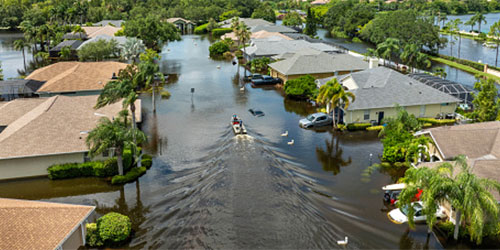

How Often Flooding Occurs
Deadly floods swept through the United States at a record pace in 2025, triggering more flash flood warnings than any year to-date. Additionally, between 2020 and 2023, the United States experienced 80 major flood disasters, a rate that represents nearly half of the previous decade’s total.
Annual Flood‑Related Losses
Recent analysis estimates that flooding now costs the U.S. between $179.8 and $496 billion annually, equivalent to 1–2% of the U.S. GDP. These losses include infrastructure damage, business interruption, residential property losses and far‑reaching economic impacts.
Losses Avoided Through Building Codes and Mitigation
Mitigation through code adoption and implementation is one of the most cost‑effective strategies communities can use to reduce long‑term flood impacts and insurance costs.
Federally funded riverine flood mitigation projects produce a 7:1 benefit‑cost ratio, meaning $7 saved for every $1 spent.
Using the International Codes (I‑Codes) to Mitigate Flood Hazards
The International Codes® (I‑Codes®) provide a comprehensive framework for designing, constructing and retrofitting buildings to be more flood‑resilient. Excerpts of the flood-resistant provisions from the 2024 I-Codes, including a summary of changes to flood provisions from the 2021 to 2024 editions, can be accessed here.
Key Flood Provisions
Click book cover below to reveal/hide code sections.

International Existing Building Code®
Chapter 1 Scope and Administration
- Section 104 Duties and Powers of Code Official
- 104.2.4.1 Flood hazard areas. Only under certain extraordinary circumstances can the code official grant modifications to provisions related to flood resistance for repairs, alterations or additions to existing buildings located in flood hazard areas that constitute substantial improvement.
- 104.3.1 Determination of substantially improved or substantially damaged existing buildings and structures in flood hazard areas. The code official is required to determine if proposed work on existing buildings located in flood hazard areas constitutes substantial improvement or repair of substantial damage. Where the code official determines that the proposed work constitutes substantial improvement or repair of substantial damage, the building is required to meet the requirements of the IBC or the IRC as applicable.
- Section 109 Inspections
- 109.3.3 Lowest floor elevation. For additions and substantial improvements to existing buildings in flood hazard areas, after placement of the lowest floor and prior to vertical construction, documentation related to the elevation of the lowest floor is to be submitted to the code official.
- 109.3.10 Flood hazard documentation. For additions and substantial improvements to existing buildings in flood hazard areas, prior to the final inspection, documentation related to the elevation of the lowest floor or the elevation of dry floodproofing is to be submitted to the code official.
Chapter 2 Definitions
These definitions provide a common language for designing buildings to resist severe wind events. While the IEBC incorporates the definitions found in the International Building Code® (IBC), those terms that are unique to existing buildings can be found within Chapter 2 of the IEBC.
DANGEROUS
EXISTING BUILDING
EXISTING STRUCTURE
FLOOD HAZARD AREA
HISTORIC BUILDING
LOWEST FLOOR
REPAIR
RISK CATEGORY
STORM SHELTER
SUBSTANTIAL DAMAGE
SUBSTANTIAL IMPROVEMENT
SUBSTANTIAL STRUCTURAL ALTERATION
SUBSTANTIAL STRUCTURAL DAMAGE
UNSAFE
Chapter 3 Provisions for All Compliance Methods
- Section 301 Administration
- 301.3 Alteration, addition or change of occupancy. This section provides the code official with the authority to allow alterations that comply with the laws in existence at the time the building was built, unless the alterations constitute substantial improvement in a flood hazard area. When the alterations constitute substantial improvement in a flood hazard area all work is required to comply with Sections 503.2, 701.3 or 1303.1.3.
Chapter 4 Repairs
- Section 401 General
- 401.3 Flood hazard areas. In flood hazard areas, repairs that constitute substantial improvement shall require that the building comply with the IBC or the IRC as applicable.
- Section 405 Structural
- 405.2.6 Flood hazard areas. In flood hazard areas, buildings that have sustained substantial damage shall be brought into compliance with the IBC or the IRC as applicable.
Chapter 5 Prescriptive Compliance Method
- Section 502 Additions
- 502.2 Flood hazard areas.For buildings in flood hazard areas, any addition that constitutes substantial improvement of the existing building is required to comply with the flood design requirements for new construction, and the balance of the existing building is to be brought into compliance with the flood requirements for new construction.
For buildings in flood hazard areas, any addition that does not constitutes substantial improvement of the existing building is not required to comply with the flood design requirements for new construction, provided the addition does not violate flood-resistant construction requirements and the lowest floor of the addition is constructed at or above the lower of the lowest floor of the existing building.
- Section 503 Alterations
- 503.2 Flood hazard areas. For buildings in flood hazard areas, any alteration that constitutes substantial improvement of the existing building is required to comply with the flood design requirements for new construction, and the balance of the existing building is to be brought into compliance with the flood requirements for new construction.
For buildings in flood hazard areas, any alteration that does not constitutes substantial improvement of the existing building is not required to comply with the flood design requirements for new construction.
- Section 507 Historic Buildings
- 507.3 Flood hazard areas. For Historic buildings that meet certain criteria and located in flood hazard areas, any work that constitutes substantial improvement of the existing building is not required to comply with the flood design requirements for new construction.
Chapter 7 Alterations — Level 1
- Section 701 General
- 701.3 Flood hazard areas. In flood hazard areas, alterations that constitute substantial improvement are required to comply with the IBC or the IRC, as applicable.
Chapter 11 Additions
- Section 1103 Structural
- 1103.3 Flood hazard areas. This section addresses additions within flood hazard areas that are required to comply with specific requirements. These requirements are based on whether the addition is structurally interconnected or independent of the existing building. The requirements are also based on whether the addition is a vertical addition atop an existing building or atop its own foundation.
Chapter 12 Historic Buildings
- Section 1201 General
- 1201.4 Flood hazard areas. For Historic buildings that meet certain criteria and located in flood hazard areas, any work that constitutes substantial improvement of the existing building is not required to comply with the flood design requirements for new construction.
Chapter 13 Performance Compliance Methods
- Section 1303 Acceptance
- 1303.1.3 Compliance with flood hazard provisions. If the work covered by this section is a structurally connected horizontal addition that does not constitute substantial improvement, the addition is not required to comply with the flood design requirements for new construction, provided the addition does not violate flood-resistant construction requirements and the lowest floor of the addition is constructed at or above the lower of the lowest floor of the existing building.
Chapter 14 Relocated or Moved Buildings
- Section 1402 Requirements
- 1402.6 Flood hazard areas. If an existing building is relocated into a flood hazard area, the building is required to comply with the IBC or the IRC, as applicable.
International Residential Code®
Chapter 1 Scope and Administration
- R106.1.4 Information for construction in flood hazard areas: Addresses delineation of flood hazard areas, elevation of lowest floor and lowest horizontal structural member, etc.
- R109.1.3 Floodplain inspections: Elevation documentation to be prepared and sealed by a registered design professional shall be submitted upon placement of the lowest floor prior to vertical construction.
Chapter 3 Building Planning
- R306.1 Flood-resistant construction: Requires buildings located in flood hazard areas be designed and built in compliance with Section R306. Buildings located in floodways shall be designed and constructed with ASCE 24(2014).
- R306.2.1 Elevation requirements: Flood hazard areas, not including Coastal A Zones, shall have the lowest floors (including basement floors) at or above the base flood elevation plus one foot, or the design flood elevation, whichever is higher.
International Building Code®
Chapter 1 Scope and Administration
- 104.2.4.1 Flood hazard areas: Limits the building official’s ability to grant modifications in flood hazard areas.
- 107.2.6 Site plan: Site plans are required in the construction documents for permitting. Flood hazard areas, floodways and design flood elevations shall be indicated on site plans as applicable.
- 110.3.3 Lowest floor elevation: Requires elevation certification in flood hazard areas.
- 110.3.12.1 Flood hazard documentation: Requires documentation of the elevation of the lowest floor or the elevation of dry floodproofing, if applicable.
Chapter 16 Structural Design
- 1612.2 Design and construction: Requires that the design and construction of buildings and structures located in flood hazard areas shall be in accordance with Chapter 5 of ASCE 7 and ASCE 24.
- 1612.3 Establishment of flood hazard areas: Requires the applicable governing authority shall adopt flood hazard map and supporting data.
- 1612.4 Flood hazard documentation: Requires that documentation shall be prepared and sealed by a registered design professional and submitted to the building official for construction in flood hazard areas and coastal high hazard areas
Appendix G Flood-Resistant Construction
- Intended to provide the additional flood-plain management and administrative requirements of the National Flood Insurance Program.
- Adoption of the IBC and Appendix G will meet the minimum requirements of NFIP as set forth in Title 44 of the Code of Federal Regulations.
Flood Resources

Preparedness
Emergency Planning
Visit Ready.gov for emergency planning, supplies lists, alerts, evacuation prep and household readiness resources for flooding events.
Training for Officials
When Disaster Strikes Institute’s Substantial Damage Estimates and Determinations, Building Safety Evaluator, and Coordinator training courses teach field teams, team leaders and managers to efficiently and consistently assess post-flood damage.

Response
Stay Safe
Learn how to stay safe during and after a flood. Evacuate if told to do so, move to higher ground or a higher building floor and stay where you are.
Training for Officials
When Disaster Strikes Institute’s Evaluator Training and Coordinator Training courses teaches evaluators, team leaders and managers to safely and effectively assess and inspect post‑flood structures.

Recovery
Evaluation for Safety
The Substantial Damage Evaluation process is required by FEMA as part of the NFIP. This process determines whether a building is Substantially Damaged thereby requiring compliance with current flood-resistant code requirements.
Training for Officials
The 2024 IBC/IRC/IEBC have updated definitions and relocated Substantial Improvement and Substantial Damage terminology to support consistency, enforcement and compliance.
Pairing Mitigation with Local Recovery
When communities begin recovering after a flood, it’s essential to rebuild in ways that reduce future risk. Local governmental leaders, recovery committees and planning groups can integrate mitigation into every recovery decision by using established assessment methods, such as state and local hazard mitigation plans and through applying a multi‑hazard approach to rebuilding.

Use hazard mitigation plans as roadmaps
Reference state or local hazard mitigation plans to guide decisions on where and how recovery projects should be designed, funded and implemented.

Conduct post‑flood damage & risk assessments
Evaluate the extent of damage, identify recurring problem areas and document vulnerabilities to inform mitigation‑focused rebuilding.

Embed mitigation in all recovery discussions
Ensure that community town hall meetings, planning meetings and community workshops include mitigation options as part of every proposed solution.

Prioritize multi‑hazard strategies
Consider community hazards and risks beyond flooding (e.g. wildfire, earthquakes, etc.) and pursue solutions that reduce exposure to multiple hazards at once.

Rebuild with resilience
Encourage use of flood‑resistant materials and infrastructure redesigns that address long‑term risk.

Leverage recovery funding for mitigation
Explore opportunities within federal, state and local disaster assistance funding programs that allow or encourage mitigation as part of repair and reconstruction.

Engage the community
Involve residents, businesses and local organizations to ensure mitigation measures reflect community needs and support long‑term resilience.