
Wildfire Mitigation
Wildfires are among the fastest growing and most destructive natural hazards in the United States. They threaten homes, businesses, critical infrastructure and entire communities, often with little warning.
From wind driven vegetation fires to large scale fires within forested areas, these events can cause immediate devastation and long term economic, environmental and public health impacts.
How Often Wildfires Occur
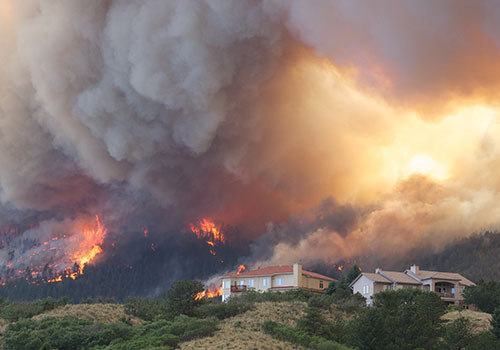
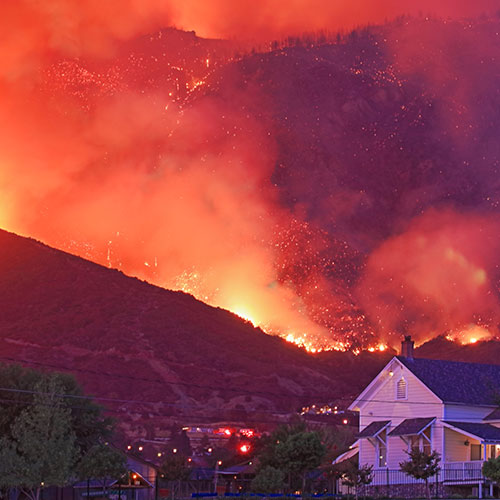
Wildfire activity in the United States has intensified significantly over the past decade. Longer fire seasons, hotter temperatures and drier conditions have contributed to more frequent, fast moving and severe wildfire events across both rural and urban communities within the wildland-urban interface (WUI) area.
The identified WUI area continues to expand by approximately two million acres per year – increasing the number of homes and critical facilities exposed to wildfire hazards and highlighting the growing need for proactive mitigation and resilient construction practices.
Wildfire Related Losses
More than 46 million homes in 70,000 communities are at risk from wildfire in the WUI. This expanding exposure creates cascading impacts for housing availability, insurance markets, local economies and recovery timelines.
The National Interagency Fire Center (NIFC) National Significant Wildland Fire Potential Outlook (issued April 1, 2026) documented that as of March 31, 2026, 1,615,683 acres have burned nationally — 231 percent of the previous ten-year average — with 16,746 wildfires reported (also above average).
Additionally, over the past 15 years, wildland fires have destroyed more than 100,000 structures in the U.S., with 70 percent of these losses occurring since 2018.
The cost of wildfire includes structural losses, infrastructure damage, business interruption, environmental impacts and long term health consequences from smoke exposure.

Losses Avoided Through Building Codes and Mitigation
Mitigation remains one of the most effective tools for reducing wildfire risk and long term costs. Communities that adopt and enforce modern construction codes experience significantly lower losses during hazard events. The International Wildland-Urban Interface Code® (IWUIC) is designed specifically to address the vulnerabilities that drive large-loss WUI disasters, including ember exposure, radiant heat and direct flame contact.
FEMA's Building Code Save: Fire Hazards Pilot Study estimates modern wildfire-related building codes produce billions in avoided losses over the useful life of homes in studied wildfire-prone areas.
Using the International Codes (I‑Codes) to Mitigate Wildfire Hazards
The International Codes® (I Codes®), including the 2024 IWUIC, provides a comprehensive framework for designing, constructing and retrofitting buildings to be more wildfire resilient.
The IWUIC establishes regulations to safeguard life and property from the intrusion of wildland fire and to help prevent structure fires from spreading to wildland fuels. It focuses on practical measures that reduce the likelihood of building ignition from embers, radiant heat and direct flame contact, and it is designed to be compatible with the full suite of I Codes.
The 2024 IWUIC addresses four broad areas:
- WUI Area Designation: Where the code applies after state/local WUI mapping or formal designation process
- Ignition-resistant construction: Building features and materials that reduce ignition risk, especially from embers
- Defensible Space and Vegetation Management: Requirements for managing fuels near structures to reduce wildfire intensity
- Access, Water Supply and Fire Protection: Community provisions that support firefighting operations, including access, water supply and fire protection
Key Wildfire Provisions
Click book cover below to reveal/hide code sections.

International Wildland Urban Interface Code®
Chapter 1 – Scope and Administration
Chapter 1 establishes the administrative framework for applying the IWUIC when adopted by a state or jurisdiction. It addresses scope, administration and how the adoption - such as whether appendices are enforceable - is activated through an adopted ordinance and the authority of the code official.
Key IWUIC references: Chapter 1, including Section 101.2.1 (Appendices).
Key terms (defined in Chapter 2): Scope, Applicability, Code official/authority, Permits, Construction documents, Approved agency, Alternative materials or methods, Appeals.
Chapter 2 – Definitions
Chapter 2 provides definitions used throughout the IWUIC. These definitions support consistent interpretation and enforcement of WUI area designations, defensible space, ignition-resistant construction and fire protection concepts across the code.
Key IWUIC references: Chapter 2, including Sections 201 (General) and 202 (Definitions).
Key terms (defined in Chapter 2): Wildland-urban interface area, Wildfire, Defensible space, Fire hazard severity, Ignition-resistant construction, Fuel (light/medium/heavy).
Chapter 3 — Wildland-Urban Interface Areas
Chapter 3 explains how WUI areas are identified so a community can determine where IWUIC requirements apply. It supports both mapped and procedure-based designation approaches and provides a basis for documenting designations and updates over time.
Key IWUIC references: Sections 301 (General) and 302 (WUI area designations), including Sections 302.2 (Mapping) and 302.3 (Review of WUI areas).
Key terms (defined in Chapter 2): Wildland-urban interface area, Wildland, Mapping of wildland-urban interface area, Wildland-urban interface area designations, Findings of fact, Fire hazard severity, Fire hazard severity form.
Chapter 4 — Wildland-Urban Interface Area Requirements
Chapter 4 addresses site and development requirements for projects in designated WUI areas. The provisions focus on enabling safe and effective fire service operations by addressing access and related infrastructure considerations which are often coordinated with local fire department standards.
Key IWUIC references: Sections 401 (General) through 405 (as applicable), including Sections 402.1.1 (Access), 403.2 (Driveways), and 403.3 (Fire apparatus access road).
Key terms (defined in Chapter 2): Access, Driveways, Fire apparatus access road, Address markers, Subdivision, Service utilities, Water supply, Fire flow calculation area.
Chapter 5 — Special Building Construction Regulations
Chapter 5 focuses on how buildings can better resist wildfire exposures. It provides ignition-resistant construction concepts and requirements based on identified severity level intended to reduce susceptibility to ignition, with emphasis on common ignition pathways such as embers and exposure to heat and flame.
Key IWUIC references: Sections 501 (Scope) and 503 (Ignition-Resistant Construction and Material).
Key terms (defined in Chapter 2): Ignition-resistant construction (Classes 1–3), Ignition-resistant building material, Noncombustible, Roof assembly, Roof covering, Noncombustible roof covering, Fire-retardant-treated lumber or wood, Multilayered glazed panels, Flame spread index.
Chapter 6 — Fire Protection Requirements
Chapter 6 addresses wildfire-related fire protection measures that complement site and construction provisions. It includes topics such as automatic suppression provisions (where applicable), fuel modification concepts, defensible space maintenance, and fire protection considerations for hazards and equipment commonly present in WUI settings.
Key IWUIC references:Selected sections include 602.1 (Automatic sprinkler systems), 603.2 (Fuel modification), 604 (Defensible space/maintenance), and 606 (Liquefied petroleum gas installations).
Key terms (defined in Chapter 2): Automatic sprinkler systems, Defensible space, Maintenance of defensible space, Fuel modification, Fuel modification distance, Vegetation control, Vegetation management plan, LP-gas installations, Storage of firewood and combustible materials, Spark arrestors.
Chapter 7 — Referenced Standards
Chapter 7 lists the external standards that are referenced by the IWUIC. When a state or jurisdiction adopts the IWUIC, these referenced standards become part of the compliance framework for IWUIC provisions that rely on test methods, product standards and installation criteria.
Key IWUIC references: Chapter 7 (Referenced Standards).
Key terms (defined in Chapter 2): Referenced standards, Approved, Approved agency, Listed (as applicable), Inspection and enforcement.
Appendices (Optional—Apply Only When Adopted)
Appendices provide supplemental tools and provisions that a state or jurisdiction may choose to adopt. Their applicability depends on adoption language (see Section 101.2.1).
- Appendix A — General Requirements
Appendix A provides supplemental fire protection measures that support wildfire risk reduction, including vegetation control, ignition source controls, storage practices and protection of water supply equipment. It can be adopted to supplement Chapter 6 where a jurisdiction wants additional operational and preventive measures.
Key IWUIC references: Appendix A, including Sections A101 (General) and A102 (Vegetation control).
Key terms (defined in Chapter 2): Vegetation control, Ignition source control, Control of storage, Hazardous materials, Protection of pumps and water storage facilities, Temporary structures and uses.
- Appendix B — Vegetation Management Plan
Appendix B provides a framework for preparing a vegetation management plan when required. It helps document the actions, methods and schedules that will be used to manage fuels and defensible space in a way that is clear, repeatable and maintainable.
Key IWUIC references: Appendix B, including Sections B101.1 (Scope) and B101.2 (Plan content).
>Key terms (defined in Chapter 2): Vegetation management plan, Defensible space, Fuel mosaic, Fuel-loading, Fire-resistive vegetation.
- Appendix C — Fire Hazard Severity Form
Appendix C provides a form-based tool that jurisdictions may use to document fire hazard severity considerations. This can support consistent determination and communication of wildfire exposure and severity classifications in local implementation.
Key IWUIC references: Appendix C, including Section C101.1 and Table C101.1 (as applicable).
Key terms (defined in Chapter 2): Fire hazard severity, Fire hazard severity form, Critical fire weather, Slope.
- Appendix D — Fire Danger Rating System
Appendix D provides a structured fire danger rating approach that can support operational decisions during periods of heightened wildfire risk. When adopted, it can help guide restrictions or heightened precautions in WUI areas during critical fire weather.
Key IWUIC references: Appendix D (Fire Danger Rating System).
Key terms (defined in Chapter 2): Fire danger rating system, Fire danger rating, Critical fire weather.
- Appendix E — Findings of Fact
Appendix E provides a findings-of-fact framework that can support documentation for WUI designations and other determinations where a documented basis is needed. It helps create transparent, repeatable decision-making processes.
Key IWUIC references: Appendix E (Findings of Fact).
Key terms (defined in Chapter 2): Findings of fact, Mapping, Wildland-urban interface area designations.
- Appendix F — Characteristics of Fire-Resistive Vegetation
Appendix F provides information on characteristics associated with fire-resistive vegetation. It can be used as guidance when evaluating landscaping and vegetation choices that contribute to reduced ignition potential near structures.
Key IWUIC references: Appendix F (Characteristics of Fire-Resistive Vegetation.
Key terms (defined in Chapter 2): Fire-resistive vegetation, Trees, Tree crown.
- Appendix G — Self-Defense Mechanism
Appendix G provides alternative concepts that jurisdictions may use as an implementation tool for communities and property owners to help protect exposed structures. Where used, it can help organize protective actions and increase options for structure preparedness.
Key IWUIC references: Appendix G (Self-Defense Mechanism).
Key terms (defined in Chapter 2): Self-defense mechanism, Emergency access, Fire weather.
- Appendix H — IWUIC Flowchart
Appendix H provides a flowchart-style navigation aid intended to help users understand the application of the IWUIC. It may support consistent application and communication of requirements based on fire hazard severity.
Key IWUIC references: Appendix H (International Wildland-Urban Interface Code Flowchart).
Key terms (defined in Chapter 2): Flowchart, Applicability, Compliance alternatives.
Wildfire Resources

Preparedness
Emergency Planning
Visit Ready.gov for emergency planning, evacuation preparation, alerts and household readiness resources for wildfire events.
National Trends
For current conditions and national trends, see the National Significant Wildland Fire Potential Outlook from the National Interagency Fire Center (NIFC).

Response
Stay Safe
Learn how to stay safe during and after a wildfire. Follow evacuation orders, avoid smoke exposure and stay informed through local emergency alerts.

Recovery
Rebuilding Resiliency
Rebuilding with the I-Codes and IWUIC helps communities recover stronger, reduce future wildfire losses, and create a more resilient future for residents, businesses, and critical infrastructure.
Pairing Mitigation with Local Recovery
When communities begin recovering after a wildfire, it’s essential to rebuild with future resilience in mind. Local governmental leaders, recovery committees and planning groups can integrate mitigation into every recovery decision by using established assessment methods, such as state and local hazard mitigation plans and applying a multi-hazard approach to rebuilding.

Use wildfire mitigation plans as roadmaps
Reference state or local hazard mitigation plans to guide decisions on where and how recovery projects should be designed, funded and implemented.

Conduct post‑wildfire damage & risk assessments
Evaluate the extent of damage, identify recurring problem areas and document vulnerabilities to inform mitigation‑focused rebuilding.

Embed mitigation in all recovery discussions
Ensure that community town hall meetings, planning meetings and community workshops include mitigation options as part of every proposed solution.

Prioritize multi‑hazard strategies
Consider community hazards and risks beyond wildfires (e.g. flooding, tornado, earthquakes, etc.) and pursue solutions that reduce exposure to multiple hazards at once.

Leverage recovery funding for mitigation
Explore opportunities within federal, state and local disaster assistance funding programs that allow or encourage mitigation as part of repair and reconstruction.

Rebuild with resilience
Encourage use of ignition-resistant materials, installation methods and infrastructure designs that address long‑term risk.

Engage the community
Involve residents, businesses and local organizations to ensure mitigation measures reflect community needs and support long‑term resilience.