
Hail Mitigation
Hail is one of the most frequent and costly severe-weather hazards in the United States, affecting homes, businesses, community infrastructure and critical services. From small hail to destructive large hailstones, these events can damage roofs, exterior walls, openings, rooftop equipment and vehicles, creating long-term consequences for property owners, local economies and community recovery.
The effective application of modern building codes and standards plays a critical role in reducing damage, improving resilience and helping communities recover more quickly after these events.
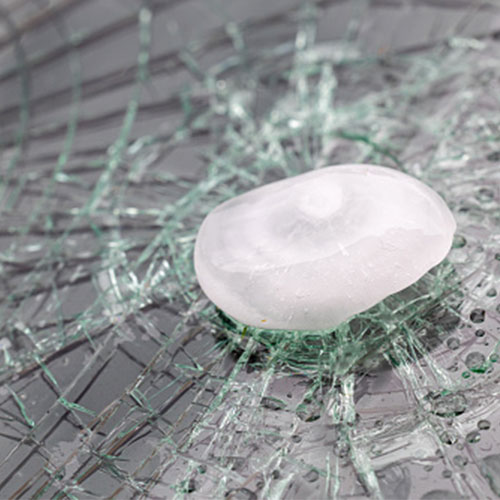

How Often Hail Events Occur
Hailstorms occur across the United States every year. Records from the National Oceanic and Atmospheric Administration (NOAA) document nearly 9,000 hail events in the US with hail two inches or larger in the past 10 years. These storms can develop quickly within severe thunderstorms and produce hail large enough to damage homes, vehicles, businesses, crops, livestock and exposed infrastructure.
Hail-Related Losses
In 2024, severe weather and hail accounted for 11 of the nation’s billion-dollar weather and climate disasters, contributing to a year with 27 total billion-dollar disasters and approximately $182 billion in damages. These losses reinforce the need for modern codes, resilient materials and mitigation strategies that reduce damage before the next storm occurs.

Losses Avoided Through Building Codes and Mitigation
Mitigation through code adoption and implementation is one of the most cost effective strategies communities can use to reduce the long-term impacts of hail, including insurance costs.
The National Institute of Building Sciences found that current code requirements save $11 for every $1 invested, while adding about 1 percent to construction costs.
Using the International Codes (I‑Codes) to Mitigate Hail Hazards
The International Codes® (I Codes) provide a comprehensive framework for designing, constructing and retrofitting buildings to be more hail resilient. Excerpts of hail-related provisions from the 2024 I-Codes can be accessed here.
Key Hail Provisions in the I-Codes
Click book cover below to reveal/hide code sections.

International Existing Building Code®
Chapter 3 Provisions for All Compliance Methods
Chapter 3 explains the three compliance options which include repairs from extreme weather events such as hail are to comply with the provisions of Chapter 4.
- 301.2 Repairs This section specifies that repairs are to comply with the requirements of Chapter 4.
Section 309 Additions and Replacements of Exterior Wall Coverings and Exterior Wall Envelopes
This section also specifies that the provisions of Section 309 apply to all repairs from extreme weather events regardless of compliance method.
Chapter 4 Repairs
Chapter 4 provides requirements for repairs of existing buildings. The provisions within this chapter define conditions under which repairs may be made using materials and methods like those of the original construction or the extent to which repairs must comply with requirements for new buildings.
- 401.2 Compliance This section states that any repair work cannot make the building less complying than it was before the repair was undertaken. Further, work on nondamaged components that is necessary for the required repair of damaged components shall be considered part of the repair and shall not be subject to requirements for alterations. This would include any building envelope components, except roofing, that is damaged by hail.
Chapter 7 Alterations—Level 1
Chapter 7 provides the technical requirements for those existing buildings that undergo Level 1 alterations, which include replacement or covering of existing materials, elements, equipment or fixtures using new materials for the same purpose. The purpose of this chapter is to provide detailed requirements and provisions to identify the required improvements in the existing building elements, building spaces and building structural system. This chapter requires only replacement of building components with new components.
- 702.7 Materials and methods This section specifies that any new work shall comply with the materials and methods requirements in the International Building Code, that specify material standards, detail of installation and connection, joints, penetrations and continuity of any element, component or system in the building.
- 705.1 General This is the section that specifies that the materials and methods used for recovering or replacing an existing roof covering are to comply with the requirements of Chapter 15 of the International Building Code.
International Residential Code®
Chapter 7 Wall Covering
Chapter 7 establishes the various types of materials, materials standards and methods of application permitted for exterior wall coverings. Exterior wall coverings regulated by this section include aluminum, stone and masonry veneer, wood, hardboard, particleboard, wood structural panel siding, wood shakes and shingles, exterior plaster, steel, vinyl, fiber cement and exterior insulation finish systems. This chapter also contains requirements for the use of vapor retarders for moisture control in walls; wind resistance and water-resistive barriers for exterior wall coverings; and the water resistive barrier required beneath exterior materials. All of which are intended to provide protection from extreme weather events such as hail.
Section R701 General
- R701.2 Installation This section establishes the requirement that all products sensitive to adverse weather shall not be installed until adequate weather protection for the installation is provided.
Section R703 Exterior Wall Covering
This section requires exterior walls to provide the building with a weather-resistant exterior wall envelope and to include flashing as described in Section R703.4.
- R703.1.1 Water resistance This section establishes the requirement that the exterior wall envelope is to be designed and constructed to prevent the accumulation of water within the wall assembly by providing a water-resistive barrier behind the exterior cladding.
- Section R703.1.2 Wind resistance This section establishes the requirement that wall coverings, backing materials and their attachments are to be capable of resisting wind loads including wind-pressure resistance of the siding, exterior soffit and backing materials.
Chapter 9 Roof Assemblies
Chapter 9 addresses the design and construction of roof assemblies and establishes requirements aimed at providing protection from extreme weather events such as hail. Roof assemblies include the roof deck, substrate or thermal barrier, insulation, vapor retarder and roof covering. The extreme weather event requirements include wind resistance of roof coverings. The types of roof covering materials and installation addressed by Chapter 9 are: asphalt shingles, clay and concrete tile, metal roof shingles, mineral-surfaced roll roofing, slate and slate-type shingles, wood shakes and shingles, built-up roofs, metal roof panels, modified bitumen roofing, thermoset and thermoplastic single-ply roofing, sprayed polyurethane foam roofing, liquid applied coatings and building-integrated photovoltaic (BIPV) roof coverings.
Section R903 Weather Protection
This section establishes the requirement that roof decks are to be covered with approved roof coverings secured to the building or structure and designed and installed in accordance with this code and the approved manufacturer’s instructions such that the roof assembly shall serve to protect the building or structure.
Section R904 Materials
The requirements set forth in this section apply to the application of roof covering materials and that they are to be applied in accordance with this chapter and the manufacturer’s installation instructions.
- R904.2 Compatibility of materials This section establishes the requirement that roof assemblies are to be constructed of materials that are compatible with each other and with the building or structure to which the materials are applied.
Section R905 Requirements for Roof Coverings
The requirements set forth in this section establish that roof coverings are to be applied in accordance with the applicable provisions of this section and the manufacturer’s installation instructions and are to resist component and cladding loads.
International Building Code®
Chapter 14 Exterior Walls
Chapter 14 addresses requirements for exterior walls of buildings. Minimum standards for wall covering materials, such as material performance, installation of wall coverings and the ability of the wall to provide weather protection from events such as hail. Specifically, the provisions of this chapter establish the minimum requirements for exterior walls, exterior wall assemblies, exterior wall coverings, exterior wall openings, exterior windows and doors, exterior soffits and fascias, and architectural trim to provide protection from the exterior environment.
- 1402.2 Weather protection
This section requires that the exterior wall assembly be designed and constructed in such a manner as to prevent the accumulation of water within the exterior wall assembly by providing a water-resistive barrier behind the exterior veneer, as described in Section 1403.2, and a means for draining water that enters the assembly to the exterior.
Sections 1406 through 1411
These sections address specific materials which includes: Metal Composite Material (MCM), Exterior Insulation and Finish Systems (EIFS), High-Pressure Decorative Exterior-Grade Compact Laminates (HPL), Insulated Metal Panel (IMP), Plastic Composite Decking, Building-Integrated Photovoltaic (BIPV) Systems for Exterior Wall Coverings and Fenestration.
Chapter 15 Roof Assemblies And Rooftop Structures
Chapter 15 provides minimum requirements for the design and construction of roof assemblies and rooftop structures to provide weather protection from events such as hail. The criteria address the weather-protective barrier at the roof. The chapter is largely prescriptive in nature and is based on decades of experience with various traditional materials, but it also recognizes newer products.
Section 1503 Weather Protection
This section requires that roof decks are to be covered with approved roof coverings secured to the building or structure in accordance with the provisions of this chapter and installed in accordance with this code and the manufacturer’s approved instructions.
Section 1506 Materials
This section deals with the materials used and establishes requirements for labeling and product identification. Specifically, roof-covering materials are to be delivered in packages bearing the manufacturer’s identifying marks and approved testing agency labels.
Section 1507 Requirements for Roof Coverings
This section establishes the minimum requirements for roofing systems which include: Asphalt Shingles, Clay and Concrete Tile, Metal Roof Panels, Metal Roof Shingles, Mineral-Surfaced Roll Roofing, Slate Shingles, Wood Shingles, Wood Shakes, Built-Up Roofs, Modified Bitumen Roofing, Single-Ply Roofing, Sprayed Polyurethane Foam Roofing, Liquid-Applied Roofing, Vegetative Roofs and Landscaped Roofs, BIPV Shingles, and Building-Integrated Photovoltaic Roof Panels.
Chapter 16 Structural Design
Chapter 16 establishes minimum design requirements so that the structural components of buildings are proportioned to resist the loads that are likely to be encountered. In addition, this chapter assigns buildings and structures to risk categories that are indicative of their intended use. The loads specified herein along with the required load combinations have been established through research and service performance of buildings and structures. The application of these loads and adherence to the serviceability criteria enhance the protection of life and property.
- 1603.1 General Establishes minimum requirements for construction documents. It specifies that they are to show, among other things, the design loads and other information pertinent to the structural design required by Sections 1603.1.1 through 1603.1.9 on the construction documents. The minimum requirements for design loads include: Floor and roof dead and live loads, Ground snow load and allowable stress design ground snow load, Basic wind speed, allowable stress design wind speed and wind exposure, Seismic design category and site class, Flood design data, and Rain load data.
- 1604.4 Analysis This section requires that all load effects on structural members and their connections shall be determined by methods of structural analysis that take into account equilibrium, general stability, geometric compatibility and both short- and long-term material properties. Further, members that tend to accumulate residual deformations under repeated service loads shall have included in their analysis the effects of added deformations expected to occur during their service life.
- 1609.2 Protection of openings This section addresses protecting openings from windborne debris. Specifically, in windborne debris regions, glazing in buildings shall be impact resistant or protected with an impact-resistant covering meeting the requirements of an approved impact-resistant standard or ASTM E1996.
- 1609.2.2 Garage doors Similarly, this section addresses protecting glazing within garage doors from windborne debris and requires that they meet the requirements of an approved impact-resisting standard or ANSI/DASMA 115.
Hail Resources

Preparedness
Emergency Planning
Visit Ready.gov for emergency planning, evacuation preparation, alerts and household readiness resources for hail events.
Storm Preparedness
Learn how to stay safe before, during and after a winter storm. For more information on winter alerts, science and hazards, snow coverage maps and information describing the different types of winter storms.
Training for Officials
When Disaster Strikes Institute’s Disaster Planning for the Building Department course outlines roles, responsibilities and readiness strategies before hail-related disasters.

Response
Stay Safe
Learn how to stay safe during and after a hail event. Follow evacuation orders, avoid debris and flooded areas, and stay informed through local emergency alerts.
Training for Officials
ICC's When Disaster Strikes Institute’s Initial and Preliminary Damage Assessment and Building Safety Evaluator training courses train how to safely assess post event structures and determine habitability.

Recovery
International Codes®
Updated 2024 I Codes include clarified definitions and documentation requirements to support efficient recovery and consistent enforcement.
Pairing Mitigation with Local Recovery
When communities begin recovering after a hail event, it’s essential to rebuild with future resilience in mind. Local governmental leaders, recovery committees and planning groups can integrate mitigation into every recovery decision by using established assessment methods, such as state and local hazard mitigation plans and applying a multi-hazard approach to rebuilding.

Use hazard mitigation plans as roadmaps
Reference state or local hazard mitigation plans to guide decisions on where and how recovery projects should be designed, funded and implemented.

Conduct post‑event damage & risk assessments
Evaluate the extent of damage, identify recurring problem areas and document vulnerabilities to inform mitigation‑focused rebuilding.

Embed mitigation in all recovery discussions
Ensure that community town hall meetings, planning meetings and community workshops include mitigation options as part of every proposed solution.

Prioritize multi‑hazard strategies
Consider community hazards and risks beyond hail events (e.g. flooding, wildfire, tornado, etc.) and pursue solutions that reduce exposure to multiple hazards at once.

Leverage recovery funding for mitigation
Explore opportunities within federal, state and local disaster assistance funding programs that allow or encourage mitigation as part of repair and reconstruction.

Rebuild with resilience
Encourage use of hail-resistant materials, installation methods and infrastructure designs that address long-term risk.

Engage the community
Involve residents, businesses and local organizations to ensure mitigation measures reflect community needs and support long‑term resilience.