


Information & Advocacy
The International Code Council's (ICC) Fire and Disaster Mitigation (FDM) team has compiled resources to assist code officials, fire service professionals and community stakeholders in informed decision‑making, professional collaboration and effective implementation of strategies that strengthen resilience across the built environment.
This page includes information on ICC's Fire Service Membership Council, broader community engagement opportunities, key informational documents on emerging issues and a selection of reputable stakeholder organizations.










Find our more about or Stakeholder Organizations.
Fire Service Membership Council
The Fire Service Membership Council (FSMC) is a forum for concerns and issues that are of particular interest to the fire service. The FSMC facilitates the engagement of ICC members and stakeholders in the discussion and activities of interest to the fire service within the built environment. Members are encouraged to participate in ICC’s code development process, and to advise ICC on programs and policies, legislative matters, code adoption issues and such other matters as the FSMC deems appropriate. The FSMC is led by a Governing Committee comprised of fire officials from across the country, who guide the direction and activities of the FSMC.
Membership Qualifications
Membership in the FSMC is open to any individual who wishes to affiliate with the Fire Service Membership Council and is a member of ICC, an ICC Governmental Member Voting Representative, or employed by a jurisdiction or corporate member of ICC or a member in good standing of a closely aligned organization as approved by the ICC Board of Directors.
Join the FSMC
To join the FSMC, ICC members may access their myICC account and visit the FSMC site on ICC’s Member Community to sign up. Interested stakeholders or any general questions about the FSMC may be directed to Fire and Disaster Mitigation Program Manager Christine Reed. FSMC meeting information and general updates can be found on the ICC Member Community.
FSMC Governing Committee Members
Timothy Diehl, Howard County, MD; (IAFC: E); FSMC Chair
Doug Nelson, Bismarck, ND; (NASFM); FSMC Vice Chair
Bryan Adams, Pleasant Valley, OH
Ted Black, State of UT (NASFM)
Justin Sherwood, Bemidji, MN; (IAFC: GL)
Darcy Davidson, Carlsbad, CA
Michael Desrochers, State of VT
William Hyde, Rogers, AR (IAFC:SW)
Edward Kaminski, Clark County, NV
Kevin Lefebrve, Nisku, AB Canada (IAFC:C)
Jonathan Lund, Des Moines, IA; (IAFC:MV)
Larry Medina, State of OR (IAFC:W)
Kelly Nicolello, Fort Worth, TX
Brandon Sullivan, Colorado Springs, CO
Brendan O'Sullivan, Durham, NH (IAFC:NE)
Jon Davine, Stow, MA (NASFM)
Craig Landolt, Atlanta, GA (NASFM)
Sean Toomey, Concord, NH; ICC BOD Liaison
Karl Fippinger, Washington, DC; FSMC Staff Liaison
Christine Reed, Brea, CA; FSMC Staff Liaison
FSMC Governing Committee Meeting Schedule
The FSMC Governing Committee meets monthly and is open to all FSMC members and interested parties.
Virtual meetings take place on the third Thursday of each month at 1:30 pm ET (excluding in-person meetings). Meeting information, including the virtual meeting link, is listed in the Events section of the ICC Member Community.
Two in-person meetings are held annually in conjunction with the ICC Leadership Week in April and the ICC Annual Conference in October. These meetings are also open to all, and the meeting dates are listed on each event schedule.
Member Community
ICC's state-of-the-art Member Community is a free exclusive benefit offered only to ICC members. It's a self-service tool where building safety professionals can connect and network with other members, streamline communication and collaboration, create and share events and more.
The ICC Member Community App is now available on both Apple and Android devices. This powerful new tool puts a community of building safety professionals and a wealth of knowledge right at your fingertips. Learn more and download, here.
For any questions, please email membercommunity@iccsafe.org.
Stakeholder Organizations
International Association of Fire Chiefs (IAFC) represents the leadership of firefighters and emergency responders worldwide and provides leadership to current and future career, volunteer, fire-rescue and EMS chiefs, chief fire officers, company officers and managers of emergency service organizations throughout the international community.
The International Association of Firefighters (IAFF) is one of the largest and most influential labor unions in North America and is committed to advancing the rights, safety and future of fire fighters, emergency medical workers and rescue workers across the United States and Canada.
The National Volunteer Fire Council (NVFC) is the leading nonprofit membership association representing the interests of the volunteer fire, EMS, and rescue services. The NVFC serves as the voice of the volunteer in the national arena and provides critical resources, programs, education, and advocacy for first responders across the nation.

The U.S. Fire Administration supports and strengthens the fire and emergency medical services to prepare for, prevent, mitigate, and respond to all hazards.
Congressional Fire Services Institute (CFSI) educates members of Congress about the needs and challenges of the United States’ fire and emergency services to help them understand how the federal government can support the needs of local first responders.
National Association of State Fire Marshals NASFM’s mission is two-fold: To protect human life, property and the environment from fire, and to improve the efficiency and effectiveness of State Fire Marshals’ operations.

The Fire Safety Research Institute (FSRI) advances fire safety knowledge to address the world’s unresolved fire safety risks and emerging dangers. FSRI shares fire safety insights with everyone to advance UL’s public safety mission of providing safe living and working environments for people everywhere.
The National Institute of Standards & Technology (NIST) was founded in 1901 and is one of the nation's oldest physical science laboratories. Through its focus on buildings and construction, fire testing has been a cornerstone of NIST’s research. Its Disaster & Failure Studies Program assesses building performance in the wake of disasters and failure events.
Society of Fire Protection Engineers (SFPE) mission is to define, develop and advance the use of engineering best practices, expand the scientific and technical knowledge base, and educate the global fire safety community, to reduce fire risk
Insurance Institute for Business & Home Safety (IBHS) is an independent nonprofit scientific research and communications organization supported by property insurers, reinsurers, and affiliated companies. IBHS’s building safety research leads to real-world solutions for home and business owners, helping to create more resilient communities.
The Federal Emergency Management Administration (FEMA) mission is helping people before, during and after disasters. FEMA leverages a tremendous capacity to coordinate within the federal government to make sure America is equipped to prepare for and respond to and recover from disasters.

National Emergency Management Association (NEMA) provides national leadership and expertise in comprehensive emergency management, serves as a vital emergency management information and assistance resource, and advances continuous improvement in emergency management through strategic partnerships, innovative programs and collaborative policy positions.
The International Association of Emergency Managers (IAEM) is a non-profit educational organization dedicated to promoting the "Principles of Emergency Management" and representing those professionals whose goals are saving lives and protecting property and the environment during emergencies and disasters.
The Association of State Floodplain Managers is a 501(c)(3) scientific and educational nonprofit organization dedicated to reducing flood loss in the United States.
Building Safety Month
Building Safety Month is an international campaign held each May to raise awareness about the importance of safe building practices within the built environment. Everyone can play a role in enhancing building safety and reducing fire risks by supporting Building Safety Month initiatives.
The campaign features weekly themes, including one dedicated to practical safety tips for homes. Topics include fire prevention and awareness, smoke alarms and fire sprinklers, water and pool safety, disaster preparedness and electrical hazard awareness, with actionable strategies for each to help increase safer living spaces.
For more information on Building Safety Month and resources for fire safety at home, click here.
 .
.
Stay informed with essential industry updates and expert technical insights from the award-winning Building Safety Journal. Explore hundreds of free articles, including Batteries and ESS, Disaster Preparedness and Fire & Wildland Urban Interface-related content.
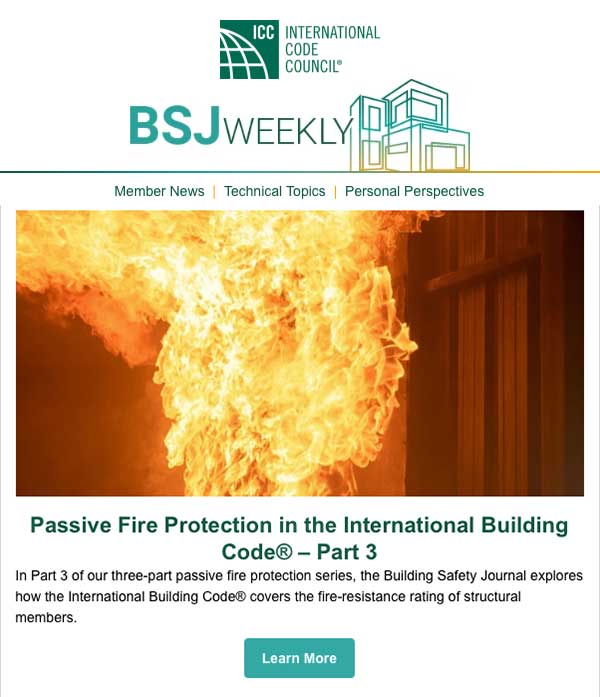
The Building Safety Journal (BSJ) Weekly is a free weekly newsletter from the International Code Council that compiles the latest news on the building safety and construction sectors, including fire-related news and updates, and is delivered to your inbox on Thursdays. Subscribe, here.
Training, Education and Certification
The International Code Council's (ICC) Fire and Disaster Mitigation (FDM) Team is committed to equipping professionals with the latest knowledge and practical skills to prevent, mitigate and respond to disasters effectively.
Below you'll find information on fire service and emergency management educational tracks, certifications and training materials to help you stay current with evolving codes and standards.
Fire Service & Emergency Management Educational Tracks
The International Code Council’s (ICC) Fire & Disaster Mitigation (FDM) Team is developing structured and comprehensive training tracks to support fire and emergency management professionals at every stage of their careers. These tracks will offer clear progression from foundational skills to advanced leadership, ensuring that professionals are equipped to protect communities and implement safety codes effectively.

Plan Review
Essential training for fire plans examiners to review construction documents, identify compliance issues and apply the latest fire and life safety requirements.

Inspections
Foundational training for fire inspectors, focusing on core skills such as code interpretation, field inspections and documentation.

Fire Marshal
Advanced curriculum for fire marshals, including leadership development, program management, community risk reduction strategies and technical expertise.

Disaster Mitigation/ Response
Training for building and fire code officials involved in disaster mitigation, preparedness, response and recovery.

Specialty & Hot Topics
Explore emerging and specialized areas in fire and disaster mitigation. These five tracks are designed to address evolving challenges and technologies.
- Battery Energy Storage Systems (BESS)
- Code Adoption & Legislative Process
- Fire & Life Safety Systems
- Hazardous Materials
- Wildland-Urban Interface (WUI)
Certifications
Why Get Certified?
ICC certifications are a globally-recognized mark of excellence. They validate technical expertise, enhance professional credibility and demonstrate commitment to public safety.
Benefits of Certification
- Career Advancement: Certifications open doors to promotions, specialized roles and leadership positions.
- Credibility: Gain recognition from peers, employers and jurisdictions around the world.
- Community Impact: Certified professionals play a vital role in reducing risk and improving safety in their communities.

Explore ICC Fire Code Certifications
- Fire Inspector I (66)
- Fire Inspector II (67)
- Fire Plans Examiner (F3)
- Fire Code Specialist
(combination designation) - Fire Marshal (combination designation)
- Commercial Fire Alarm Inspector
- Commercial Fire Sprinkler Inspector
- Commercial Fire Alarm Plans Examiner I
- Commercial Fire Alarm Plans Examiner II
- Commercial Fire Sprinkler Plans Examiner
- Residential Fire Sprinkler Plans Examiner
CEUs and Renewals
Maintain your ICC credentials with continuing education opportunities. ICC offers a variety of CEU-eligible courses to help you stay current with evolving codes and standards.
Reciprocal/Transition Certifications
ICC recognizes certifications from other professional organizations, allowing for streamlined transitions and cross-recognition.
Partner Organizations
- ProBoard (Fire Inspector I and Fire Inspector II)
- State of California (CA to ICC and ICC to CA)
- NCPCCI
Training Materials
Live/Online Training Courses
Participate in expert-led sessions available in both virtual and in-person formats. These courses cover essential topics in fire safety, inspections and emergency response.
Self-Guided Study Courses
Learn at your own pace with structured programs designed to help you prepare for certification exams and deepen your understanding of fire codes.
Study Guides & Materials
Access code-specific references, practice exams and support tools to help you prepare for exams effectively.
Online Learning Subscription
Join ICC code experts every Wednesday for 90-minute ICC Learn Live sessions covering a wide range of code topics.
Evaluation Reports
Product Compliance is a major pillar in the regulatory framework, and its importance only intensifies when new or innovative building materials/systems are not covered or addressed in the building codes. One way to accommodate the compliance procedure is to update the code to incorporate such changes; however, since the I-Codes are on a three-year update cycle, this option can be impractical and resource-intensive. The alternative approval process offered by the Evaluation Service Reports (ESRs) is a highly credible and rigorous solution. An ICC-ES Report (ESR) is a document that presents the product, scope of evaluation, proof of compliance, installation, and condition of use from a performance perspective. ESRs verify that building products comply with code requirements, acceptance criteria used to evaluate a product, how the product should be identified, installed and much more.

ICC-ES has expanded its scope of services to include evaluation to the following codes in the MENA region:
- United Arab Emirates (UAE): Dubai Building Code (DBC) set by Dubai Municipality and the Abu Dhabi International Building Code (ADIBC), set by the Abu-Dhabi Department of Municipality and Transport (AD-DMT).
- Kingdom of Saudi Arabia (KSA): Saudi Building Code (SBC) in the Kingdom of Saudi Arabi (KSA) set by the Saudi Building Code National Committee (SBCNC).
Visit ICC-ES’s ESRs online directory for more information on our evaluation scope.
Building Safety Regulatory Ecosystem Toolkit
This free, online toolkit is designed to be used by jurisdictions around the world to identify and improve the elements of their building safety regulatory ecosystems most critically in need. All essential elements of an effective building safety regulatory ecosystem are represented in the graphic and briefly described below. This page is a work in progress. Please check back soon for more information.
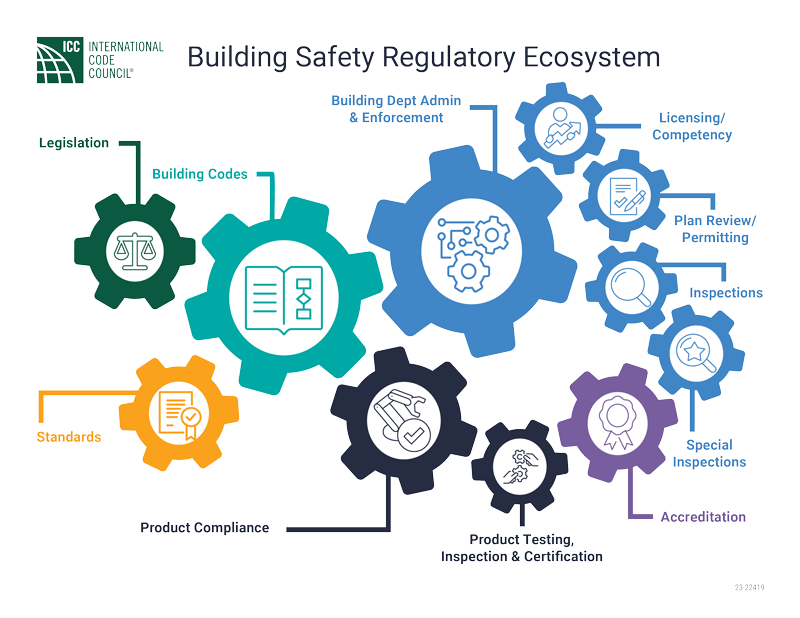

Legislation
In most countries, a law or act is required to implement a set of building regulations and set forth the framework for their enforcement. This resource offers the principles that should be included in enabling legislation for an effective building control system.

Building Code & Standards
The building code used in a jurisdiction should be right-sized and enforceable, and the standards referenced in that code should be aligned with both the code and the availability of materials and common construction practices in that jurisdiction. This resource provides a guide for creating or adapting a building code and aligning it with appropriate construction standards.

Building Department Administration & Enforcement
In order to coordinate compliance efforts, regulatory authorities need to be established to ensure that the intent of the building regulations is realized and it results in safer, more resilient, sustainable and affordable buildings. This resource offers the essential components and functions of an effective building department administration and enforcement network.

Licensing & Competency
Jurisdictions require a method to define, measure and monitor the required competencies for the various types of practitioners and construction professionals operating within the building control system. This resource offers a list of considerations for assessment, licensing and credentialing rules for jurisdictions to consider based on the availability of internal and external resources.

Plan Review & Permitting
Building designs and sites must be approved through a clearly defined and delineated process that ensures proper application of the building codes during the planning stages of building development activities. This resource provides guidance on establishing and maintaining these processes, which can be used to generate revenue to underwrite the operations of building departments.
Evaluation Reports
Product Compliance is a major pillar in the regulatory framework, and its importance only intensifies when new or innovative building materials/systems are not covered or addressed in the building codes. One way to accommodate the compliance procedure is to update the code to incorporate such changes; however, since the I-Codes are on a three-year update cycle, this option can be impractical and resource-intensive. The alternative approval process offered by the Evaluation Service Reports (ESRs) is a highly credible and rigorous solution. An ICC-ES Report (ESR) is a document that presents the product, scope of evaluation, proof of compliance, installation, and condition of use from a performance perspective. ESRs verify that building products comply with code requirements, acceptance criteria used to evaluate a product, how the product should be identified, installed and much more.
ICC-ES has expanded its scope of services to include evaluation to the following codes in the MENA region:
- United Arab Emirates (UAE): Dubai Building Code (DBC) set by Dubai Municipality and the Abu Dhabi International Building Code (ADIBC), set by the Abu-Dhabi Department of Municipality and Transport (AD-DMT).
- Kingdom of Saudi Arabia (KSA): Saudi Building Code (SBC) in the Kingdom of Saudi Arabi (KSA) set by the Saudi Building Code National Committee (SBCNC).
Visit ICC-ES’s ESRs online directory for more information on our evaluation scope.

Inspections
Inspectors, and special inspectors for certain types of construction and construction processes, with the necessary competencies and enforcement powers, should be conducting on-site inspections at all critical stages throughout the construction process. This resource is a guideline for establishing and maintaining an effective building inspection system, including consideration for qualifications, training and credentialing.

Product Compliance
Based on the mandated codes and standards, the jurisdictional authority will need a system in place to ensure that products specified in a building’s design are compliant – ideally using ISO/IEC 17065 accredited conformity assessment bodies. This resource references international best practices and tools to help determine which products should be regulated and which approaches to ensuring compliance are most appropriate.

Testing, Inspection & Certification (TIC) Services
If construction product assurance is to be dependable and transparent , it is necessary to have a system in place to certify those regulated products for compliance with the regulations through documented, effective TIC Services. This resource offers a guideline for establishing and maintaining competency of a robust system for the testing, inspection and certification system for construction products and systems.
Evaluation Reports
Product Compliance is a major pillar in the regulatory framework, and its importance only intensifies when new or innovative building materials/systems are not covered or addressed in the building codes. One way to accommodate the compliance procedure is to update the code to incorporate such changes; however, since the I-Codes are on a three-year update cycle, this option can be impractical and resource-intensive. The alternative approval process offered by the Evaluation Service Reports (ESRs) is a highly credible and rigorous solution. An ICC-ES Report (ESR) is a document that presents the product, scope of evaluation, proof of compliance, installation, and condition of use from a performance perspective. ESRs verify that building products comply with code requirements, acceptance criteria used to evaluate a product, how the product should be identified, installed and much more.
ICC-ES has expanded its scope of services to include evaluation to the following codes in the MENA region:
- United Arab Emirates (UAE): Dubai Building Code (DBC) set by Dubai Municipality and the Abu Dhabi International Building Code (ADIBC), set by the Abu-Dhabi Department of Municipality and Transport (AD-DMT).
- Kingdom of Saudi Arabia (KSA): Saudi Building Code (SBC) in the Kingdom of Saudi Arabi (KSA) set by the Saudi Building Code National Committee (SBCNC).
Visit ICC-ES’s ESRs online directory for more information on our evaluation scope.

Accreditation
Entities (such as material testing laboratories, certification bodies, and inspection agencies) entrusted with compliance functions should be accredited to the appropriate ISO conformity assessment standard to ensure their impartiality and competence. This resource will help to determine accreditation requirements and to assess the best approach for establishing a system of accreditation.
Batteries & Energy Storage Systems (ESS)
Lithium-ion batteries are rechargeable batteries known for their lightweight and long-lasting properties. They can be found in electric vehicles and battery energy storage systems (ESS), as well as smaller devices including e-bikes, e-scooters, cell phones, computers and hoverboards. Despite their wide range of uses in commercial and residential settings, these technologies present unique safety challenges.
New innovations and battery chemistries continue to be developed, challenging manufacturers, code officials and consumers to stay up-to-date on operational best practices of the technology.
Learn how codes, standards and guidelines are adapting to support the safe use, manufacture, storage, use and recycling of batteries and ESS, and find key resources to help ensure protection for installers, code officials, system designers, retailers and everyday users.

Battery and ESS Basics: What You Need to Know
From personal electronics to mobility devices, the consumer demand for reliable stored energy is drastically increasing. These needs are further increased by the desire for more clean energy in the automotive sector as well as the growing demand for improvements to our utility systems and the need for more stored energy.
As the development, manufacture and use of these batteries increases, attention to the storage, handling, disposal and recycling of new and aged battery units is crucial to ensure health and safety in the built environment and develop future code considerations that address battery chemistries and technologies.
To ensure performance, longevity and safety, it’s critical to follow best practices throughout the lifecycle of lithium-ion batteries and ESS.


Batteries in Emergency Planning and Response
Many U.S. states and other countries have experienced a significant surge in fires associated with lithium-ion batteries.
The use of lithium-ion batteries as ESS in our homes can create a potential need for early identification in post incident mitigation and evaluation. Containment, collection and disposal of batteries impacted by a disaster, especially involving fire or flood, takes much care and consideration as part of the response and recovery phases of disaster management.
Training emergency responders and managers to stay up to date in codes, regulations and best practices of battery handling is critical to maintain community awareness and safety. This is especially crucial after a disaster when damaged batteries are left in homes and buildings affected by the disaster.
The Code Council’s When Disaster Strikes (WDS) Institute prepares participants to properly evaluate damage through instruction, interactive activities and review of case studies. The goals of the WDS Institute are to increase the number of trained and qualified Post-Disaster Building Safety Evaluators and Post-Disaster Building Safety Evaluation Coordinators and to increase awareness regarding when and how to perform Post-Disaster Building Safety Evaluations. Learn more here.

Codes and Standards
Adopting and implementing current building codes and standards ensures that lithium-ion batteries and ESS are installed, operated and maintained safely to minimize risks of fire, electrical hazards and system failures.
The International Code Council (ICC), through its membership, code action committees and the code development process, has rapidly developed the I-Codes since the 2015 editions of the International Fire Code® (IFC), International Building Code® (IBC) and International Residential Code® (IRC) to incorporate the evolving and advancing battery chemistries and technologies. These codes and standards incorporate the latest research and best practices, helping protect both occupants and first responders while supporting the safe integration of advanced energy technologies.
Over the past two code development cycles, the collaborative efforts of ICC Code Action Committees and various Code Development Committees have established and enhanced a minimum level of battery safety across the built environment.
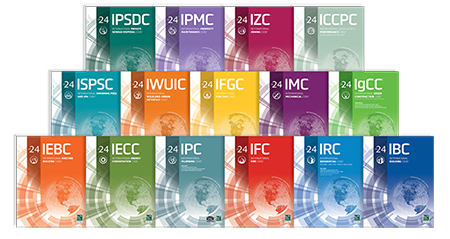
This progress is evident in the 2024 suite of I-Codes including the IFC, IBC and IRC as shown in the ESS Development Time frame recap below.

2000-2015
Early Considerations for Battery Storage and Fire Safety

2018
IBC/IFC: Initial Recognition of Lithium-Ion and Emerging Technologies

2018
IBC/IFC: Expansion of Fire Protection Requirements for Energy Storage

2021
IBC/IFC/IRC: Refining ESS Regulations and Integration of Large-Scale Systems

2024
IBC/IFC/IRC: A Comprehensive Framework for ESS in the Built Environment
Resources

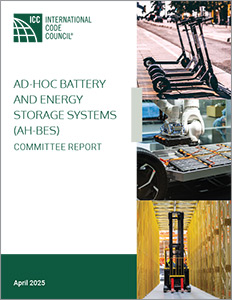
The ICC Ad-Hoc Battery and Energy Storage Committee's efforts are documented in this comprehensive report that includes how and where batteries and ESS are used in the built environment, details the committee's code gap analysis approach, highlights areas of focus within future I-Codes, examines professional training and community education needs, and explains necessary public awareness strategies for maintenance and charging of personal mobility devices.
ICC Fire and Disaster Mitigation
The International Code Council’s (ICC) Fire and Disaster Mitigation (FDM) Team brings together a powerhouse of experts in building and fire codes, emergency management, disaster mitigation, wildfire preparedness and mitigation, and public safety awareness and professional leadership. Our team, located across the country, supports ICC membership and stakeholders involved with fire and disaster management. This allows for greater presence in national, state and regional efforts for building code officials, fire code officials, and emergency managers.


Our Mission

Meet the Team

Areas of Focus
Our Mission

Protect Communities and Property
Protect the built environment, including occupants and responders, from fire and disaster losses that result in significant damage to property, injuries, loss of life and disruptions to business operations and infrastructure.
Advance Code-Based Disaster Mitigation
Advocate for the effective use of the International Codes® (I-Codes) to mitigate natural hazards in the built environment. Reduce property damage and loss of life by taking proactive steps to lessen the impact of natural hazards, ultimately creating safer and more resilient communities and enabling faster recovery.
Strengthen Member and Stakeholder Engagement and Partnerships
Deepen ICC engagement with the fire service, code officials, emergency managers, design professionals and the engineering community. This includes assessing, developing and implementing new tools, resources, products and services for fire service and emergency management stakeholders.
Build Capacity Through Training, Education and Certification
Facilitate specialized training, education and certification programs to enhance the capabilities of fire service, code professionals and disaster mitigation personnel.
Support Legislative and Policy Initiatives
Track congressional and legislative activities related to fire safety and disaster resilience.
Provide Support and Resources
Support code officials and emergency management personnel through guidance, resources and insights from lessons learned to prepare for future challenges.
Promote ICC and Committee Participation
Encourage and support participation in ICC membership councils and ICC committees, including the Fire Code Action Committee and the Fire Service Membership Council, to advance professional engagement, code development and community advocacy.
Deliver Trusted Information and Technical Resources
Provide timely, relevant information and tools to code officials and emergency managers to address emerging issues and trends effectively.





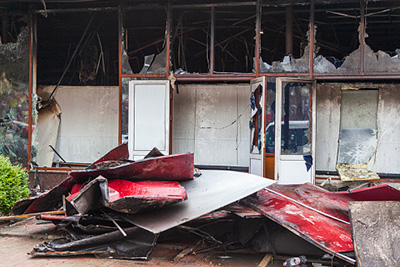

Meet the Fire & Disaster Mitigation Team
With decades of combined experience across federal, state and local jurisdictions, the FDM team is committed to advancing resilient codes and standards and supporting communities in reducing community risks from natural and human-caused hazards.
The FDM team works hand-in-hand with the International Code Council’s Government Relations and Technical Services – Fire Protection Engineering (FPE) teams to drive member engagement, advocacy and information sharing.





Areas of Focus

Wildfire Preparedness & Mitigation
Explore proactive approaches to wildfire prevention, response and recovery. Learn how communities and individuals can reduce risk and build resilience in the Wildland-Urban Interface through collaboration, preparedness and the application of the International Wildland-Urban Interface Code®.

Disaster
Mitigation
Identify strategies to minimize the impact of disasters such as floods, hurricanes and earthquakes. Learn about the four phases of emergency management and how to build resilience in your community.

Battery & Energy Storage Systems
Examine how batteries and energy storage systems are used in communities and their associated risks. Explore best practices for battery manufacturing, installing battery energy storage systems, and proper charging and maintenance of personal battery-powered devices.

Training, Education and Certification
Expand knowledge and expertise in fire and disaster mitigation strategies. Explore resources for training, education, certifications and career tools that support professional advancement and proficiency of code professionals and emergency managers.

Information & Advocacy
Find sharable resources to promote awareness about the importance of community risk reduction, fire prevention and disaster mitigation. Learn about current community fire risks in your community.

Post-Disaster Rebuilding
Establish a framework for post-disaster rebuilding including adopting, implementing and enforcing the most recent editions of the I-Codes, coupled with best practices and a strong commitment to increasing community resilience.
Technical Resources
The FDM Team curates essential technical provisions of the I-Codes, broken down by risk, hazards, into an easily accessible and understandable set of online technical resources. From battery and energy storage systems to wildfires, hurricanes, floods, tornadoes, and earthquakes – this is your one-stop, comprehensive source for tools and resources to mitigate and strengthen the built environment to withstand all-hazards in your community. Coming soon!
Current Topics & What’s New
Every three-year cycle of code development brings new thoughts and challenges to fire and disaster mitigation professionals. Here we track the latest topics of interest and provide insights about the code proposals of interest to you.
- Building Safety Journal: ICC Pulse Podcast Episode 65: Lahaina’s Fire and the Future of Resilient Building in Hawaii
- Building Safety Journal: Mexico City Hosts Key Fire Safety Training and Collaboration Event with the Code Council, AMRACI and CONAPCI
- Building Safety Journal: The International Code Council Supports Federal Government Leaders in Advancing Building Codes for Wildfire Prevention and Disaster Mitigation
- Building Safety Journal: UL’s Fire Safety Research Institute Recommends IWUIC Adoption Following Lahaina Fire
- Building Safety Journal: FEMA Highlights the Life and Property Savings of Building Codes
- Building Safety Journal: Former Utah State Fire Marshal Coy Porter Receives 2024 Robert W. Gain Fire Prevention Leadership Award
Verify Your Building Plans Are Compliant
With the International Code Council
Plan Review Services


Our team of certified plan review experts can help you review your building plans. From jurisdictions to architects and builders, we verify that all plans are compliant with building codes and standards.
Why ICC Plan Review Services
Delegate Plan Reviews
Don't let a backlog of plan review requests keep you from issuing building permits for important projects. Use our team to supplement yours. As the developer of the most widely adopted codes and standards, we can verify compliance for your jurisdiction's commercial and residential building plans.
Get Advice From Code Experts
With our in-depth knowledge and understanding of codes and standards, we can provide guidance and conduct reviews for commercial and residential projects.
Stay on Schedule
Our Plan Review team knows time is critical for the success of your project. We work quickly to understand your project and review your plans for commercial and residential buildings to identify any areas of concerns or technical issues that do not meet code compliance before submitting them for building permits.
Comprehensive Plan Review Services
From high-rise buildings, retail facilities, residential developments, schools, hospitals or civic institutions, you can trust the International Code Council to conduct thorough reviews during any point of the building plans process. Document Requirements
Preliminary Plan Review Services
Complete Plan Review Services
Limited Scope Plan Review & Technical Consulting Services
Preliminary Plan Review Services
Preliminary Plan Review Services
Our Preliminary Plan Review Services are designed to offer critical information to further your plan development. We review initial design code compliance, including use and occupancy classification, type of construction, height and area calculations, means of egress, fire-resistance construction requirements and foundation design.
Complete Plan Review Services
Limited Scope Plan Review & Technical Consulting Services

Our staff includes expert plan examiners with certifications in all disciplines.
- Accessibility
- Building
(structural and nonstructural) - Commercial
- Electrical
- Energy & Conservation
- Fire Safety & Protection Systems
(includes sprinklers) - Life Safety
- Mechanical
- Modular
- Plumbing
- Residential
- Structural

Use Our Automated Plan Review Estimator Today
Get a detailed estimate in minutes – Use our fee calculator to understand the anticipated costs to review your commercial or residential plans.
Organize and Accelerate Your Projects
with Our Plan Review Portal
Track and Review From Anywhere
Check the status of your project at any time. With 24/7 access, ICC Plan Review Services are designed to fit your schedule whenever and wherever you are.
Digital Reports
Easily submit your transmittal requests electronically. Download your completed digital reports through our online plan review portal.
Upload and Tag
Organize relevant building plan files, downloads, status updates and more on the ICC Plan Review portal.
Automated Notifications
Receive automated email notifications and follow-ups that keep you updated on the progress of your plan review.

News, Trends & Resources
Stay up-to-date with emerging building safety news, events, and resources.
News, Trends & Resources
Stay up-to-date with emerging building safety news, events, and resources.

Everything You Need For a Preliminary Building Review
We understand how codes and standards get applied during the building permitting process... Learn more >

Necessary items for a Complete Building Review
Our Complete Plan Review Services include experts performing a review of design...
Learn more >

Get In Touch with a Plan Review Expert So We Can Help You with Your Project
ICC Plan Review Services
1-888-ICC-SAFE (888-422-7233) Option 5
1-574-773-7975
planreview.iccsafe.org