Colorado jurisdictions statewide to update to the 2021 International Energy Conservation Code (IECC)

Washington, D.C. – On June 2, Colorado Governor Jared Polis signed House Bill (HB) 22-1362 into law requiring all jurisdictions to adopt a modern energy code. Beginning July 1, 2023, the new bill requires all of the state’s jurisdictions to adopt and enforce the 2021 International Energy Conservation Code (IECC) or an energy code that achieves equivalent or better energy performance when one or more building codes are updated. This legislation replaces a previous policy requiring that jurisdictions adopting a building code must adopt an energy code that meets or exceeds one of the three prior editions of the IECC. The State Architect must also update standards for state buildings to meet or exceed the 2021 IECC by the end of 2024.

The updates come as the U.S. Department of Energy (DOE) is standing up a grant program to assist with the implementation of updated energy codes. The Energy Code Implementation Program was established in the Infrastructure Investment and Jobs Act (IIJA) passed in November 2021, providing $225 million over five years. The DOE is expected to release its funding opportunity announcement later this year. The Code Council is providing resources to help jurisdictions access this funding.

The new legislation aligns with the Code Council’s Code on a Mission campaign, which aims to have over a third of the U.S. population covered by energy codes that meet or exceed the 2021 IECC by the end of 2023. Several local governments in Colorado had already updated to the 2021 IECC before the law was passed.

“We’ve seen the proactive leadership of many Colorado jurisdictions earlier in the year in adopting the 2021 IECC, which set a positive outlook for the state’s access to clean energy resources and job opportunities,” said Code Council Vice President of Innovation Ryan Colker. “Bringing this leadership statewide highlights the significant energy savings homeowners can expect to see along with job creation and greenhouse gas emission reductions.”

In addition, HB 22-1362 requires that updated code adoptions include electric-ready, electric vehicle-ready, and solar-ready provisions. A solar-ready appendix already appears in the 2021 IECC, allowing jurisdictions to seamlessly implement this new requirement. The Code Council has also released a resource for communities interested in establishing electric vehicle charging requirements.

The law sets in motion additional requirements leading to energy efficiency improvements. The Colorado Energy Office will identify green code language that can be adopted voluntarily by jurisdictions by July 1, 2024. The International Green Construction Code (IgCC) has been adopted in Denver and could serve as a model for such provisions. The new law also requires that jurisdictions update their energy code again by July 1, 2026. The second update is to a code that is the more stringent than the 2021 or 2024 IECC (including potential appendices). With the new scope and intent for the 2024 IECC development process, the 2024 edition is required to be more stringent than the 2021 edition and will include additional requirements that set a glidepath to zero energy buildings by 2030. The inclusion of these requirements to the overall scope of the new legislation can lead to a significant increase of zero energy buildings in the state by 2030.

More details about the recently passed legislation can be found here.

###

About the International Code Council
The International Code Council is the leading global source of model codes and standards and building safety solutions. Code Council codes, standards and solutions are used to ensure safe, affordable and sustainable communities and buildings worldwide.
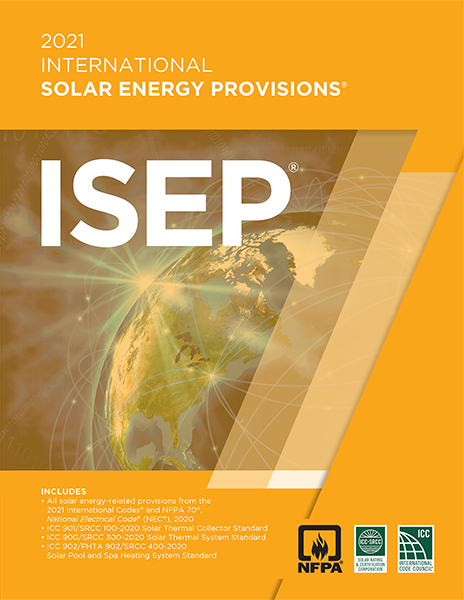
International Code Council announces release of 2021 International Solar Energy Provisions®

Washington, D.C. – The International Code Council collaborated with the National Fire Protection Association (NFPA) to publish the 2021 International Solar Energy Provisions (ISEP). The document compiles all solar energy-related provisions from the 2021 International Codes (I-Codes) and the NFPA 70® National Electrical Code ® (NEC®), 2020, making it streamlined and easy to apply in the field.

“The 2021 ISEP consolidates current code requirements for solar energy systems into a single, comprehensive, cost-effective publication,” said Mark Johnson, Executive Vice President and Director of Business Development at the Code Council. “All the building, electrical, fire, plumbing, energy and mechanical requirements pertaining to solar energy are at your fingertips.”

The ISEP was created to provide an all-inclusive tool for the design, installation and administration of both solar thermal (or solar heating and cooling) and photovoltaic (PV) systems. The document contains information on pertinent standards and provides additional resources, such as solar permitting forms, checklists, solar site access points and links to the U.S. Department of Energy solar site. With the growing demand for energy efficiency and sustainability, the ISEP will greatly benefit the industry by providing a single, organized source of solar thermal and photovoltaic safety code provisions in one publication.

“The 2020 edition of NFPA 70®, National Electrical Code® (NEC®), plays a key role in the design and installation of solar photovoltaic systems. Through this proud partnership with the Code Council, NFPA can continue delivering key information and knowledge needed by designers, installers, and administrators as they work to deliver safe solar projects,” said Erik Hohengasser, Electrical Technical Lead at NFPA.

Three referenced standards are included: “ICC 900/SRCC 300-2020 Solar Thermal System Standard,” “ICC 901/SRCC 100-2020 Solar Thermal Collector Standard” and “ICC 902/PHTA 902/SRCC 400-2020 Solar Pool and Spa Heating System Standard.” The standards establish the minimum criteria for the design, installation and testing of solar thermal collectors and solar water heating systems and establish minimum regulations for public and residential pools, spas, and hot tubs.

“One of the key aspects of the 2021 ISEP is that it brings together the most important code resources for both photovoltaic and thermal solar systems,” said Shawn Martin, Vice President of Technical Services of ICC Evaluation Service. “Users get the benefit of the latest code provisions and the latest reference standards – all in one book.”

To order a copy of the 2021 ISEP, click here.

To download an image of the publication cover, click here.

###

About the International Code Council
The International Code Council is the leading global source of model codes and standards and building safety solutions. Code Council codes, standards and solutions are used to ensure safe, affordable and sustainable communities and buildings worldwide.

About NFPA

The National Fire Protection Association (NFPA) is a global nonprofit organization, established in 1896, devoted to eliminating death, injury, property and economic loss due to fire, electrical and related hazards. NFPA delivers information and knowledge through more than 300 consensus codes and standards, research, training, education, outreach and advocacy; and by partnering with others who share an interest in furthering our mission. Our mission is to help save lives and reduce loss with information, knowledge and passion.

White House Announces National Initiative to Advance Building Codes Based on the International Codes

Washington, D.C. –  On June 1, 2022, the U.S. Federal Emergency Management Agency (FEMA) Administrator Deanne Criswell announced a National Initiative to Advance Building Codes, a new government-wide effort to boost national resiliency and reduce energy costs. Under the initiative U.S. federal departments and agencies will review federal funding and financing of building construction to ensure projects follow updated model codes and provide incentives and support for communities to adopt modern building codes. Members of the Mitigation Framework Leadership Group (MitFLG) will review their infrastructure grantmaking processes to ensure that they align with and support the adoption and use of current editions of the International Residential Code (IRC) and International Building Code (IBC). FEMA chairs the MitFLG, which consists of another 13 federal agencies, including the Department of Housing and Urban Development (HUD), the Department of Energy (DOE), and the Department of Health and Human Services (HHS).

The announcement is being made at the Florida International University Wall of Wind in Miami, Florida at the start of Atlantic hurricane season. In the aftermath of Hurricane Andrew, which struck south Florida nearly 30 years ago and resulted in 65 deaths and more than $26 billion in damages, Florida significantly strengthened its building codes and enforcement practices. As a result, according to FEMA, Florida’s codes, which are based on the I-Codes, have prevented over $1 billion in losses annually since 2000.  

“By modernizing building codes, communities will not only save money through lower energy costs and protecting their property, but together, we will also save lives by ensuring our infrastructure remains resilient in the face of climate change and the associated extreme weather events,” said FEMA Administrator Deanne Criswell. “Working with stakeholders like our partners at the International Code Council, we will leverage our collective knowledge and experience to bolster the adoption of the latest, current building codes and standards across this nation.”

Every year, the U.S. government spends hundreds of billions of dollars supporting building construction and retrofits through grants and other incentives. FEMA views the adoption of current building codes as the most effective means to enable communities to become more resilient to hurricanes, flooding, wildfires, and other natural hazards that are increasing in frequency and severity as a result of the changing climate. Yet, FEMA is currently the only U.S. federal agency that requires the construction it funds to adhere to current, hazard-resistant codes. FEMA is also the only U.S. federal agency that incentivizes state, local, tribal, and territorial (SLLT) governments to adopt and effectively implement resilient codes through its infrastructure grants.

Under the new initiative, MitFLG agencies are charged with:

  • Ensuring, to the extent feasible, that current programs funding and financing new and substantially rehabilitated homes and buildings follow current editions of relevant I-Codes, including, for example, the IRC, IBC, and International Existing Building Code (IEBC).
  • Leveraging $225 million in DOE funding through the Bipartisan Infrastructure Law to support adoption and implementation of updated building energy codes, like the International Energy Conservation Code (IECC) and International Green Construction Code (IgCC).
  • Providing incentives and support for SLTT governments to adopt and effectively implement modern building codes, including through outreach, education, and technical support efforts like those envisioned in FEMA’s recently announced Building Codes Strategy.
  • Lead by example to pilot above-code resilience and energy conservation efforts across the U.S. federal building portfolio.

Requiring the current IBC and IRC prevents roughly $14,000 in losses per building in jurisdictions where codes have not been updated in the past two decades, an $11 to $1 return on investment in many of these areas that will mitigate the loss of life and injuries, property damage, business interruptions, as well as first responder and annual homeownership costs. According to FEMA, in recent years, 30% of new construction has taken place in these areas. According to DOE, nearly half of states’ residential energy codes are currently at least 15% less efficient than the 2021 IECC. Per DOE, modern energy codes can save households an average of $162 dollars each year on utility bills. Without federal resilience and energy conservation requirements, federally-assisted construction defaults to locally adopted codes and standards. 

“The Code Council commends the administration for leading by example through a comprehensive effort that will ensure federally-assisted construction is safer and more sustainable and will support communities in enhancing their resilience through the adoption and implementation of modern building codes,” said Code Council Chief Executive Officer Dominic Sims, CBO. “This is about sound stewardship of federal investments. It’s the first step towards breaking the cycle of damage and repair. And it will help assure communities across the country get the resources they need to strengthen construction in the face of growing hazard risk.”    

###

About the International Code Council
The International Code Council is the leading global source of model codes and standards and building safety solutions. Code Council codes, standards and solutions are used to ensure safe, affordable and sustainable communities and buildings worldwide.

Protected: master 1100

This content is password protected. To view it please enter your password below: