
International Code Council Honors Building Safety Professionals with 2025 Awards

Cleveland, OH – During its 2025 Annual Conference in Cleveland, Ohio, the International Code Council recognized individuals and organizations within the building safety industry who stand as examples of industry excellence.

The Code Council honors the following:

The Bobby J. Fowler Award honors the legacy of the organization’s first chair of the Board of Directors. The award is presented to a leader who demonstrates compassion, professionalism and integrity in their duties. Robert Davidson, Managing Partner for Davidson Code Concepts, LLC, was presented with this year’s award.

The Chapter of the Year Award is presented to a chapter that best promotes the goals and mission of the Code Council. This year’s winner is Big Sky Country – Montana’s ICC Chapter.

The Chapter Merit Award is dedicated to chapters exhibiting the Code Council’s goals and objectives. This year’s award went to the Building Officials of Palm Beach County, the San Diego Fire Prevention Officers Association and the Maryland Building Officials Association.

The Community Service Award is given to those who provide outstanding service and promote the public health, safety and welfare of their local community. This year’s recipients are the City of Dallas Code Compliance and the City of South Fulton Code Enforcement.

The Educator of the Year Award acknowledges excellence in promoting professional development and is given in memory of Brent Snyder, a renowned Code Council educator and past presiding officer, who was known for his calm and inspiring leadership. The California Fire Prevention Institute was named the 2025 Educator of the Year.

The Gerald H. Jones Code Official of the Year Award is given to an individual who has helped promote the code enforcement profession and carries out the Code Council’s mission. Presented in honor of the founders of the three model code organizations, this year’s winner is Yolanda Bundy, Director of Environmental Sustainability Department and Building Official for the City of Malibu, CA.

The Global Award acknowledges distinguished service to the Code Council’s global mission and vision. The 2025 recipient is Jimata Kabua, Assistant Secretary for the Republic of Marshall Islands Ministry of Public Works, Infrastructure and Utility.

The Meritorious Service Award recognizes an individual who has dedicated their time and talent to furthering the development of the Code Council’s codes and standards. The 2025 award is awarded to Lucas Pump, Building Inspector for the City of Cedar Rapids, IA.

The National Leadership in Sustainability and Energy Efficiency Award recognizes contributions to the growth and enhancement of codes or public policy related to sustainability and energy efficiency. The winner of the 2025 Leadership in Sustainability Award is Greg Johnson, Owner of Johnson & Associates Consulting Services.

The PMG Leadership Award is given to an individual or organization for exceptional service to the plumbing, mechanical, fuel gas and swimming pool/spa (PMG) industry. This year’s recipient is Spencer Brown, Director of Sales for Pfister Faucets and Project Lead of American Plumber Stories.

The Raising the Profile Award recognizes acts or contributions that raise public awareness of accomplishments by code personnel that improve public safety in the built environment. Ryan Celestino, Electrical Inspector with Newport News, VA, received this year’s award.

The Robert W. Gain Fire Prevention Leadership Award is presented to an individual who has demonstrated exceptional leadership and longstanding dedication to the support of fire codes and fire prevention. Christopher Brunette, Chief of Fire and Life Safety with the Colorado Division of Fire Prevention and Control, is the 2025 recipient.

The Trailblazer Award recognizes an outstanding mentor in the building safety industry who guides and inspires others in their code-related careers. This year’s award is presented to Julissa Garcia, Owner of j.design.studio in San Diego, CA.

The W. Scott Copp Chapter Leadership Award recognizes a chapter or individual that champions the Code Council mission and inspires others to become Code Council leaders. This prestigious award honors the memory of Scott Copp, a true leader who dedicated his career to advancing building safety at the local, state, regional and national levels. The 2025 winner is Adele Schaffeld, Building Official for Malheur County, OR.

“We deeply appreciate the commitment and contributions of our members and partner organizations, whose efforts continue to strengthen the safety, sustainability and resilience of our communities and the built environment,” said John Belcik, Chief Executive Officer of the Code Council. “It’s an honor to recognize the 2025 award recipients for their outstanding achievements.”

For more information on the Code Council Awards Program, click here.

###

About the International Code Council
The International Code Council is the leading global source of model codes and standards and building safety solutions. Code Council codes, standards and solutions are used to ensure safe, affordable and sustainable communities and buildings worldwide.

International Code Council’s 2025 Annual Conference and Expo to Kick Off in Cleveland, Ohio

Washington, D.C.– The International Code Council (ICC) will host its Annual Conference, Expo and Hearings at the Huntington Convention Center of Cleveland from Oct. 19-30, 2025. The event will offer a unique experience for building safety professionals from around the world to engage in educational sessions and network with peers.  

“Our annual conference and code hearings are a catalyst for progress and innovation in the building safety industry,” said ICC Chief Executive Officer John Belcik. “By bringing together dedicated professionals, industry experts and community leaders, we create a space for meaningful connection, shared learning and collaboration. This annual event empowers our members to shape the future and strengthen the communities they serve.”

The Opening Session and Annual Business Meeting will take place on Monday, Oct. 20, and will feature updates from association leadership and the election of ICC Board Officers and Directors.

Participants will also benefit from eight tracks of educational sessions on hot topics in building safety. A new educational track will be offered this year for code enforcement professionals featuring topics ranging from inspection and compliance notices to safety protocols during inspections.

ICC has also partnered with ConstructReach to host a work-based learning event entitled, “I built this!” During this event, students will participate in hands-on activities and interactive demos led by construction professionals as well as get the opportunity to discuss career pathways with industry experts.

This year’s Committee Action Hearings will be held Oct. 22-30 and offer code officials, architects, builders, structural engineers, fire, residential and building code professionals, as well as those responsible for the administration of the International Codes® (I-Codes®), the opportunity to provide input on proposed code changes to the Group B #2 2027 I-Codes. The code hearings are free to attend and open to the public, but registration is required.

Click here for more information and use the hashtag #ICCAC25 to join the conversation on social media.

###

About the International Code Council
The International Code Council is the leading global source of model codes and standards and building safety solutions. Code Council codes, standards and solutions are used to ensure safe, affordable and sustainable communities and buildings worldwide.

Building Safety Regulatory Ecosystem Toolkit

Evaluation Reports

Product Compliance is a major pillar in the regulatory framework, and its importance only intensifies when new or innovative building materials/systems are not covered or addressed in the building codes. One way to accommodate the compliance procedure is to update the code to incorporate such changes; however, since the I-Codes are on a three-year update cycle, this option can be impractical and resource-intensive. The alternative approval process offered by the Evaluation Service Reports (ESRs) is a highly credible and rigorous solution. An ICC-ES Report (ESR) is a document that presents the product, scope of evaluation, proof of compliance, installation, and condition of use from a performance perspective. ESRs verify that building products comply with code requirements, acceptance criteria used to evaluate a product, how the product should be identified, installed and much more.

ICC-ES has expanded its scope of services to include evaluation to the following codes in the MENA region:

  • United Arab Emirates (UAE): Dubai Building Code (DBC) set by Dubai Municipality and the Abu Dhabi International Building Code (ADIBC), set by the Abu-Dhabi Department of Municipality and Transport (AD-DMT).
  • Kingdom of Saudi Arabia (KSA): Saudi Building Code (SBC) in the Kingdom of Saudi Arabi (KSA) set by the Saudi Building Code National Committee (SBCNC).

Visit ICC-ES’s ESRs online directory for more information on our evaluation scope.

Building Safety Regulatory Ecosystem Toolkit

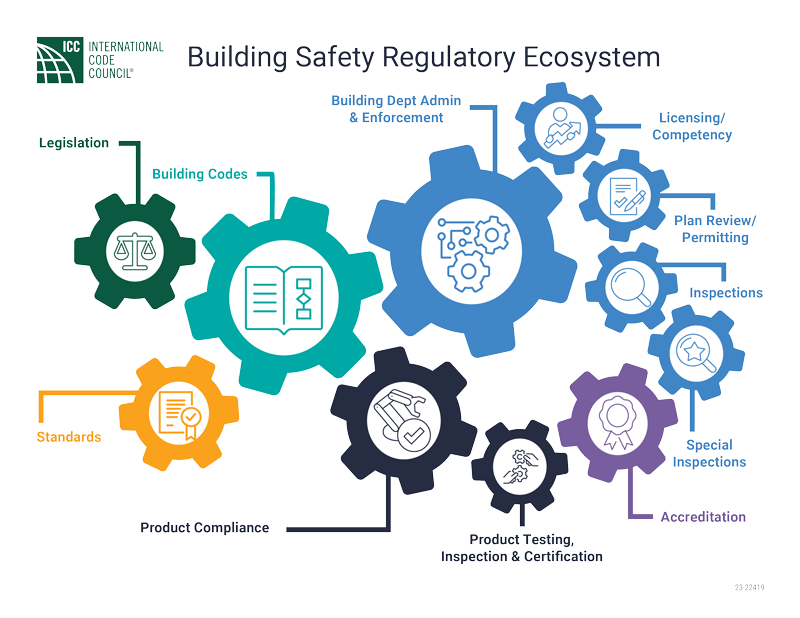
This free, online toolkit is designed to be used by jurisdictions around the world to identify and improve the elements of their building safety regulatory ecosystems most critically in need. All essential elements of an effective building safety regulatory ecosystem are represented in the graphic and briefly described below. This page is a work in progress. Please check back soon for more information.

legal weight symbol

Legislation

In most countries, a law or act is required to implement a set of building regulations and set forth the framework for their enforcement. This resource offers the principles that should be included in enabling legislation for an effective building control system.

Building Code & Standards

The building code used in a jurisdiction should be right-sized and enforceable, and the standards referenced in that code should be aligned with both the code and the availability of materials and common construction practices in that jurisdiction. This resource provides a guide for creating or adapting a building code and aligning it with appropriate construction standards.

Building Department Administration & Enforcement

In order to coordinate compliance efforts, regulatory authorities need to be established to ensure that the intent of the building regulations is realized and it results in safer, more resilient, sustainable and affordable buildings. This resource offers the essential components and functions of an effective building department administration and enforcement network.

Licensing & Competency

Jurisdictions require a method to define, measure and monitor the required competencies for the various types of practitioners and construction professionals operating within the building control system. This resource offers a list of considerations for assessment, licensing and credentialing rules for jurisdictions to consider based on the availability of internal and external resources.

Plan Review & Permitting

Building designs and sites must be approved through a clearly defined and delineated process that ensures proper application of the building codes during the planning stages of building development activities. This resource provides guidance on establishing and maintaining these processes, which can be used to generate revenue to underwrite the operations of building departments.

Evaluation Reports

Product Compliance is a major pillar in the regulatory framework, and its importance only intensifies when new or innovative building materials/systems are not covered or addressed in the building codes. One way to accommodate the compliance procedure is to update the code to incorporate such changes; however, since the I-Codes are on a three-year update cycle, this option can be impractical and resource-intensive. The alternative approval process offered by the Evaluation Service Reports (ESRs) is a highly credible and rigorous solution. An ICC-ES Report (ESR) is a document that presents the product, scope of evaluation, proof of compliance, installation, and condition of use from a performance perspective. ESRs verify that building products comply with code requirements, acceptance criteria used to evaluate a product, how the product should be identified, installed and much more.

ICC-ES has expanded its scope of services to include evaluation to the following codes in the MENA region:

  • United Arab Emirates (UAE): Dubai Building Code (DBC) set by Dubai Municipality and the Abu Dhabi International Building Code (ADIBC), set by the Abu-Dhabi Department of Municipality and Transport (AD-DMT).
  • Kingdom of Saudi Arabia (KSA): Saudi Building Code (SBC) in the Kingdom of Saudi Arabi (KSA) set by the Saudi Building Code National Committee (SBCNC).

Visit ICC-ES’s ESRs online directory for more information on our evaluation scope.

Inspections

Inspectors, and special inspectors for certain types of construction and construction processes, with the necessary competencies and enforcement powers, should be conducting on-site inspections at all critical stages throughout the construction process. This resource is a guideline for establishing and maintaining an effective building inspection system, including consideration for qualifications, training and credentialing.

Product Compliance

Based on the mandated codes and standards, the jurisdictional authority will need a system in place to ensure that products specified in a building’s design are compliant – ideally using ISO/IEC 17065 accredited conformity assessment bodies. This resource references international best practices and tools to help determine which products should be regulated and which approaches to ensuring compliance are most appropriate.

Testing, Inspection & Certification (TIC) Services

If construction product assurance is to be dependable and transparent , it is necessary to have a system in place to certify those regulated products for compliance with the regulations through documented, effective TIC Services. This resource offers a guideline for establishing and maintaining competency of a robust system for the testing, inspection and certification system for construction products and systems.

Evaluation Reports

Product Compliance is a major pillar in the regulatory framework, and its importance only intensifies when new or innovative building materials/systems are not covered or addressed in the building codes. One way to accommodate the compliance procedure is to update the code to incorporate such changes; however, since the I-Codes are on a three-year update cycle, this option can be impractical and resource-intensive. The alternative approval process offered by the Evaluation Service Reports (ESRs) is a highly credible and rigorous solution. An ICC-ES Report (ESR) is a document that presents the product, scope of evaluation, proof of compliance, installation, and condition of use from a performance perspective. ESRs verify that building products comply with code requirements, acceptance criteria used to evaluate a product, how the product should be identified, installed and much more.

ICC-ES has expanded its scope of services to include evaluation to the following codes in the MENA region:

  • United Arab Emirates (UAE): Dubai Building Code (DBC) set by Dubai Municipality and the Abu Dhabi International Building Code (ADIBC), set by the Abu-Dhabi Department of Municipality and Transport (AD-DMT).
  • Kingdom of Saudi Arabia (KSA): Saudi Building Code (SBC) in the Kingdom of Saudi Arabi (KSA) set by the Saudi Building Code National Committee (SBCNC).

Visit ICC-ES’s ESRs online directory for more information on our evaluation scope.

Accreditation

Entities (such as material testing laboratories, certification bodies, and inspection agencies) entrusted with compliance functions should be accredited to the appropriate ISO conformity assessment standard to ensure their impartiality and competence. This resource will help to determine accreditation requirements and to assess the best approach for establishing a system of accreditation.