2022 Conference – Covid

COVID-19 Preparedness

We are looking forward to seeing you at our Annual Conference and Public Comment Hearings in Louisville, KY. As we prepare to gather, we want to assure you that your safety is of primary importance to us.

Here’s what you can expect:

  • There will be readily available hand-sanitizing stations
  • We will offer complimentary disposable masks for those who wish to wear one
  • We will make any adjustments necessary to adhere to local, state, and federal safety guidelines in place at the time of the event

We will continue to monitor the situation with COVID-19 and stand ready to implement increased safety measures if needed. You’ll also be updated accordingly in the coming days if there are any additional protocols added.

Stay Safe and we look forward to seeing you in Louisville!

U.S. President signs into law legislation with largest-ever federal investment in building efficiency and sustainable construction

Washington, D.C. – On August 16, 2022, U.S. President Biden signed into law the Inflation Reduction Act, a broad package of economic policy changes including the largest ever investment in building efficiency, sustainable construction and distributed generation. The International Code Council worked with policymakers to support the provided resources. These resources will help communities update their energy codes, promote low-carbon construction materials, and encourage energy-efficient retrofits and distributed energy generation including solar thermal and small-scale wind.

Building upon last year’s Infrastructure Investment and Jobs Act, the Inflation Reduction Act provides $1 billion to support jurisdictions seeking to adopt, update and improve the implementation of current energy codes. More specifically, the new legislation supports codes and standards or local amendments that meet or exceed the 2021 International Energy Conservation Code (IECC), and zero-energy building codes, including codes and standards or local amendments that meet or exceed 2021 IECC’s net zero appendices.

The bill makes further historic investments in sustainable construction, including $250 million through the U.S. Environmental Protection Agency (EPA) for work toward enhanced standardization for low-embodied carbon construction materials through environmental product declarations (EPDs), as well as assistance for the manufacturing industry to more widely use and validate EPDs. The EPA will receive an additional $100 million to work with the U.S. Department of Transportation (DOT) and General Services Administration (GSA) on expanded labeling with EPDs for low-carbon construction materials used in building and infrastructure projects. The GSA, DOT and the Federal Emergency Management Agency (FEMA) will be provided with roughly $4.2 billion in funding to incentivize low-carbon material use in federally funded projects.

The Inflation Reduction Act further includes provisions to boost efficiency in both multi-family and single-family housing and extends tax credits for building efficiency, distributed generation, and energy storage (including through hydrogen as a medium). These provisions include a total of $9 billion in consumer-focused home energy rebate programs. An additional program would provide $1 billion for a new grant program to make the U.S. Department of Housing and Urban Development-assisted housing more energy and water efficient, resilient, and sustainable. The Code Council will continue to engage with the Administration and Congress to support additional provisions for community resilience and to expand incentives that enable jurisdictions to meet climate goals through a range of energy sources.

“The Inflation Reduction Act makes historic investments to support U.S. communities seeking to update their building energy codes and to promote sustainable construction,” said Code Council Chief Executive Officer Dominic Sims, CBO. “These efforts will cut consumers’ energy bills, significantly curb building emissions, and kick-start the market for green construction materials. The Code Council looks forward to working with industry, as well as federal, state, local, tribal, and territorial governments to ensure that these investments and incentives are utilized to their fullest potential.”

###  

About the International Code Council   
The International Code Council is the leading global source of model codes and standards and building safety solutions. Code Council codes, standards and solutions are used to ensure safe, affordable and sustainable communities and buildings worldwide. 

International Code Council Board of Directors appoints new Ad Hoc Committee on Diversity, Equity and Inclusion

Washington, D.C. – The International Code Council Board of Directors announced the committee members of the newly established Ad Hoc Committee on Diversity, Equity and Inclusion (DEI). The goal of this committee is to increase DEI in the membership association while helping Code Council members diversify their own organizations and, ultimately, the building safety profession overall.

The committee will also support the Code Council’s Safety 2.0 program, by encouraging individuals representing a wide range of perspectives and backgrounds to consider careers in building safety.

In alignment with the Code Council’s guiding statement, the Ad Hoc Committee on Diversity, Equity and Inclusion will research best practices, collect information from current and potential members to inform the committee’s recommendations and provide a list of these recommendations for the Code Council Board of Directors to consider.

“The Code Council encourages teamwork and innovation. It is in everyone’s best interest to acknowledge diversity as a way of addressing the critical shortage of building safety professionals,” said Code Council Board President Cindy Davis, CBO. “The individuals serving on this committee are dedicated to empowering our members with resources to engage new and underrepresented voices in the profession and continue to build a community of welcoming and belonging which drives shared success.”

View the list of committee appointees and learn more about the committee here.

###

About the International Code Council
The International Code Council is the leading global source of model codes and standards and building safety solutions. Code Council codes, standards and solutions are used to ensure safe, affordable and sustainable communities and buildings worldwide.

2022 Forum on Federal Funding

Forum on U.S. Federal Funding Opportunities
Presented by the ICC Government Relations Team

Tuesday, September 13, 8 – 11 am
Louisville Convention Center | Room M101/102

The federal government is making available to code officials and building safety professionals an unprecedented amount of resources – hundreds of millions of dollars – in grants, technical assistance and additional support to encourage the adoption and effective implementation of safe, resilient, and sustainable building codes. The ICC Government Relations Team has been working hard to line up these resources and to connect Code Council members with these opportunities.

Join us to hear from FEMA, HUD, and DOE on the resources their organizations are making available and from the City of Chicago on how it successfully navigated FEMA’s Hazard Mitigation Grant Program (HMGP).

Presentations will be followed by breakout sessions with FEMA, HUD, and DOE.

Speakers

Jeremy Wiliams

Jeremy Williams,
Energy Technology Specialist, Department of Energy (DOE)

Jennifer H. Carpenter

Jennifer H. Carpenter,
Assistant Director of Policy for the Disaster Recovery & Special Issues Division, U.S. Department of Housing and Urban Development (HUD)

Camille Crain

Camille Crain,
BRIC Section Chief, Federal Emergency Management Agency (FEMA)

Matthew Beaudet

Matthew Beaudet,
Commissioner, City of Chicago Department of Buildings, and FEMA HMPG Grant Recipient.

Program Highlights

DOE

  • Infrastructure Investment and Jobs Act (IIJA) Energy Code Implementation Program and Inflation Reduction Act (IRA) Energy Codes Funding

FEMA

  • Building Resilient Infrastructure in Communities (BRIC)
  • Hazard Mitigation Grant Program (HMGP)
  • Post-Disaster Code Administration and Enforcement Assistance (DRRA sec. 1206)

HUD

  • Community Development Block Grant – Disaster Recovery (CDBG-DR) and Disaster Mitigation (CDBG-MIT)

2022 Water Reuse Working Group

Water Reuse Working Group: Preparing Our Buildings and Communities for Water Reuse in the 21st Century

Sunday, Sep. 11, 2 – 4 pm

Given an increasingly limited water supply, and with more jurisdictions adopting ONWS as a result, comprehensive water quality requirements for reuse are necessary. Greater uniformity protects public health and facilitates the consistency necessary for advances in reuse products, reduction in cost, and increased availability of reuse solutions.

The Code Council is establishing a Water Reuse Working Group of code development leaders and reuse experts to, in partnership with the National Blue Ribbon Commission (NBRC), explore opportunities to protect public health and to better support state, local, tribal, and territorial governments seeking to advance water reuse opportunities through integration of best practices into the I-Codes that govern water quality and additional reuse issues.

Potable water from a public drinking water treatment plant is required to meet Safe Drinking Water Act (SDWA) standards. But no national regulations exist for onsite non-potable water systems (ONWS) for reuse treatment, storage, and delivery. A handful of jurisdictions have adopted requirements, but they are varied.

The I-Codes (including the IPC, IRC, IgCC, and CSA B805/ICC 805) address construction, installation, alteration, and repair of on-site non-potable water reuse systems, non-potable rainwater collection and distribution systems, and reclaimed water systems. Generally speaking, these codes and standards address delivery, and to an extent, the quality of potable and non-potable water. But none of these codes and standards address pathogen and chemical contaminants.

The National Blue Ribbon Commission for Onsite Non-potable Water Systems (NBRC) was established in 2016 to craft model policy and develop resources for the safe, practical, and sustainable implementation of onsite non-potable water systems. It is composed of leaders from all levels of government across the United States.

Scope
This diverse working group will research all aspects of onsite water reuse, develop a roadmap, and propose needed resources, including recommended updates to the International Codes (I-Codes) – that are necessary to meet jurisdictions’ water reuse goals. The Code Council will entrust the working group to complete the following actions:

  • A comprehensive review of current I-Code requirements as they relate to onsite water reuse.
  • A comprehensive review of existing adopted codes, guides, executive orders, white papers, reports, and standards, as they relate to design standards, preparedness, water quality, health considerations, and tools for installing and maintaining onsite water reuse systems.
  • Develop a report with recommendations concerning potential code change proposals to include the most recent technologies, design standards, water quality, health considerations, and minimum requirements for on-site water reuse systems.
  • Develop model code proposals to based on the report and above objectives.

The working group will include a broad range of experts from the building safety, construction, design, health, regulatory, and insurance industries.

ICC PMG logoPlease join ICC and industry Stakeholders on Sunday September 11, 2022, for this inaugural meeting taking place in a hybrid platform to find out more about the Water Reuse Working Group. Join us in person at the Kentucky International Convention Center, 221 S 4th St Louisville, KY 40202, room L007/008 or virtually.

For virtual and in-person attendance please register using the link below.

Media Relations

International Code Council Media Resources

The International Code Council is the leading global source of model codes and standards and building safety solutions. Code Council codes, standards and solutions are used to ensure safe, affordable and sustainable communities and buildings worldwide.

Artwork of 2 people in front of a build site

How to Get in Touch

International Code Council staff members are available to provide expert commentary and analysis on a broad range of building code and safety-related topics. If you’d like to speak with one of our staffers for research or media interviews, please contact:

Donna Stanley
(734) 660-6518
dstanley@iccsafe.org

Our Recent Press Releases

For recent press releases distributed by the Code Council, visit our press release webpage

Follow Us on Social Media

Subscribe to Our Newsletter

The Building Safety Journal (BSJ) Weekly is a weekly newsletter from the International Code Council that covers the latest news on the building safety and construction sectors. It offers everything from in-depth technical articles about innovative technologies to quick tips on how best to prepare your home for the season.

Copyright Permission

Third parties who wish to reproduce Code Council materials must receive advance written permission from the Code Council for any incorporation of Code Council copyrighted material into external materials. For more information, please visit our Rights and Usage Policy webpage.

About cdpACCESS

About cdpACCESS

cdpACCESS® is a cloud-based, custom-built change management and document management tool built in-house at ICC. Cdp stands for Code Development Process, the process we use to modify our model building, fire, and safety codes. We have been using cdpACCESS® for almost ten years now to manage that process digitally, and it has led the way to the digital-first publishing processes we are now adopting.


cdpACCESS® is hosted in AWS, and is built on Amazon Linux and uses PHP and the Symfony framework. The public-facing side of the application allows the general public to access a database of our codebooks, select individual sections, and create suggested modifications to the content. Once those modifications, called code change proposals, are submitted, the staff-facing side of cdpACCESS® allows our team to guide the content through our rigorous and democratic process. The proposals are reviewed by experts at an in-person meeting, discussed and debated by our membership both in-person and through public comments, and finally voted on by our Validated Governmental Members. Those changes that make it through the process are then passed via an API to our publishing software to be incorporated into the next version of the book. If you\'d like to learn about the public side of our code change process or participate, here are some

resources to get you started!


Update on Deadly Kentucky Flooding

Update on Deadly Kentucky Flooding 

This morning, President Biden signed a major disaster declaration for the state of Kentucky. The Presidential declaration comes in the wake of yesterday’s significant rainfall and deadly flash flooding in Southeastern Kentucky. Tragically, 15 lives have been lost and that number is expected to rise throughout the weekend. The International Code Council extends its deepest sympathies to all those affected, particularly those who have lost loved ones during this tragic event. Kentucky is still recovering from last year’s tornadoes so this news hits particularly hard as the Code Council wraps up final planning with our state and local partners in Kentucky for our Annual Conference and Expo in Louisville this September.  

We continue to coordinate with our member organizations as well as with federal, state, and local partners to support any requests for support or assistance. This includes coordinating resources for post-disaster building safety assessments, supplemental staffing, or other needs as they might arise. We also encourage you to review our Flood Safety and Recovery resources on incorporating disaster-resilient provisions of the International Codes (I-Codes) during flood recovery, reconstruction, and in future flood prevention and mitigation efforts. If your organization needs assistance, please reach out directly to us through your regional Government Relations representative for Kentucky, Corey Roblee. 

Disaster Response Alliance 

As an aid to community disaster response, the Code Council and the National Council of Structural Engineers Associations (NCSEA) sponsor the Disaster Response Alliance (DRA). The DRA maintains a national database of skilled, trained, and certified building safety professionals who are standing by and ready to assist communities in need. The DRA has assembled a cadre of skilled code officials, engineers, and others from across the country who are willing to assist with post-disaster safety assessments, building damage assessments, inspections, and surge support for other code-related functions. The Disaster Response Alliance brings together skilled, volunteer second responders in one place for easy access and quick mobilization. Federal, state, local, tribal, and territorial entities may request assistance directly through the DRA website.  

Interested in becoming a DRA resource? 

The DRA is always looking for volunteers. If you or someone you know is interested in becoming a DRA second responder resource, please visit the Volunteer Now link on the DRA website. Architects, engineers, and building safety professionals willing to make a difference during times of disaster are encouraged to apply. The DRA is also looking for individuals with specialized skills, knowledge, or abilities such as plans examiners, permit technicians, and building inspectors. 

New FEMA Disaster Recovery Grant Program Resource for Code Officials - DRRA Section 1206 

When disasters strike, codes and standards serve as a baseline for the return to safe, sanitary, and habitable buildings. Code officials and their floodplain management counterparts rely on support from emergency managers and community leaders to help secure the critical resources needed to ensure the health, safety, and welfare of the community. To that end, FEMA has announced a new disaster policy - Disaster Recovery Reform Act, Section 1206, that is specifically aimed at providing much-needed financial assistance for code officials and floodplain managers during disaster response and initial recovery for up to 180 days following a major disaster declaration. This policy, administered under FEMA’s Public Assistance program, offers reimbursement for critical community functions such as building code administration, code enforcement, floodplain management administration and enforcement, and conducting substantial damage survey inspections in affected communities. Short video from FEMA here. For more information, visit the Code Council’s DRRA 1206 resource page. 

U.S. Senate passes legislation for research to improve safety, efficiency and resilience of aging plumbing systems

Washington, D.C. – On Wednesday, July 27, 2022, the U.S. Senate passed the National Institute of Standards and Technology (NIST) Plumbing Research Act as part of a broader legislative push to enhance U.S. economic competitiveness. The act directs NIST, working in concert with the Environmental Protection Agency (EPA), to conduct research on premise plumbing systems to improve their safety, efficiency and resilience. The research will be coordinated among academia, the private sector, the International Code Council, and federal agencies. The Code Council, through its leadership role on the High-Performance Building Coalition, strongly supported this legislation’s advancement.

The NIST Plumbing Research Act will address the challenges surrounding the size of existing plumbing systems in the United States which were based on research conducted in the 1930s by NIST predecessor, the National Bureau of Standards. The current water piping in our communities is oversized, which decreases efficiency and has implications for water quality. New research from NIST will complement studies by the Code Council, already underway at the University of Miami, and other academic institutions in the U.S.

“The adoption and implementation of up-to-date building and plumbing codes are key to increasing the availability of clean water globally. The Code Council applauds Congressmen Cartwright and Tonko and Senator Duckworth for their leadership and commitment to improving the efficiency and safety of water systems in the United States,” said Matt Sigler, PMG Executive Director at the Code Council. “As an international leader in ensuring water quality and building safety, the Code Council looks forward to partnering with NIST, the EPA and others to develop next-generation codes and standards that will protect and modernize our plumbing infrastructure.”

The codes and standards developed by the Code Council have helped improve water safety and efficiency for decades. In particular, the International Plumbing Code (IPC) and International Green Construction Code (IgCC) are modern plumbing codes that set minimum requirements to safeguard public health, safety, and property, while conserving water resources.  The Code Council is in the beginning stages of developing a new American National Standard Institute (ANSI) plumbing pipe sizing standard (ICC 815). The new standard will take a worldwide approach to properly size water, sewer, and vent piping for residential, mixed-use, and institutional occupancies based on today’s plumbing fixtures and post-COVID-19 water usage patterns. It will also help conserve water and energy beyond the scope of current model codes and standards.

“Improving the efficiency and reliability of our nation’s plumbing systems is key in strengthening our infrastructure and ensuring Americans have access to safe, clean water,” Congressman Paul Tonko said. “I supported the NIST Plumbing Research Act that will take the needed steps to at last bring U.S. plumbing standards into the 21st century. I was proud to push for these research investments and, moving forward from this success, I’ll continue working alongside colleagues and advocates to modernize our water infrastructure and strengthen public health.”

“Plumbing Manufacturers International (PMI) applauds the passage of this important legislation which contains increased investments in scientific research and strong science, technology, engineering, and math education provisions to support U.S. global competitiveness,” said Kerry Stackpole, PMI CEO.  “The creation of a robust program for premise plumbing research at NIST will have a vital impact on homes, schools, and buildings across the nation by utilizing innovative technologies to significantly improve water efficiency, reliability, and reuse in our water systems.”

For more information, please visit the Code Council’s PMG webpage.

###  

About the International Code Council   
The International Code Council is the leading global source of model codes and standards and building safety solutions. Code Council codes, standards and solutions are used to ensure safe, affordable and sustainable communities and buildings worldwide. 

Off-Site Construction

What is Off-Site Construction?

Solutions for Today’s Challenges

The process of constructing buildings or components of buildings in a factory to increase quality, sustainability and job site safety to project completion over site-building projects. The International Code Council helps project teams and communities unlock the potential of off-site construction.

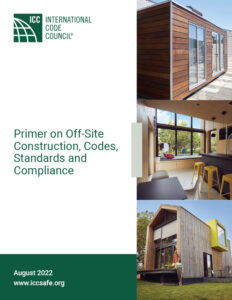
Primer on Off-Site Construction to better understand the Codes, Standards and Compliance

Download the International Code Council’s Primer on Off-Site Construction to better understand the Codes, Standards and Compliance Processes Associated with Off‑Site Construction.

Benefits

Breaking Ground with Off-Site Construction

The Code Council’s off-site construction solutions confront the multiple challenges that the building industry faces today; from affordable housing to more sustainable practices.

Off-Site Construction Stats

  • Project timelines can be accelerated by 20 to 50%
  • Potential for more than 20% cost savings
  • Lower wastage rates providing both environmental benefits and cost savings
  • Improved project quality

award icon

Develop quality and
safe structures

tools icon

Increase the workforce
and job opportunities

world icon

Positively impact
the environment

Speed icon

Speed to market

affordable icon

Make housing
more affordable

job safety icon

Safer job sites
for workers

Design, Fabrication and Assembly

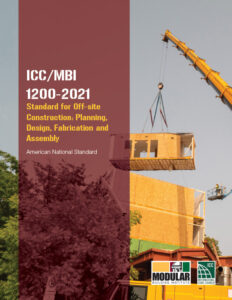
ICC/MBI Standard 1200 provides the off-site construction industry with the requirements for the safe and efficient deployment of off-site construction projects

Design

The ICC NTA Engineering Department can provide you with complete engineering calculations and analysis to ensure code compliance for all off-site construction projects.

Fabrication

IAS offers accreditation for manufacturers and fabricators of metal buildings and shipping containers to verify that these buildings and components meet industry standards and IAS accreditation criteria.

ICC ES provides product evaluations for multiple components used in off-site construction including shipping containers and sandwich panels and can work with other innovative technologies to support wider use in the market.

Compliance Standards

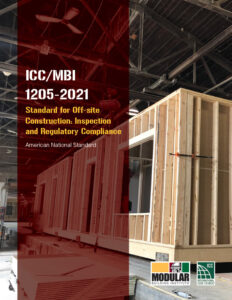
ICC/MBI Standard 1205 provides criteria for the effective and efficient approval of off-site construction manufacturers and projects.

Plan Review and Inspection

ICC NTA’s third-party plan review and inspection services help ensure your structures meet or exceed requirements for quality, safety and performance

IAS accreditation assesses third-party service provider’s policies and procedures for providing quality plan review and inspections

ICC Off-Site Solutions

ICC/MBI Standard 1200 for Off-Site Construction: Planning, Design, Fabrication, and Assembly

ICC/MBI Standard 1205 for Off-Site Construction: Inspection and Regulatory Compliance

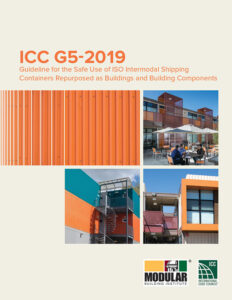
ICC G5-2019 for the Safe Use of ISO Intermodal Shipping Containers Repurposed as Buildings and Building Components

What is your role?
RO.
Regulatory Official
MFR.
Manufacturer
COM.
Components
TPA.
Third party agency
Role
RO.
Regulatory Official
Select your solution
NTA
ICC-ES
ICC
Role
MFR.
Manufacturer
Select your solution
NTA
ICC-ES
IAS
Role
COM.
Components
Select your solution
IAS
ICC-ES
Role
TPA.
Third Party Agency
Select your solution
IAS
ICC

ICC Resources

The Code Council and its Family of Solutions have developed or are developing multiple resources to help building safety professionals and manufacturers realize the benefits of off-site construction.

Publications

Guideline 5. ICC G5-2019

Guideline 5 covers the use of shipping containers as building materials

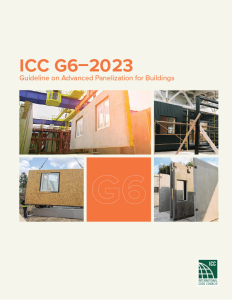
Guideline 6. ICC G6-2023

Guideline 6 covers lessons learned from global approaches to advanced panelization

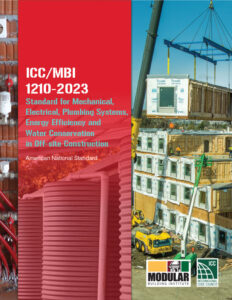
ICC/MBI Standard 1200: Standard for Off-Site Construction: Planning, Design, Fabrication, and Assembly   ICC/MBI Standard 1205: Standard for Off-Site Construction: Inspection and Regulatory Compliance   ICC/MBI Standard 1210-2023

Three standards are also available:
ICC/MBI Standard 1200, ICC/MBI Standard 1205 and ICC/MBI Standard 1210

FAQs, Factsheets, Briefs and More Resources

FAQs on Off-Site Construction

FAQs on Off-Site Construction (pdf) – also available below

Factsheet: Facilitating Affordability, Sustainability Goals through Standards

Factsheet: Facilitating Affordability, Sustainability Goals through Standards

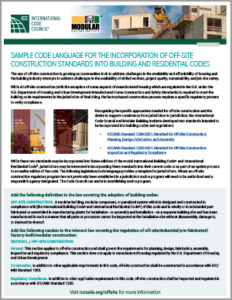
Brief: New Off-Site Construction Standards

Brief: New Off-Site Construction Standards

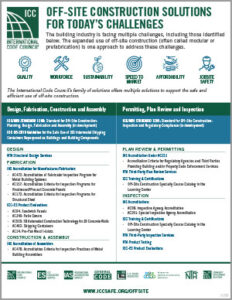
Off-site Construction Solutions for Today’s Challenges

Off-site Construction Solutions for Today’s Challenges

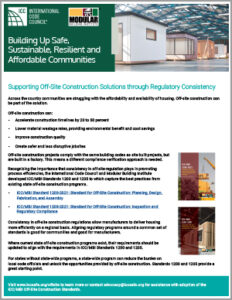
Factsheet: Building up Safe, Sustainable, Resilient and Affordable Communities

Factsheet: Building up Safe, Sustainable, Resilient and Affordable Communities

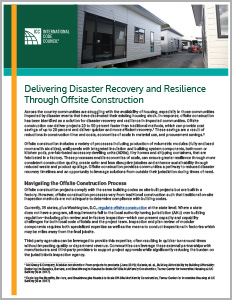
Delivering Disaster Recovery and Resilience Through Offsite Construction

Delivering Disaster Recovery and Resilience Through Offsite Construction

Services

NTA is a respected provider of third party plan review and inspection services for the off-site construction industry

ICC-ES provides evaluation services for multiple off-site construction products.

IAS provides accreditation for inspection agencies and manufacturers/fabricators and assemblers.

ICC Training includes a specialty catalog of courses for code officials interested in off-site construction

Tiny Home Solutions

The International Code Council has the resources and expertise to deliver the solutions needed to ensure safe, sustainable and resilient construction and use of tiny houses.

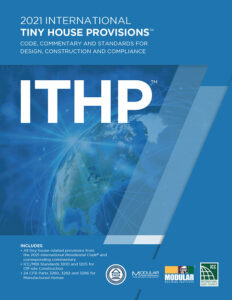
2021 International Tiny House Provisions

2021 International Tiny House Provisions outlines the existing codes, standards and compliance mechanisms available for tiny houses.

Off-Site Explained

Off-Site construction is a modular building, modular component or panelized system that is wholly or in substantial part fabricated or assembled in manufacturing plants for installation – or assembly and installation – on a separate building site and has been manufactured in such a manner that all parts or processes cannot be inspected at the installation site without disassembly, damage to, or destruction thereof.

The Different Types of Off-Site Construction

Volumetric is a type of modular construction that assembles fully enclosed 6 sided building blocks at an Off-Site construction location and then joins each block at the final site to create a larger structure. Structures include both residential or commercial buildings.


Examples:

  • Bathroom or Kitchen pods
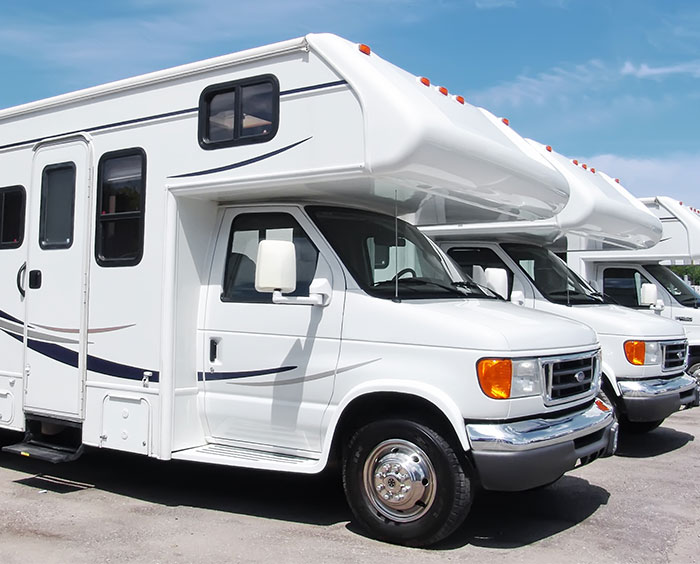
  • Tiny Homes
  • Shipping Containers
  • Modules

Non-volumetric is another type of Off-Site constructions that involves the assembly of smaller parts of the structure that help create the main structure of the building.

Examples:

  • Wall, ceiling and foundation panels
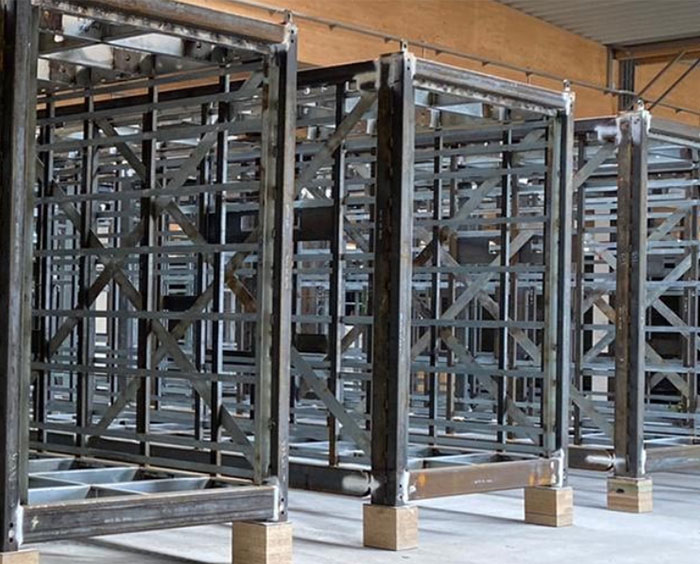
  • Mechanical racking
  • Headwalls

The Benefits

Modular construction can speed construction by as much as

50%

In the right environment and trade-offs, it can cut costs by

20%

Complexity and scale of modular construction

Complexity

Fully functional with complex fixtures

Limited fixtues in one or more materials

Largely structural (concrete, steel, or wood)

Fully serviced and finished single unit

Fully serviced and finished walls

Fully serviced and finished room

Fully serviced and finished house

Scale

Transitional single unit

Pre-finished panel

Pre-finished room

Pre-finished house

Scale

Single discipline, individual units

Panels

Volumetric Units

Complete Structures

Scale

Third Party Approvals

Working with A Recognized Leader

Third party plan reviews save time and money by expediting the approval process. ICC NTA has been doing plan reviews and inspections for the off-site construction industry for over 40 years, ensuring manufacturers and projects meet or exceed state and local requirements.

How can ICC help?

The International Code Council works directly with manufacturers to inspect, review and evaluate modular systems to analyze code compliance. The Code Council partners with the Modular Building Institute to develop standards to support consistency and efficiency in planning, design, fabrication to assembly, inspection, and regulatory compliance.

Off-Site Construction Today

Contact The Code Council to Learn More About Off-Site Construction

FAQs