Global Resiliency

Global Resiliency Dialogue

Buildings and people are facing increasingly severe natural hazards caused by extreme weather.
This increased risk is felt by countries around the world.
International collaboration can lead to deeper understanding and better outcomes.

Global Building Resilience Guidelines

The Global Resiliency Dialogue (GRD) announced the publication of the Global Building Resilience Guidelines at the 27th UN Conference of the Parties (COP27) in Sharm El Sheik, Egypt on at the Buildings Pavilion. View the presentation below.

The Guidelines are based on the findings of two prior surveys conducted by the GRD and provide a framework for jurisdictions around the world to consider as they work to effectively integrate future‑focused climate science into building codes and standards.
Access both the full publication and summary document below.
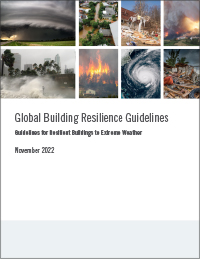
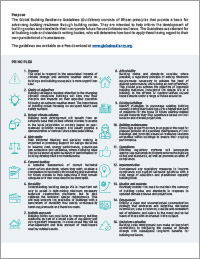
Global Building Resilience Guidelines

Global Building Resilience Guidelines

Delivering Climate Resilient Building Codes and Standards

Representatives from the Global Resiliency Dialogue announced the release of the new publication, Delivering Climate Resilient Building Codes and Standards in a hybrid presentation during COP26 in Glasgow.
Access the report and view the presentation below.
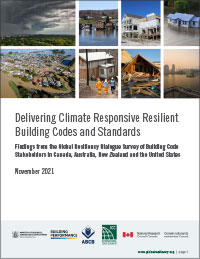
Delivering Climate Responsive Resilient Building Codes and Standards

Building code developers/researchers from Australia, Canada, New Zealand and the United States have launched the Global Resiliency Dialogue, a joint initiative to inform the development of building codes that draw on both building science and climate science to improve the resilience of buildings and communities to intensifying risks from weather-related natural hazards.

The Findings on Changing Risk and Building Codes statement outlines the work to be undertaken by the members of the Global Resiliency Dialogue, including:

  • Identifying strategies for the identification of future risks and the development of building code solutions that support adaptation to those risks
  • Cooperating on the development of international building resilience guidelines and further exploration of the relationship with land use planning instruments that help determine the location of buildings
  • Supporting research initiatives to better understand climate science, to assist in aligning expectations for building durability and resilience with the projection of future hazards
  • Developing and deploying messages and resources that enhance understanding of building codes, support a common understanding of risk and communicate the importance of up-to-date building codes
  • Advancing risk and impact analysis to recognize the multiple economic and social benefits provided by resilience investments and the desirability of alternative approaches that fully capture the benefits and costs provided by the building codes

The survey findings of the first Global Resiliency Dialogue international survey were published in January 2021 in the report, The Use of Climate Data and Assessment of Extreme Weather Event Risks in Building Codes Around the World. The survey, which was circulated to building code development and research organizations around the world, was designed to help illuminate – in detail – how climate-based risks are currently considered within national building codes and standards. It includes an exploration of the types of codes (building, fire, energy, electrical, plumbing, etc.) that rely on climate-related data to support their requirements, as well as the source of that climate data, how it is communicated, and how often it is updated.

Get Involved!

  • Join the initiative by signing on as an endorsing organization (public sector or NGO) or a supporting private sector business.

Building Code Development/Research Organization Signatories
Endorsing Organizations

Urban Land InstituteSTANDARDS AustraliaAustralian Govenment. Geoscience Australia
Engineers AustraliaPIA. Planning Institute AustraliaASBEC. Australian Sustainable Built Environment Council
Insurance Council of AustraliaBuilding Officials Institute of NZNorthwest Code Professionals
CSA GroupAustralian Institute of Architects

Private Sector Business Supporters

Resilient ProjectsLumaware Safety

Week 2 of Building Safety Month highlights the importance of building codes for safe, clean and abundant water

Washington, D.C. – The International Code Council, its members and partners launch week 2 of the 40th annual Building Safety Month with a focus on water safety. Worldwide up to 785 million people lack access to a vital resource – clean water. The adoption and enforcement of up-to-date building and plumbing codes is key to increasing the availability of clean water globally.

“As we continue to navigate the COVID-19 pandemic, now more than ever we understand the critical need for access to clean and safe water and plumbing systems,” said Code Council Chief Executive Officer Dominic Sims, CBO. “Week two highlights the value of codes, such as the International Plumbing Code, and code professionals that serve as vigilant protectors of our water supply through the enforcement of proper construction, conversation and disposal requirements.”

The Code Council and the Residential Energy Service Network (RESNET) partnered to develop a joint standard accredited by the American National Standards Institute – ANSI/RESNET/ICC 850-2020 Standard Calculation and Labeling of the Water Use Performance of One-and Two-Family Dwellings Using the Water Rating Index. This standard helps communities with water conservation efforts by setting technical specifications for inspections, testing and ratings of home water efficiency. The standard is now available for preorder.

On Thursday, May 14, 2020, the Code Council will host a free webinar on the new standard, the development process, and a new program based on the standard called HERS H2O. Code Council Vice President of Business Support Initiatives Dave Walls and RESNET Program Director Ryan Meres will talk about ways that communities can use the standard to improve residential water use. Click here for more information and to register.

Mark Fasel, Manager of Codes and Standards at Viega, LLC, a week 2 sponsor, said, “Viega understands the importance of Building Safety Month and the outreach to the community that the events provide. We are proud to support this endeavor and recognize the benefit of public education and the comradery that is developed during Building Safety Month.”

Code Council partner, the Pool and Hot Tub Alliance (PHTA), is also celebrating water safety this month for National Water Safety Month.  “Providing essential pool, spa and hot tub services is important for public health and safety because it prevents algae growth, mosquitoes, water-borne diseases and cloudy water,” adds PHTA President & CEO, Sabeena Hickman, CAE. “The busy swim season starts with National Water Safety Month, and that’s the best time to learn about being safe in and around water.”

Learn more about water safety at www.BuildingSafetyMonth.org. Join the conversation online with #BuildingSafety365.

###

About the International Code Council

The International Code Council is a nonprofit association that provides a wide range of building safety solutions including product evaluation, accreditation, certification, codification and training. It develops model codes and standards used worldwide to construct safe, sustainable, affordable and resilient structures.

The International Code Council hires premier advocacy firm in California

Washington, D.C. – The International Code Council hires KP Public Affairs, a leading advocacy, lobbying and public affairs firm based in Sacramento, California, to represent the interests of the association, its members and key stakeholders in the state.

KP is an experienced firm with decades of advocacy and communications talent on staff. The firm represents regional governments, private developers, home builders, utilities, construction companies and many others. With a long-standing presence in California’s Capitol and a thorough knowledge of the building community, KP will work closely with the Code Council on a range of building safety related issues.

“The Code Council has long been active in California on the state and local levels, supporting our members and chapters,” said Sara Yerkes, Senior Vice President of Government Relations for the Code Council. “We’re looking forward to expanding our efforts to support modern building codes and code compliance in the state as well as building strong coalitions across the design and construction industries.”

The Code Council Government Relations Department will be hosting a virtual reception with KP to give members and chapter leaders a chance to meet the new team. Details will be forthcoming.

For more information about the Code Council’s advocacy efforts, visit www.iccsafe.org/advocacy.

###

About the International Code Council

The International Code Council is a nonprofit association that provides a wide range of building safety solutions including product evaluation, accreditation, certification, codification and training. It develops model codes and standards used worldwide to construct safe, sustainable, affordable and resilient structures.

Special Inspector Exam FAQ’s

FAQ's on Special Inspector Module Exams

Got questions? We've got answers!

Click on one of the frequently asked questions below for more information.

Special Inspector Certifications

CREDENTIALING

Special Inspector Certifications

The ICC Special Inspector certification program does not qualify an individual as a Special Inspector under Chapter 17 of the International Building Code (IBC). Such a designation resides within the sole discretion of a given jurisdiction’s building official. The ICC Special Inspector certification program solely aims to provide a designation for a building official’s use as they evaluate special inspector qualifications as part of the process of approving a Special Inspector under Chapter 17 of the IBC for a given scenario.

20 19970 AC Sp Insp LandingPg Img 400x283 WEB FINAL

Type Special Inspector

47 Reinforced Concrete

Exam ID/Prerequisite Exam/Certification(s)

Special Inspector General Requirements - *GR
Reinforced Concrete Codes - 47C
Reinforced Concrete Plans - 47P

View steps to obtain certification as a Reinforced Concrete Special Inspector:

  1. Pass the three exams listed above with ICC to complete ICC Category 47
    *GR exam module required if candidate does not hold an Active ICC Special Inspector certification.
  2. Visit ACI to apply for next category options:

ICC Category 48 (Reinforced Concrete Special Inspector Associate)

  • Achieve ICC Category 47
  • Become an ACI Concrete Field Testing Technician - Grade I
    • Note: Grade I Technician is required to obtain Category 48; not required to maintain/renew certification
  • Email customersuccess@iccsafe.org with a copy of your Active ACI Field Grade I card

ICC Category 49 (Reinforced Concrete Special Inspector)

  • Achieve ICC Category 47
  • Apply with ACI for the Reinforced Concrete Special Inspector/Experience Evaluation Results Certification
    • Note: Grade I Technician is required to obtain Category 49; not required to maintain/renew certification
  • ACI emails ICC list of verified applicants.

Type Special Inspector

84 Structural Masonry

Exam ID/Prerequisite Exam/Certification(s)

Special Inspector General Requirements GR
Structural Masonry Codes 84C
Structural Masonry Plans 84P

Type Special Inspector

86 Spray-applied Fireproofing

Exam ID/Prerequisite Exam/Certification(s)

Special Inspector General Requirements - GR
Spray-applied Fireproofing Codes and Plans - 86

Type Special Inspector

92 Prestressed Concrete

Exam ID/Prerequisite Exam/Certification(s)

Reinforced Concrete Special Inspector Certification - Category 49
Prestressed Concrete Codes - 92C
Prestressed Concrete Plans - 92P

View three steps for requirements of Certification for Prestressed Concrete Special Inspector:

  1. Obtain the 49 – Reinforced Concrete Special Inspector Certification
  2. Pass the 92C – Prestressed Concrete Special Inspector Codes Exam
  3. Pass the 92P – Prestressed Concrete Special Inspector Plans Exam

Type Special Inspector

93 Tall Mass Timber Buildings

Exam ID/Prerequisite Exam/Certification(s)

Special Inspector General Requirements GR
Tall Mass Timber Buildings Special Inspector Exam - 93

Type Special Inspector

EC Soils

Exam ID/Prerequisite Exam/Certification(s)

Special Inspector General Requirements - GR
Soils Codes - ECC
Soils Plans - ECP

Type Special Inspector

S1 Structural Steel and Bolting

Exam ID/Prerequisite Exam/Certification(s)

Special Inspector General Requirements GR
Structural Steel and Bolting Codes S1C
Structural Steel and Bolting Plans S1P

Type Special Inspector

S2 Structural Welding

Exam ID/Prerequisite Exam/Certification(s)

Structural Steel and Bolting Special Inspector Certification - Category S1
Structural Welding Codes - S2C
Structural Welding Plans - S2P

Start Your Journey

Learn everything you need to know about before, during and after the exam.

Admin Rules and Policies

Be sure to review all rules and policies before exam day.

What’s Next?

Have questions? View FAQs.

Candidates are encouraged use a free tool that will help you navigate plans and exhibits as found on our PRONTO Special Inspector Exams. Start Your FREE PRONTO SI: Plans Exercise.

Ready to take the exams? Purchase exams through our exam catalog.

Questions? Contact Us

ICC Credentialing
Email: customersuccess@iccsafe.org
Phone: 1-888-ICC-SAFE (422-7233) ext. 0

Certification Policies

ICC understands the importance of impartiality in carrying out our certification activities, managing conflict of interest, and ensuring the objectivity of our certification activities.

To learn more about our certification and education policies, please read the following:
Council Policy 45, CC Rules of Procedure, Records Release, and ICC Credentialing Compliance Principles.

Supreme Court decision bolsters ICC’s copyright case

ICC Pulse

Supreme Court decision bolsters ICC’s copyright case


The International Code Council initiated litigation against UpCodes for the wholesale copying of the International Codes (I-Codes) without permission. UpCodes' defense has been that the I-Codes are not copyrightable because they are adopted by various governmental authorities and have the force of law. In a decision issued on April 27, the U.S. Supreme Court expressly rejected UpCodes' defense, holding that instead of examining whether something carries 'the force of law,' we ask only whether the author of the work is a judge or a legislator."

The Supreme Court case, Georgia v. Public.Resource.Org., considered whether Georgia could claim copyright in annotations to the Georgia code. While the author of a work owns the copyright upon creation, there is a narrow exception to this rule called the government edicts doctrine. The Supreme Court made clear that under the government edicts doctrine "copyright does not vest in works that are (1) created by judges and legislators (2) in the course of their judicial and legislative duties." The Supreme Court concluded that the annotations to the Georgia Code met the two-part government edicts test, and thus, were not copyrightable.

The I-Codes do not meet either requirement of the government edicts doctrine – the codes were developed by the Code Council, a private, nonprofit organization that has no judicial or legislative function. The Supreme Court decision confirms that the I-Codes are entitled to copyright protection.

Accordingly, UpCodes' wholesale copying of the I-Codes for its shareholder's personal benefit constitutes willful copyright infringement. They are profiting off their unlawful use of the I-Codes. Their copyright infringement directly undermines the safety of our communities by harming the Code Council's ability to continue to fund the development of the codes.

For more resources on the importance of copyright, please visit www.iccsafe.org/copyright-protection.

You can also listen to two recent ICC Pulse Podcast episodes on the issue: A Member Perspective with Glenn Mathewson and Copyright Issues and the I-Codes with Mark Johnson and Mel Oncu.