Recently approved I-Code changes allow commercial and residential use of A2L refrigerants to replace high global warming potential (GWP) hydrofluorocarbon (HFC) refrigerants.
Recently approved I-Code changes allow commercial and residential use of A2L refrigerants to replace high global warming potential (GWP) hydrofluorocarbon (HFC) refrigerants.
The International Code Council and ASHRAE announced joint development of a standard to assess carbon emissions across the entire building life cycle.
Washington, D.C. – A broad coalition of industry, environmental, governmental and code development organizations encourage early adoption by states and localities of the 2024 International Building Code (IBC), International Fire Code (IFC) and International Mechanical Code (IMC), which now permit the use of A2L refrigerants. The recently approved code changes allow commercial and residential use of A2L refrigerants to replace high global warming potential (GWP) hydrofluorocarbon (HFC) refrigerants.
The supply of HFCs, commonly used in refrigeration and air conditioning, will decrease 40 percent in 2024 due to the bipartisan American Innovation and Manufacturing Act (AIM Act)of 2020 and the corresponding Environmental Protection Agency (EPA) rule that mandate a phasedown in GWP refrigerants by 2036. Most of the remaining supply will be used to service existing equipment currently installed in homes and businesses. The 2024 I-Code changes facilitate compliance with these requirements and support producers and refrigerant appliance manufacturers already transitioning to lower-GWP solutions such as A2Ls.
“State and local governments need to act now to enable next-generation refrigerants before older options get phased out,” said Matt Sigler, the Code Council’s PMG Executive Director. “The Code Council stands ready to partner with the construction industry to help them best navigate this positive change.”
Several major organizations, including the Air-Conditioning, Heating and Refrigeration Institute (AHRI), provided more than 7 million dollars to research and field test new, low GWP refrigerants, determining the A2L refrigerants are safe and effective replacements for the HFCs currently in use.
“We are very pleased with the Code Council’s support towards the use of next-generation refrigerants in vital HVACR equipment,” said AHRI President & CEO Stephen Yurek. “The entire supply chain must be ready for the 2024 reduction in supply. We are hopeful that this action, which validates the critical AHRI research into these new refrigerants, will spur states and localities to update their codes on an urgent basis to enable their use.”
Here are a few things jurisdictions should do right now:
“It is very encouraging to see the ICC’s great progress in adopting updated model codes for alternative refrigerants,” said Christina Theodoridi, Senior Policy Analyst for the Natural Resources Defense Council (NRDC). “This is a critical step to enable climate-friendly cooling in our homes, office buildings, schools, supermarkets and more. Our work isn’t done yet. State and local code officials shouldn’t waste any time adopting the new codes in their respective jurisdictions.”
“Jurisdictions that adopt ICC codes can be confident that their citizens are protected by the best and most up-to-date standards. We applaud the way ICC has embraced technology-neutral, cost-effective climate friendly refrigerant alternatives,” said Kristen Taddonio, Senior Climate and Energy Advisor for the Institute for Governance of Sustainable Development (IGSD).
Additional organizations supporting the AIM Act and its implementation include the U.S. Chamber of Commerce, the National Association of Manufacturers, and the American Chemistry Council.
###
About the International Code Council
The International Code Council is the leading global source of model codes and standards and building safety solutions. Code Council codes, standards, and solutions are used to ensure safe, affordable, and sustainable communities and buildings worldwide.
About the Air-Conditioning, Heating, and Refrigeration Institute
The Air-Conditioning, Heating, and Refrigeration Institute (AHRI) is the trade association representing manufacturers of air conditioning, heating, commercial refrigeration, and water heating equipment. An internationally recognized advocate for the industry, AHRI develops standards for and certifies the performance of many of these products. AHRI’s 300+ member companies manufacture quality, efficient, and innovative residential and commercial air conditioning, space heating, water heating, and commercial refrigeration equipment and components for sale in North America and around the world.
Washington, D.C. – The International Code Council and ASHRAE announced joint development of a standard to assess carbon emissions across the entire building life cycle.
Proposed ASHRAE/ICC Standard 240P – Evaluating Greenhouse Gas (GHG) and Carbon Emissions in Building Design, Construction and Operation, willprovide a whole life carbon approach to support emissions reductions in buildings. The proposed standard establishes how to measure and verify the greenhouse gas (GHG) and carbon emissions of a building, or group of buildings, over the entire life cycle. The goal is to provide consistent procedures and data to be referenced by policies, codes, and other standards that address new and existing building performance.
“There is growing demand around the world for consistent building decarbonization guidance that acknowledges the impact of carbon emissions transpired at the beginning of the construction phase to demolition, and accounts for the changes in building operation and performance over time,” said 2022-23 ASHRAE President Farooq Mehboob, Fellow Life Member. “This proposed standard will offer a comprehensive structure for evaluating energy use and supporting greenhouse gas emission reductions, as well as serve as a keystone towards harmonizing guidance within the global marketplace. We appreciate the Code Council’s partnership on this important standard.”
The proposed standard will cover:
“Buildings and the building construction sector are responsible for about 40 percent of total CO2 emissions globally. As energy codes continue to deliver increased reductions in building operational energy use, a holistic approach that addresses the entire building life-cycle is essential,” said Code Council Chief Executive Officer Dominic Sims, CBO. “The Code Council is dedicated to supporting communities worldwide in meeting their energy and decarbonization goals; the proposed standard 240P will be an essential tool towards reducing the impacts of buildings and adapting to an ever-changing climate. We look forward to our continued work with ASHRAE to provide new resources and help communities meet, and advance, their energy efficiency and decarbonization goals.”
A call for new committee members has been issued to develop proposed Standard 240P. Those interested in serving on the committee can find more information online, here. Applications are due on September 26, 2022.
###
About the International Code Council
The International Code Council is the leading global source of model codes and standards and building safety solutions. Code Council codes, standards and solutions are used to ensure safe, affordable and sustainable communities and buildings worldwide.
About ASHRAE
ASHRAE is a global professional society committed to serving humanity by advancing the arts and sciences of heating ventilation, air conditioning, refrigeration and their allied fields. ASHRAE and its members are dedicated to promoting a healthy and sustainable built environment for all, through strategic partnerships with organizations in the HVAC&R community and across related industries.
Tuesday, September 13, 1:30 – 5 pm
Louisville Convention Center | Room M100/103
This Global Building Safety Dialogue is an exploration of whether responses to building failures are appropriate, and what should we be doing differently to improve the safety of our buildings for all.
The keynote address, by Gill Kernick, Transformation Director, ARUP University,
 will look at how past disasters impacted the built environment, including the Grenfell Tower fire five years ago and the evolving response to more recent disasters like the residential high-rise collapse in Surfside, Florida, and will explore how effective responses have been at fixing the underlying problem(s).
This event will also include a Q & A, a Panel Discussion and Case Study featuring speakers below, and will conclude with Interactive Breakout Groups.

Sergio Ascunce

Nick Hill

Chris Ackerman

Philip Rizcallah

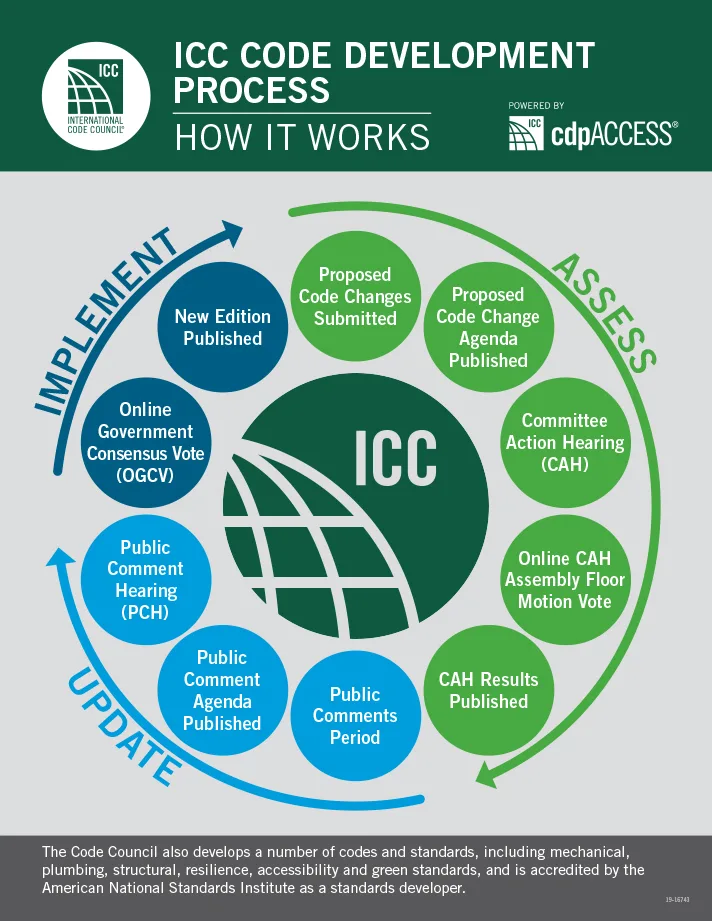
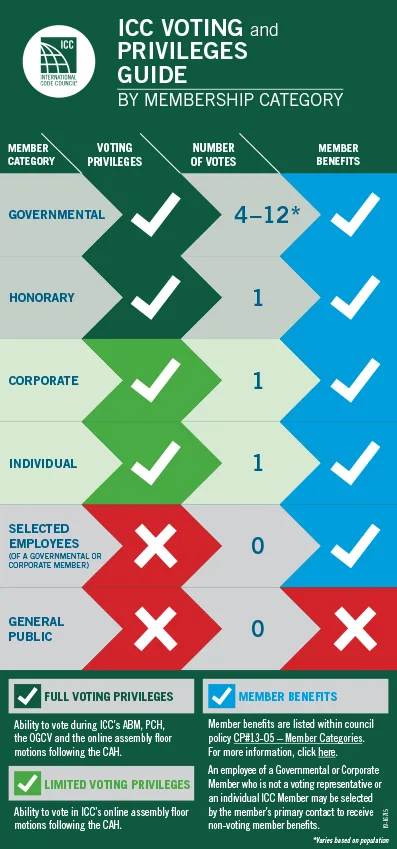
In anticipation of the upcoming Group B Public Comment Hearings (PCH) and Online Governmental Consensus Vote (OGCV), tremendous effort has been put forth in validating governmental member voting representatives (GMVR). Our members and stakeholders can be confident that PCH and OGCV voters are fully qualified to vote in accordance with the Code Council’s bylaws.
The validation process begins with governmental members (through their primary representatives) submitting the names and credentials of their voters for each three-year code development cycle. Prospective voters are then individually reviewed by Code Council staff to ensure they meet the criteria of the Code Council’s bylaws, qualifying them to vote on behalf of their governmental member. Once reviewed and validated, validated GMVR are posted on ICCsafe.org.
So far, more than 5,200 voters representing 1,300+ governmental members have been validated between 2021 and 2022. Due to the large number of submissions received towards the end of the submission deadline, a small number of voters are currently in the final stage of review and will be completed well in advance of the PCH.
For more information on the voter validation process, visit https://www.iccsafe.org/events/conference/voter-ac22/.
Note: Code Council members can view validated GMVRs through myICC (https://my.iccsafe.org/).
To learn more about the code development process:
Wednesday, September 14, 11 am – Noon
Room M104
In late 2021, the United States Environmental Protection Agency (EPA) issued a rule, the first regulation under the American Innovation & Manufacturing (AIM) Act of 2020, implementing legislation that mandates an 85-percent nationwide phasedown in HFC refrigerants over the next 15 years. HFC refrigerants have been the predominant substitute for ozone depleting CFC and HCFC refrigerants that have been phased out of the marketplace since the late 1980s. The HFC refrigerants were a good fit to fill the void left by the elimination of CFCs and HCFCs. However, the HFCs were found to be potent greenhouse gases with a medium to high global warming potential which could cause long term harm to the environment if released to the atmosphere.
Last year, the EPA adopted a final rule accepting six refrigerant alternatives to HFCs for use in new residential and light commercial air conditioners and heat pumps. These lower GWP alternatives are classified by ASHRAE as A2L refrigerants (which are low flammable). A2L refrigerants have different flammability characteristics versus current A1 refrigerants like R-410A. Therefore, the safety, training and building code updates are important considerations for the built environment. During the 2021 Group A code development cycle, several code changes were approved for the International Building Code (IBC), International Fire Code (IFC) and International Mechanical Code (IMC) that permit the usage of A2L refrigerants. These approved changes, which go into effect with the 2024 IBC, IFC and IMC, permit the use of A2L refrigerants for human comfort uses, consistent with industry standards, and will help to facilitate the phasedown of HFCs following EPA rules.
 Please join ICC and industry stakeholders on Wednesday, September 14th, 2022, in room M104 for a special presentation from ICC and industry partner AHRI, hosted by ICC’s PMG Membership Council. We will cover changes that have been made to the I-Codes regarding these new Low GWP A2L refrigerants and you will discover what AHJs, HVAC contractors, and others need to know about working with these refrigerants.
Suggested Resources:
For virtual attendance please join us at the time of the event using the link below.
Or Call to join: 1-844-740-1264 USA Toll Free;
1-415-655-0003 US Toll
Meeting Number (Access Code): 2592 901 5139;
Meeting password: cjEpS5pJp33
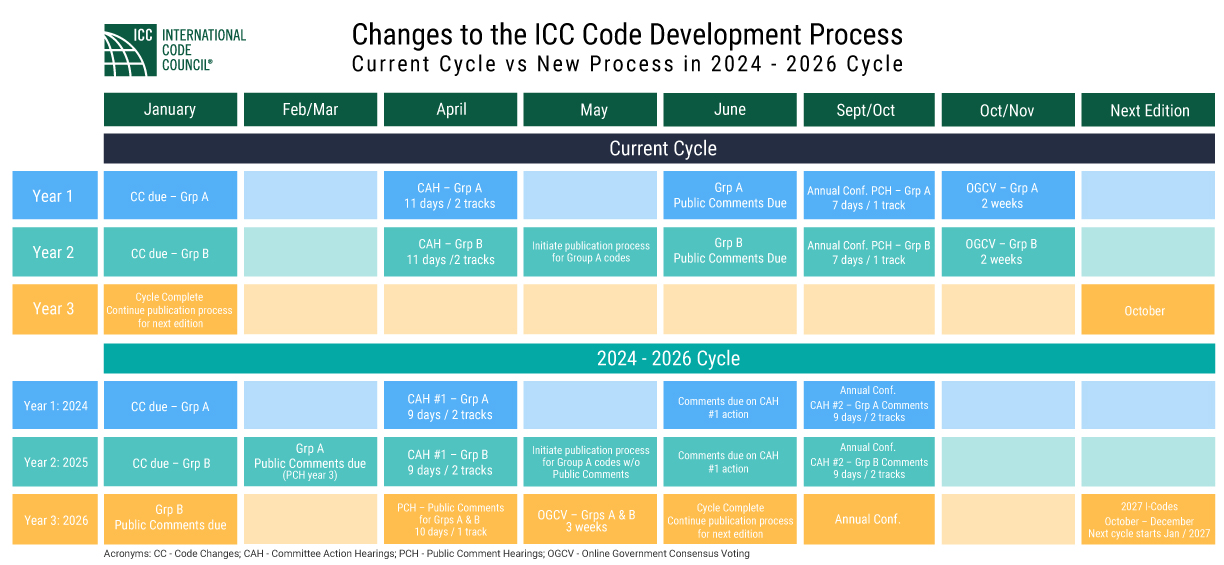
The board approved a standing motion from the Board Committee on the Long-Term Code Development Process to revise the code development cycle to incorporate two committee action hearings for each code group. This change expands the current process from two independent one-year cycles to a single continuous three-year cycle.
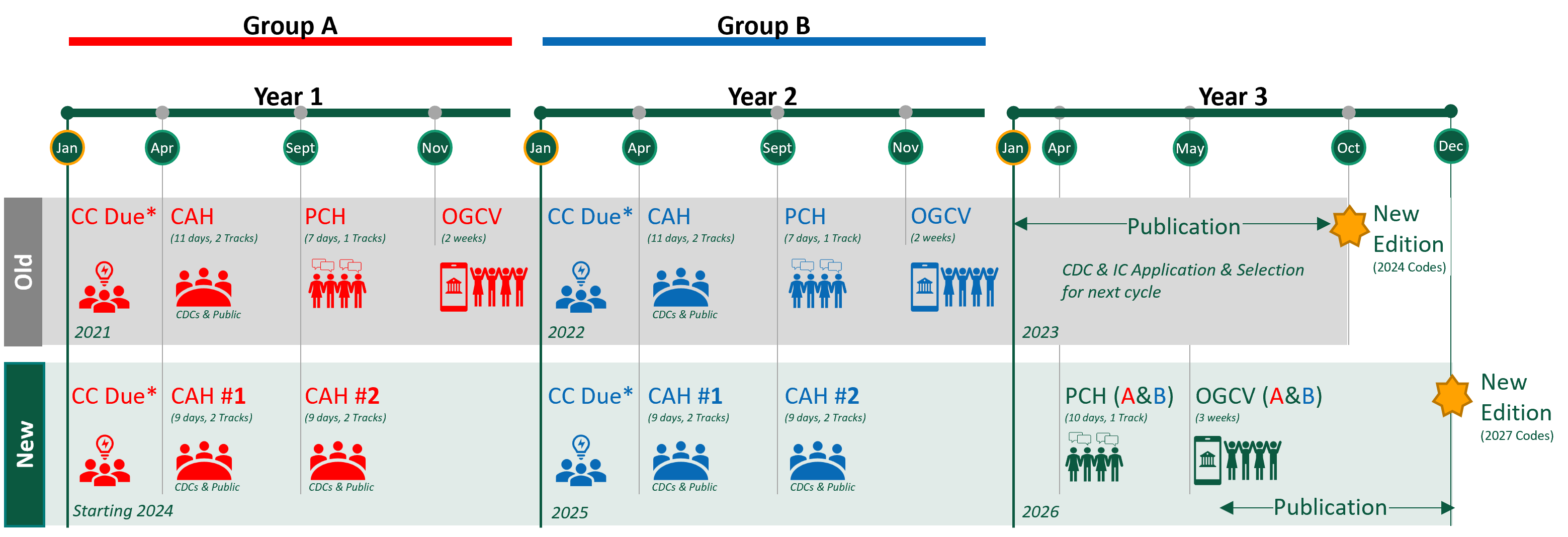
This change will not take effect until the code development cycle beginning in 2024 for the development of the 2027 International Codes.
For more information on the Code Development Process,
contact Russ Manning, SVP, Technical Services.
U.S. President Biden signed into law the Inflation Reduction Act, including large investments in building efficiency, sustainable construction and distributed generation.
The goal of this committee is to increase DEI in the membership association while helping members diversify their own organizations and the building safety profession overall.