2022 Global Building Safety

Global Building Safety Dialogue on Learnings From Tragic Events: Changes made to codes and standards in the wake of disaster

Tuesday, September 13, 1:30 – 5 pm
Louisville Convention Center | Room M100/103

This Global Building Safety Dialogue is an exploration of whether responses to building failures are appropriate, and what should we be doing differently to improve the safety of our buildings for all.

The keynote address, by Gill Kernick, Transformation Director, ARUP University,
Gill Kernickwill look at how past disasters impacted the built environment, including the Grenfell Tower fire five years ago and the evolving response to more recent disasters like the residential high-rise collapse in Surfside, Florida, and will explore how effective responses have been at fixing the underlying problem(s).

This event will also include a Q & A, a Panel Discussion and Case Study featuring speakers below, and will conclude with Interactive Breakout Groups.

Sergio Ascunce

Sergio Ascunce

Nick Hill

Nick Hill

Chris Ackerman

Chris Ackerman

Philip Rizcallah

Philip Rizcallah

Voter Validation Update

ICC Pulse Web Header v1

Voter Validation Update

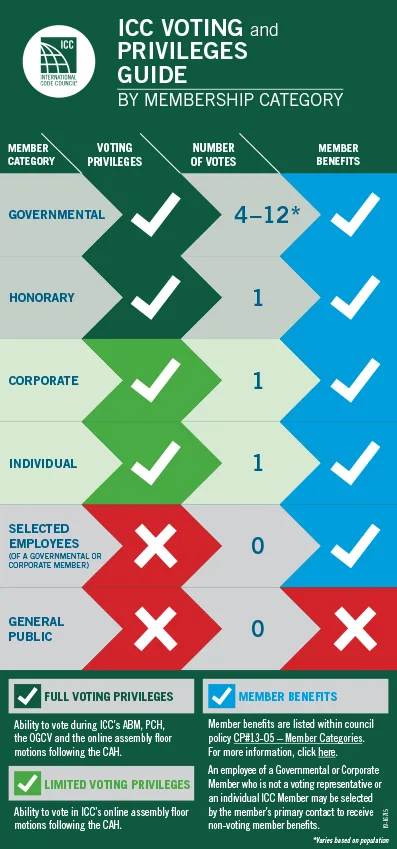
In anticipation of the upcoming Group B Public Comment Hearings (PCH) and Online Governmental Consensus Vote (OGCV), tremendous effort has been put forth in validating governmental member voting representatives (GMVR). Our members and stakeholders can be confident that PCH and OGCV voters are fully qualified to vote in accordance with the Code Council’s bylaws.

The validation process begins with governmental members (through their primary representatives) submitting the names and credentials of their voters for each three-year code development cycle. Prospective voters are then individually reviewed by Code Council staff to ensure they meet the criteria of the Code Council’s bylaws, qualifying them to vote on behalf of their governmental member. Once reviewed and validated, validated GMVR are posted on ICCsafe.org.

So far, more than 5,200 voters representing 1,300+ governmental members have been validated between 2021 and 2022. Due to the large number of submissions received towards the end of the submission deadline, a small number of voters are currently in the final stage of review and will be completed well in advance of the PCH.

For more information on the voter validation process, visit https://www.iccsafe.org/events/conference/voter-ac22/.

Note: Code Council members can view validated GMVRs through myICC (https://my.iccsafe.org/).

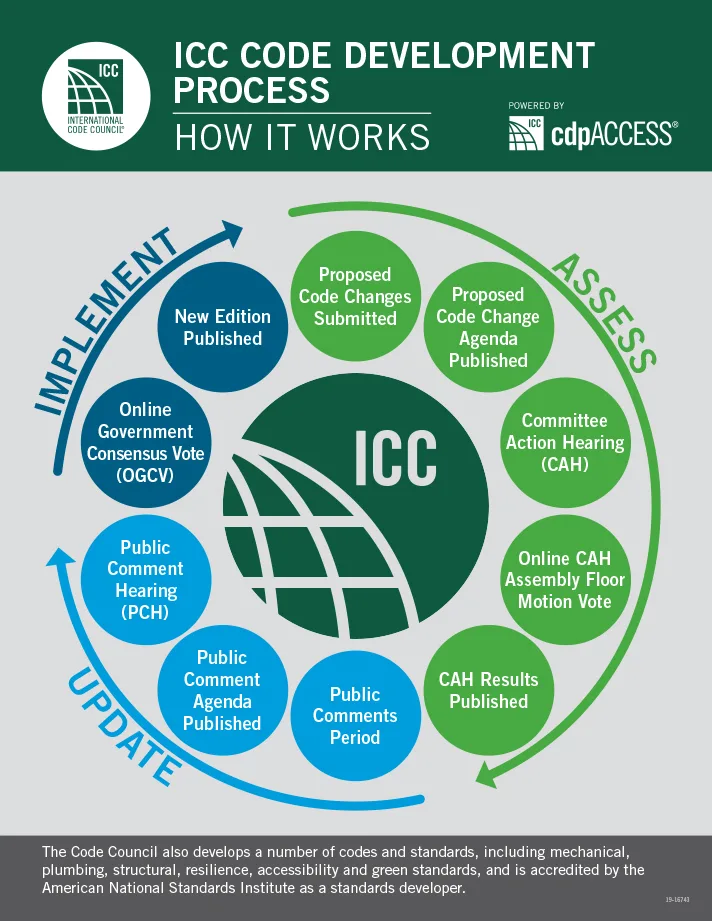
To learn more about the code development process:

New EPA Refrigerant Rules and their Impact on 2024 I-Codes

New EPA Refrigerant Rules and their Impact on 2024 I-Codes:
what AHJs, HVAC contractors, and others need to know

Wednesday, September 14, 11 am – Noon
Room M104

In late 2021, the United States Environmental Protection Agency (EPA) issued a rule, the first regulation under the American Innovation & Manufacturing (AIM) Act of 2020, implementing legislation that mandates an 85-percent nationwide phasedown in HFC refrigerants over the next 15 years. HFC refrigerants have been the predominant substitute for ozone depleting CFC and HCFC refrigerants that have been phased out of the marketplace since the late 1980s. The HFC refrigerants were a good fit to fill the void left by the elimination of CFCs and HCFCs. However, the HFCs were found to be potent greenhouse gases with a medium to high global warming potential which could cause long term harm to the environment if released to the atmosphere.

Last year, the EPA adopted a final rule accepting six refrigerant alternatives to HFCs for use in new residential and light commercial air conditioners and heat pumps. These lower GWP alternatives are classified by ASHRAE as A2L refrigerants (which are low flammable). A2L refrigerants have different flammability characteristics versus current A1 refrigerants like R-410A. Therefore, the safety, training and building code updates are important considerations for the built environment. During the 2021 Group A code development cycle, several code changes were approved for the International Building Code (IBC), International Fire Code (IFC) and International Mechanical Code (IMC) that permit the usage of A2L refrigerants. These approved changes, which go into effect with the 2024 IBC, IFC and IMC, permit the use of A2L refrigerants for human comfort uses, consistent with industry standards, and will help to facilitate the phasedown of HFCs following EPA rules. 

ICC PMG logoPlease join ICC and industry stakeholders on Wednesday, September 14th, 2022, in room M104 for a special presentation from ICC and industry partner AHRI, hosted by ICC’s PMG Membership Council. We will cover changes that have been made to the I-Codes regarding these new Low GWP A2L refrigerants and you will discover what AHJs, HVAC contractors, and others need to know about working with these refrigerants.

Suggested Resources:

For virtual attendance please join us at the time of the event using the link below.


Or Call to join: 1-844-740-1264 USA Toll Free;
1-415-655-0003 US Toll
Meeting Number (Access Code): 2592 901 5139;
Meeting password: cjEpS5pJp33

Changes to Code Development Process

Changes to the Code Development Process

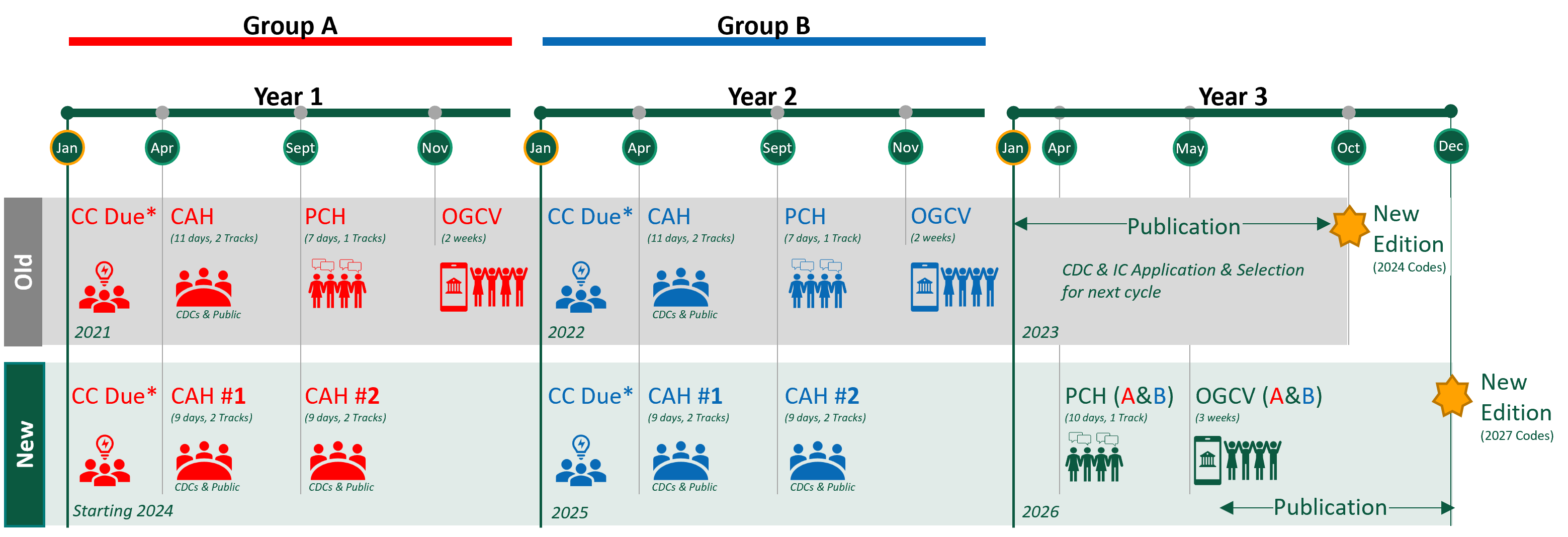
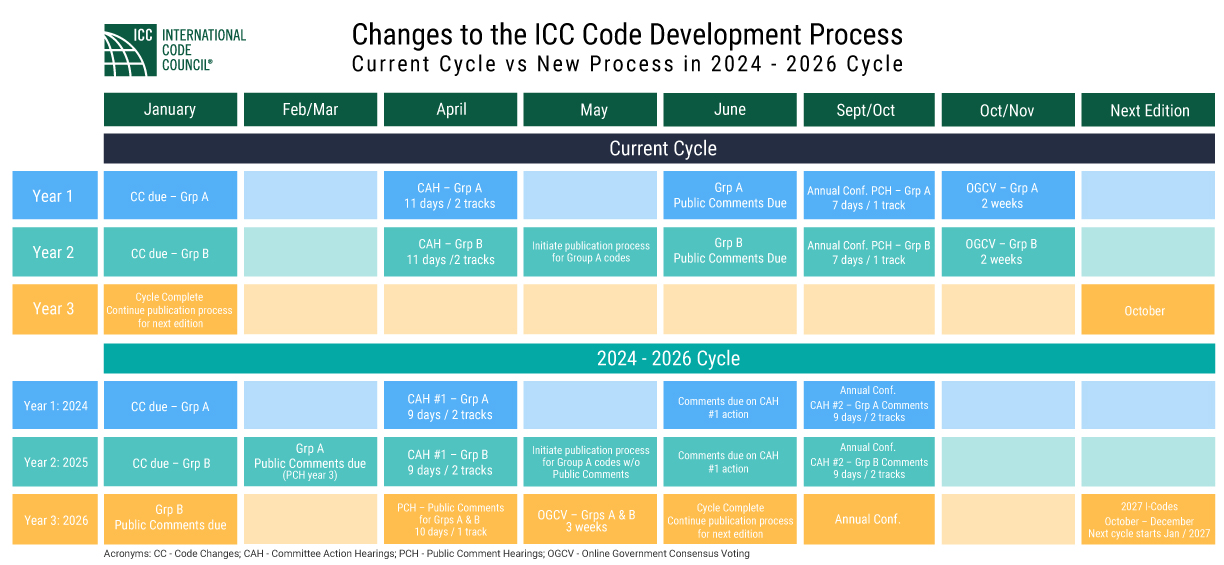
The board approved a standing motion from the Board Committee on the Long-Term Code Development Process to revise the code development cycle to incorporate two committee action hearings for each code group. This change expands the current process from two independent one-year cycles to a single continuous three-year cycle.

This change will not take effect until the code development cycle beginning in 2024 for the development of the 2027 International Codes.

News & Updates

Click below to download the infographic timeline

Download more infographics about the code development process here.

Frequently Asked Questions

For more information on the Code Development Process,
contact Russ Manning, SVP, Technical Services.

2022 Conference – App

Conference App

Sponsored by

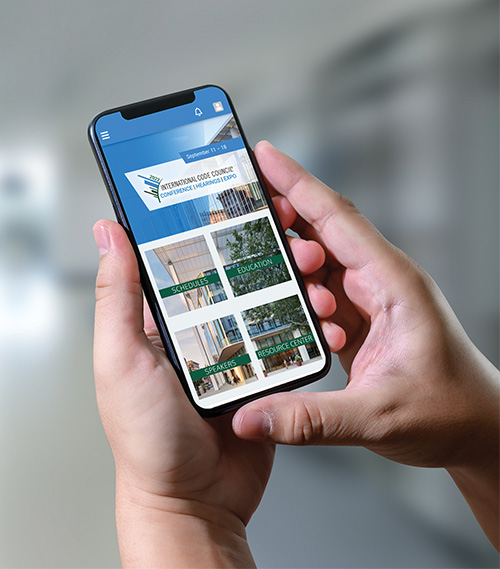
This year’s ICC Conference App, your source for all schedules and information, is now available!

All schedules, information and class materials will only be available on the ICC Conference App this year. It features conference schedule, speakers, session handouts, maps, directory, and events.

Download the App

The App is accessible from all devices: smartphones, tablets, laptops and desktops and is available for Apple and Android devices. It’s also available on the web.

Find the App quickly in stores by searching for: iccac22.

You can use the Mobile App to:

  • Create your own schedule
  • Search for classes and events
  • Stay up-to-date with event announcements
  • Learn about speakers and sponsors
  • See who else is attending and network
  • Access speaker presentations and documents
  • Learn about local hotels, dining and attractions

2022 Annual Conference app on a phone

2022 Group B Hearing Orders

2022 Group B Hearing Orders

2022 Public Comment Hearings (Group B Codes)

Hearing Orders

* Word Document(s): To download, right click icon, select "save target as" and save to your computer.

IADMIN Grp B Hearing Order Published 08/22/22 13 KB
IEBC Grp B Hearing Order Published 08/22/22 13 KB
IBC S Grp B Hearing Order Published 08/22/22 14 KB
IRC B Grp B Hearing Order Published 08/22/22 20 KB

Updates to the Hearing Orders

* Word Document(s): To download, right click icon, select "save target as" and save to your computer.

IADMIN Grp B Hearing Order 9 14 22 3PM Published 09/14/22 13 KB
IBC S Grp B Hearing Order 9 16 22 Published 09/16/22 15 KB
IRC B Grp B Hearing Order 9 16 22 6 30PM Published 09/16/22 20 KB

Federal Grants

Funding Building Safety, Resilience, and Sustainability

As the frequency and severity of hazard events increase, household energy bills grow and the nation looks to reduce energy related emissions, U.S. federal grant programs are now available to assist state, local, tribal, and territorial (SLTT) governments in implementing solutions. These grants are either exclusively or significantly designated for building code related activities.

The Code Council stands ready to work with SLTT governments to access these funds. We’ve also established relationships with other industry leaders to provide a suite of solutions that can meet any jurisdiction’s needs.

Why Apply

See how Federal Grants can support community goals.

What to Apply For

See what types of Federal Grants are available.

How to Apply

See how to apply for federal grants.

ICC is here for you throughout the process.

Jurisdictions may be able to use funding to support these goals

Why use your funding for building codes?

Building codes are the foundation for safety in the built environment. A 2019 report, Natural Hazard Mitigation Saves, by the congressionally-established National Institute of Building Sciences (NIBS) found that adopting and enforcing the 2018 International Building Code (IBC) and International Residential Code (IRC) provides communities with an $11 benefit for every $1 invested. These benefits represent avoided casualties, property damage, business interruptions, first responder expenses, and insurance costs, and are enjoyed by all building stakeholders – from developers, titleholders, and lenders, to tenants and communities. The NIBS report also found that retrofitting structures to current codes’ flood mitigation requirements can provide $6 in mitigation benefits for every $1 invested and that retrofitting structures to the Code Council’s Wildland-Urban Interface Code could provide $2 to as much as $8 in mitigation benefits for each $1 invested.

Communities that regularly adopt energy codes like the International Energy Conservation Code (IECC) save money for residents and businesses and improve community health and resilience. According to the DOE Pacific Northwest Laboratory (PNNL), the 2021 IECC represents a 9.4% site energy savings improvement and an 8.7% improvement in carbon emissions for residential buildings relative to the 2018 IECC, saving homeowners an average of $2,320 over the life of a typical mortgage. Although there is significant evidence of the value of energy code implementation, studies also show millions of dollars of untapped energy savings in states across the country. DOE has also observed, across 7 states studied, that training code officials on adopted codes can help reduce annual energy costs due to varying levels of code compliance by an average of about 45 percent.

FEMA affirmed NIBS findings in their Building Codes Save: A Nationwide Study, stating that, “...adopting building codes is the single most effective thing we can do! One change in building codes can save lives and protect property for generations to come.” The study found that if all new buildings across the U.S. were built to modern editions of the I-Codes, the country would save more than $600 billion by 2060.”

Embracing technology solutions to simplify code enforcement and compliance will give communities a wide array of new solutions that provide better economics and efficiency in workflows and continuity during disasters. Investment in Digital Codes and digital codes practices gives 24/7 access to the codes and standards that the building and safety community are founded on. Electronic collaboration tools can support consistency in code enforcement and identification of common compliance challenges and training needs. Embracing technology solutions to simplify code enforcement and compliance will give communities a wide array of new solutions that provides better economics and efficiency in the workflows and continuity during disasters. Digital solutions can produce lasting reductions in operational costs and permitting timelines. The Code Council has found a 20 percent increase in code department productivity by moving from paper to electronic inspection logs. Reduced processing times leads to savings for both consumers and the construction industry.

Assessing the current construction practices, establishing compliance and enforcement goals, and accessing intake plan review inspection tools are the first steps to successful compliance and enforcement. Training requirements are equally important. The gap that exists between the efficiency levels required in codes and the efficiency levels achieved in the field is influenced by the extent of code official training on the energy code. Although about two-thirds of states require code official certifications, only seven states require training on energy code provisions.

Navigating Current Federal Grants Policies

Important Update: FEMA Ends BRIC Program

April 4, 2025 — On April 4th, the Federal Emergency Management Agency (FEMA) announced the termination of its Building Resilient Infrastructure and Communities (BRIC) program.
FEMA will cancel a $750 million notice of funding opportunity issued earlier this year. In addition, FEMA is reallocating all outstanding funding that the Agency has not yet dispersed for projects that have been selected in prior years.

The BRIC program had been designed to fund local projects aimed at reducing damage from disasters such as flooding, tornadoes and other weather-related events.

The Code Council recognizes the dedication and hard work of building, fire and emergency management offices. For questions regarding the BRIC termination, please reach out to your regional Government Relations representative or contact us through advocacy@iccsafe.org.

Past Funding Programs & Deadlines

Energy Focused Grants

Fire Focused Grants

Resilience Focused Grants

Pro Tip: Bookmark this quarterly updated page to stay up to date on availability of federal funding programs for building departments.

How to apply for federal funding for building safety

The grant application process can be daunting if you don’t know where to start. Some tips are provided below to start the process. The Code Council, working with other leading solution providers, can help identify eligible activities and work with jurisdictions to develop their grant applications. For common building safety strategies including training, personnel certifications, department accreditation, and department modernization, we’ve developed templates to help start the application process. We also can work with jurisdictions to develop innovative strategies to address specific challenges.

  1. Research which grants you are eligible for and make a spreadsheet of all available grants and their deadlines; set calendar notifications to remind yourself.
  2. Develop relationships with potential partners, co-applicants and entities responsible for submitting state level grant applications (state energy offices, state hazard mitigation officers, state building code departments, etc.)
  3. Understand the proposal criteria including award limitations, scoring, formatting and deadlines. Pay particular attention to any cost-share requirements and what can be applied to fulfill these requirements.
  4. Note which building codes in your jurisdiction are out of date and familiarize yourself with the up-to-date versions of those codes.
  5. Assemble all the necessary supporting documents you’ll need to apply for the grants.
  6. Identify the government entity or department with authority to apply for the grant and discuss the opportunity and the importance of submitting the application.
  1. Be clear on your needs and your asks when developing your applications.
  2. Clearly articulate your desired outcomes and how external funding is needed to achieve those outcomes. Also focus on how initiatives will be maintained once funding is no longer provided.
  3. Identify potential public and private sector partners to help develop the grant application and implement the funded activities.
  4. Begin filling out your applications and have someone proofread them thoroughly.
  1. Make yourself available for any follow-up from the grant administrator.
  2. Set up a grant tracking spreadsheet including expense tracking and project management tools.
  3. Maintain discussions with co-applicants and other stakeholders to assure a smooth ramp up upon receiving the award.
  4. Be prepared for audits.

This fall ICC is launching a Grant Basics for Code Officials training which will be available for members. If you are interested in hosting this training for your community, chapter, or at a conference please fill out this interest form.

Other resources for communities applying for grants

The following resources will help you get organized and make the grant application process easier.

Contact the Code Council for Assistance on Developing Your Grant Application

  • Innovative technical and policy-driven solution development with the ICC Centers of Focus
  • Grant application development assistance

To leverage our expertise and for information concerning federal grants contact federalgrants@iccsafe.org.