International Code Council’s Code on a Mission Challenge is half-way to its goal with 61.5 million households covered

Washington, D.C. – On Tuesday, June 22, with passage of House Bill 803, the State of Louisiana updated their energy code to the 2021 International Energy Conservation Code (IECC) for residential and commercial buildings. With Louisiana’s adoption, 61.5 million Americans will now be covered by the 2021 IECC marking a significant milestone for the International Code Council’s Code on a Mission campaign.

The Code Council’s Code on a Mission challenge, launched in 2021, aims to get over a third of the U.S. population (115 million Americans) covered by energy codes that meet or exceed the 2021 IECC by the end of 2023. The challenge was issued to highlight the role that buildings play in meeting community energy and greenhouse gas (GHG) reduction goals and the power of energy codes in helping meet those goals. The 2021 IECC is particularly impactful as the U.S. Department of Energy found that it provides a 9.4 percent improvement in energy savings and an 8.7 percent reduction in GHGs over the 2018 edition—a nearly 40 percent improvement since the 2006 edition. The 2021 IECC saves homeowners an average of $2,320 over the life of a typical mortgage.

“The Code Council is dedicated to supporting jurisdictions in meeting their energy and decarbonization goals through a variety of tools including the IECC,” said Code Council Chief Executive Officer Dominic Sims, CBO. “Energy codes continue to be an essential tool for communities to achieve their energy efficiency and greenhouse gas reduction goals.”

In addition to energy efficiency improvements, the 2021 IECC contains updated provisions that improve usability and support communities interested in pursuing zero-energy buildings through new appendices. Communities that regularly adopt the IECC, save money for residents and businesses and improve community health and resilience.

Other states that have adopted a base or stretch energy code equivalent to the 2021 IECC include California, Maine, Montana, Nevada, Vermont and Washington. There are also a host of jurisdictions who have updated their energy code to the 2021 IECC including Larimer County, Colorado; over 20 cities in Texas; and the cities of Cave Creek and Chandler in Arizona. Additionally, the U.S. federal government has incorporated requirements from the 2021 IECC into design requirements for its own buildings and for federally-regulated manufactured housing. More jurisdictions are expected to adopt the 2021 IECC over the next year.

In support of the Code on a Mission challenge, the Code Council has developed a suite of resources to assist jurisdictions in their efforts to adopt updated energy codes located on a dedicated webpage. To support tracking, jurisdictions are encouraged to share their adoptions of a code that meets or exceeds the requirements of the 2021 IECC through the campaign’s submission form.

###  

About the International Code Council   
The International Code Council is the leading global source of model codes and standards and building safety solutions. Code Council codes, standards and solutions are used to ensure safe, affordable and sustainable communities and buildings worldwide. 

The International Code Council Celebrates High Performance Buildings Week

Washington, D.C. – The International Code Council (ICC) joined members of the High Performance Buildings Coalition and High Performance Buildings Congressional Caucus in celebration of High Performance Building Week, a joint effort by the Coalition and Caucus to raise awareness of the importance of prioritizing efforts to advance high performing buildings in the U.S. Congress and the private sector.   

The week’s key event featured a panel briefing by senior staff from the Architect of the Capitol and the General Services Administration on what their offices are doing to address building performance priorities, health and wellness, and return-to-office needs in a post-pandemic world. U.S. Representative Peter Welch, Vermont’s congressman and a Caucus Co-Chair, also addressed attendees to stress the importance of bipartisanship in successfully advancing energy conservation and clean energy objectives.

To help aid this effort, the Code Council is undertaking a major endeavor to overhaul the ICC Performance Code to not only enable performance-based design within all components and systems within a building but also to consider operational performance and functional recovery. The multi-year project is expected to result in a best-in-class model performance-based building regulation along with tools that will enable regulators and enforcement officials to measure compliance and simplify implementation.

“High Performance Building Week calls attention to the importance of ensuring our built environment is both sustainable and resilient. It brings the building industry together with policymakers to discuss the investments necessary to protect our residents from increasing hazard risk, lower energy bills, and reduce the greenhouse gas footprint from our building stock,” said Coalition Chair Gabe Maser, Senior Vice President of Government Relations, International Code Council. “The Code Council’s efforts to reenergize the ICC Performance Code will offer practitioners an additional tool towards realizing these goals and advancing the adoption and effective implementation of sustainable and resilient building codes and standards. The Code Council and the Coalition look forward to continuing to advance our shared priorities with the Caucus and before Congress and the U.S. Administration.”

To learn more about the High Performance Buildings Coalition and other High Performance Buildings Week events, visit hpbuildings.org

###  

About the International Code Council   
The International Code Council is the leading global source of model codes and standards and building safety solutions. Code Council codes, standards and solutions are used to ensure safe, affordable and sustainable communities and buildings worldwide. 

About the High Performance Buildings Coalition 

The High Performance Buildings Coalition is a coalition of approximately 200 organizations that provides guidance and support to the High Performance Buildings Caucus of the U.S. Congress. They support legislation and policies that protect life and property, promote innovative building technologies, enhance U.S. economic competitiveness, increase energy and water efficiency in the built-environment, advance sustainable and resilient communities, and support the development of private sector standards, codes and guidelines that address these concerns. 

Louisiana clears new bill to improve energy efficiency codes statewide

Washington, D.C. – On June 22, 2022, Louisiana Governor John Bel Edwards signed House Bill (HB) 803 into law requiring the statewide adoption of the 2021 International Energy Conservation Code (IECC) and the 2021 International Residential Code (IRC) Chapter 11 Energy Efficiency. The Louisiana legislature had previously cleared the bill unanimously. The newly signed bill will transfer the responsibility of commercial energy code enforcement from the state government to the local, municipal/parish government and third-party providers, while the Louisiana State Uniform Construction Code Council (LSUCCC) will add the IECC as part of the statewide adopted codes.

To facilitate the code’s adoption, HB 803 also establishes the “Energy Code Commission” which will be comprised of 16 members and be responsible for reviewing and amending the 2021 editions of the IRC Chapter 11 and IECC for residential, commercial and state-owned buildings. This temporary commission will review and consider amendments to the 2021 energy code provisions and will dissolve upon the completion of the LSUCCC’s Administrative Rule process, completing the adoption of the 2021 IECC. The code’s ultimate statewide effective date is July 1, 2023.

“Adopting and implementing modern building codes and standards plays a vital role in achieving a safe, affordable and sustainable built environment. Energy codes are an important contributor to individual and community resilience,” said Code Council Chief Executive Officer Dominic Sims, CBO. “They help avoid wasted energy and save consumers money on their utility bills. The Code Council commends Louisiana for its proactive leadership.”

The new legislation comes as the U.S. Department of Energy (DOE) is standing up a grant program to assist with the implementation of updated energy codes. The Energy Code Implementation Program was established in the Infrastructure Investment and Jobs Act (IIJA) passed in November 2021, which provides $225 million over five years. The DOE is expected to release its funding opportunity announcement later this year.  The Code Council provides resources to help jurisdictions access this funding.

Louisiana’s new legislation also aligns with the Code Council’s Code on a Mission campaign. This campaign aims to have over a third of the U.S. population covered by energy codes that meet or exceed the 2021 IECC by the end of 2023. The Code Council is already halfway to achieving its goal.

More details about the recently passed legislation can be found here.

###

About the International Code Council
The International Code Council is the leading global source of model codes and standards and building safety solutions. Code Council codes, standards and solutions are used to ensure safe, affordable and sustainable communities and buildings worldwide.
PMG Articles

PMG Articles, Podcasts, and Videos

The PMG Technical Resources Team (PMG Team) develops technical resources and documents to assist in understanding the technical requirements of the PMG codes and related standards.

Following is a collection of informative articles, podcasts and videos on important PMG issues and topics published by the PMG Team.

Articles

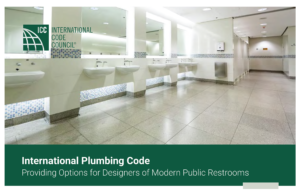
International Plumbing Code®:

Providing Options for
Designers of Modern Public Restrooms

International Plumbing Code

From its inception in 2000, the IPC has prioritized privacy for occupants of public restrooms. Updates and additions have been made to subsequent editions of the code to improve upon privacy and safety concerns inside of public restrooms. This article highlights the changes that have been made to the various editions of the codes, which have come to offer a toolbox of practical and safe solutions for the design of the modern public restroom.

Cross-Connection Control:

A Critical Line of Defense Against
Potable Water Contamination

Cross-Connection Control

We take cross-connection control for granted, but it is critical for safe, clean drinking water. Most of us can go to a faucet, water bottle filler, or drinking fountain and get a drink of potable water. This is due largely to the fact that cross-connection control is an inherit plumbing design and installation component. Cross-connection control consists of various methods, assemblies, and devices, that when installed and maintained properly, safeguard our potable water.

Private Sewage Disposal:

Flushing Out the Facts

Private Sewage Disposal

Private sewage disposal systems are underground wastewater treatment structures, commonly used in rural areas without centralized sewer systems. They use a combination of nature and proven technologies to treat wastewater from household plumbing produced by bathrooms, kitchen drains and laundry. This article dives into the proper use and maintenance of  private sewage disposal systems.

Code Changes on A2L refrigerants:

Based on changes approved
During the 2021 Group A code cycle

Code Changes on A2L refrigerants

The U.S. EPA issued a rule in 2021 mandating the phasedown of HFC refrigerant production and use over the next 15 years. The EPA adopted a final rule accepting six refrigerant alternatives for use in residential and light commercial air conditioning equipment – all are classified as A2L refrigerants. This article provides a brief history of the transition to A2L refrigerants and provides an overview of the related code changes in the 2024 IMC, IBC, and IFC that will permit the use of A2L refrigerants for human comfort.

Rainwater harvesting systems:

Protecting our water resources
for the long run

Rainwater harvesting systems

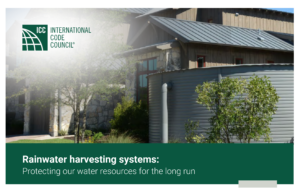
Rainwater harvesting systems have been used throughout the world to provide precious water resources to areas where water is scarce. The CSA B805-18/ICC 805-2018 — Rainwater Harvesting Systems standard applies to the design, materials, installation and operation of rainwater harvesting systems for potable and non-potable applications. This article provides an overview of the standard and how it can be used as an alternative compliance path to Chapter 13 of the International Plumbing Code.

In this episode of HPAC Engineering's 'HPCA On The Air" we cover the recent EPA refrigerant standards update, with ICC's Jim Cika. Here, he previews major code changes upcoming on A2L refrigerants that will impact the HVAC industry sooner than many in the industry may realize.

In this episode of the "ICC Pulse Podcast", we dive in to discussing water reuse. We challenge you to explore how water reuse can be a safe, innovative way to help save the world’s water supply. We speak with a few experts on breaking the stigma of water reuse and how reusing water is possible in our homes and businesses.


Videos

Backflow Basics Series

Introduction

Backflow Basics Series

Lavatory Faucets and Sinks

Backflow Basics Series

Kitchen Sinks, Faucets

and Dishwashers

Backflow Basics Series

Bathtubs and Showers

Backflow Basics Series

Hose Bibs

Parallel Water Distribution

with Rich Anderson

ICC Director, PMG Resources

Pipe Sizing
Why it is Important

with Ramiro Mata

ICC PMG Standards Manager

Product Listing, Marking, &
Labeling Requirements

with Lisa Reiheld

ICC Director, PMG Resources

Hydrogen Gas &
the Built Environment

with Mark Fasel

ICC Director, PMG Resources

Introduction to the
ANSI/PHTA/ICC-2 Standard

with Rich Anderson

ICC Director, PMG Resources

The 2024 ISPSC
Health and Life Safety

with Rich Anderson

ICC Director, PMG Resources

The 2024 ISPSC
VGBA Drain Covers

with Rich Anderson

ICC Director, PMG Resources

ICC Community Development Solutions Announces the Availability of Municity® Code Connect™ for Municity 5® Users

Rochester, N.Y. ICC Community Development Solutions (ICC CDS) announced today the integration of Municity Code Connect with the ICC Code Connect API software. Municity Code Connect allows organizations using Municity 5 to instantly access the latest building code requirements within the digital application. The software contains simplified search tools, access to the latest code content, confidence in accuracy and the ability to streamline common code references.

“We are proud to offer customers currently using Municity 5 the opportunity to add Municity Code Connect to their solution,” said Dan Foster, General Manager, ICC Community Development Solutions. “With this software, our customers will be able to ensure accuracy and compliance with the most up-to-date codes and standards for their jurisdictions.”

Municity is a cloud-based software solution built with input from U.S.-based code officials targeting and supporting the permitting, licensing and inspection/code enforcement functions within a local jurisdiction. It allows code officials to provide permits or issue certificates, conduct building, fire and safety inspections, and look up codes and standards efficiently and securely from anywhere.

This announcement coincides with the initial launch of the ICC Code Connect API and will meet customer requests for easy access to the Code Council’s codes and standards. Municity 5 also integrates with eCode360® for municipalities that access municipal codes through the General Code platform.

To learn more about how Municity Code Connect works with Municity 5, click here.

###


About the International Code Council
The International Code Council is the leading global source of model codes and standards and building safety solutions. Code Council codes, standards and solutions are used to ensure safe, affordable and sustainable communities and buildings worldwide.
About ICC Community Development Solutions
ICC Community Development Solutions is a member of the International Code Council’s family of solutions and offers software and services that provide streamlined business operations and compliant records management for jurisdictions across the United States.

The International Code Council joins the Copyright Alliance as its newest member

Washington, DC – The International Code Council has joined the Copyright Alliance as its newest member to help bolster copyright protection efforts for codes and standards. The Copyright Alliance represents the copyright interests of over 2 million individual creators and 15,000 organizations across the spectrum of copyright disciplines.

“We are very pleased to partner with the Copyright Alliance, and with its member organizations, as we work toward ensuring that codes and standards—which are essential to public health, safety, and security—continue to be effectively protected by copyright,” said Mel Oncu, Code Council General Counsel. “This is an opportunity to connect with other stakeholders and understand and represent their needs as well.”

Regarding the Code Council joining the Copyright Alliance, CEO Keith Kupferschmid stated, “We are thrilled to have the Code Council join us as a member and welcome their wealth of experience in the area of copyrightability of codes and standards. We look forward to working with Mel Oncu, and with all the Code Council’s staff and constituents, as we continue to fulfill our mission of educating the public on the importance and value of copyright to all industries, including codes and standards.” 

###  

About the International Code Council   
The International Code Council is the leading global source of model codes and standards and building safety solutions. Code Council codes, standards and solutions are used to ensure safe, affordable and sustainable communities and buildings worldwide. 
About the Copyright Alliance

The Copyright Alliance is a non-profit, non-partisan public interest and educational organization representing the copyright interests of over 1.8 million individual creators and over 13,000 organizations in the United States, across the spectrum of copyright disciplines. The Copyright Alliance is dedicated to advocating policies that promote and preserve the value of copyright, and to protecting the rights of creators and innovators.

International Code Council Technical Training Program introduces building codes to high school and college students

Washington, D.C. – The International Code Council’s Technical Training Program (TTP) introduces students to building codes associated with the trades and helps them understand the importance of building codes in the construction process. Part of the Code Council’s signature Safety 2.0 portfolio of programs, the TTP is another tool to welcome a new generation of members and leaders to the building safety profession.

The TTP utilizes the International Residential Code (IRC) and IRC study companion as the primary resources for the program. Organized into six separate modules—building, masonry, plumbing, mechanical, electrical, energy—the TTP enables schools to easily integrate one or more disciplines into current curriculum. Students learn up-to-date code information and technical training along with practical training for the workplace. The program includes the necessary course materials, exams and completion certificates.

This year, the Code Council launched a Technical Training Program Portal that provides instructors and students complete digital access to the TTP. After joining the TTP, instructors can use the portal to host the program. Once they establish their course in the portal, they invite their students to create an account and join their course. The Code Council provides instructions to both instructors and their students on course material.

The program’s technical content (2018 IRC and study companion), quizzes and exams are all available digitally through the portal. Instructors can supplement the program with their own additional content and customize administration and delivery. In addition, the portal provides automated monitoring of student performance and progress and features student communication and study tools.

“The Technical Training Program can be implemented through career and technical education programs and schools as well as community colleges with building or construction majors. We are also exploring the potential for building departments and building safety service providers to apply this program as an introductory course,” said Code Council Director of Safety 2.0 Programs Madi Dominescy. “And now, with the TTP Portal, this program is virtually accessible to anyone interested in teaching building codes as a foundation to their programs.”

Students who complete the program will receive a nationally recognized, stackable and transferable certificate from the Code Council upon completion of any of the six disciplines and passing a final exam. Students who earn a certificate of completion in all six disciplines will be better prepared for the Code Council’s Residential Building Inspector Certification exam. Learn more about the Code Council’s certification exams.

Visual resources will soon be available for instructors to help navigate the TTP Portal. Find out more about the Code Council’s Safety 2.0 Technical Training Program.

###

About the International Code Council
The International Code Council is the leading global source of model codes and standards and building safety solutions. Code Council codes, standards and solutions are used to ensure safe, affordable and sustainable communities and buildings worldwide.